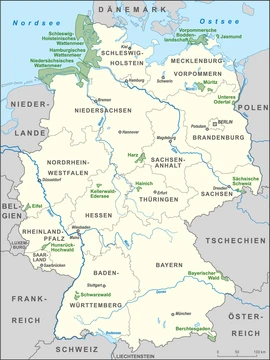
Harz National Park
Protected area merging two parks in the Harz mountains.

Harz National Park is a protected area in the German federal states of Lower Saxony and Saxony-Anhalt, covering portions of the western Harz mountain range. Established in its current form on January 1, 2006, by the merger of two earlier parks, it is part of the Natura 2000 network and is notable for its extensive forests, bogs, and rare wildlife, including the reintroduced Eurasian lynx.
Quick Facts
- Iucn Category
- II
- Location
- Lower Saxony and Saxony-Anhalt, Germany
- Established
- 1990, 1994, 2006
- Governing Body
- Nationalparkverwaltung Harz / Lindenallee 35 / 38855 Wernigerode
Facts from the source article.
Lore & Background
The park was created on January 1, 2006, by merging the Harz National Park in Lower Saxony (established 1994) and the Upper Harz National Park in Saxony-Anhalt (established October 1, 1990, two days before German reunification). The former inner German border ran through the Harz, leaving large parts as prohibited areas that remained largely unaffected for decades. The park covers parts of the districts of Goslar, Göttingen, and Harz.
The Upper Harz National Park was established as part of the GDR's national park programme. In the GDR era, the Brocken was accessible until 1961 with a pass, then became out-of-bounds. The Lower Saxon part opened on January 1, 1994, after four years of preparation. A combined park project was discussed soon after reunification but took twelve years to realize.
The park's ecology includes 82% spruce stands, 12% beech, and 6% other species. The last lynx in the Harz was shot in 1818; a reintroduction project began in 1999, and by 2002 wild lynxes gave birth. An attempt to reintroduce the western capercaillie did not succeed.
Reader's Guide
Harz National Park represents a significant conservation effort in central Germany, merging two parks that straddled the former inner German border. Its creation on January 1, 2006, unified protected areas that had been separated by political divisions, allowing for coordinated management of a landscape that had remained relatively undisturbed for decades due to its location in a prohibited border zone. The park's 24,700 hectares cover about 10% of the Harz range, with 95% forested primarily by spruce and beech, and include raised bogs of international significance.
The park's most notable conservation achievement is the reintroduction of the Eurasian lynx, extinct in the Harz since 1818. Between 2000 and 2004, 19 lynx were released from zoo breeding programs, and by 2002 wild births occurred. The park also hosts rare species such as the white-throated dipper, black stork, peregrine falcon, and European wildcat. The Brocken anemone grows only on the Brocken plateau in Germany. The park belongs to the EUROPARC Federation and was included in the European Charter for Sustainable Tourism in Protected Areas in 2005. Its 188 staff (as of 2007) include 40 rangers who conduct guided tours and environmental education.
Did You Know?
- The Brocken anemone grows in Germany only on the plateau of Brocken, the park's highest point at 1,141.1 m.
- The Oderteich reservoir, finished in 1722, supplies water to mines in Sankt Andreasberg and is within the park.
Landscape & Waterways
Spanning 24,700 hectares across the western Harz, the park encompasses roughly one-tenth of the entire mountain range. Its terrain rises dramatically from about 230 metres above sea level along the northern perimeter near Ilsenburg and Wernigerode, and 270 metres in the south near Herzberg and Bad Lauterberg, all the way to 1,141.1 metres at the summit of the Brocken. Other prominent high points include the Bruchberg and the Achtermann. The park serves as the birthplace of several significant rivers: the Bode, the Oder, and the Ilse, which feeds into the Oker. The Oder, flowing southward, is channeled into the historic Oderteich reservoir—a structure completed in 1722 to provide water for the mining operations in Sankt Andreasberg—before reaching the Oder Dam on the park's southeastern boundary. Additional water management features within or bordering the protected area include the Ecker Dam and the Silberteich. Nearly 95 percent of the landscape is blanketed in forest, interspersed with bogs, granite outcrops, and small creeks.
A Border Divided, Then United
The park's very existence is inseparable from the Cold War. Because the Inner German Border sliced directly through the Harz Mountains, vast stretches of the range were sealed off as prohibited zones. After the Brocken was a tourist destination accessible with a simple pass until 1961, it became a restricted military area on 13 August 1961, cutting off public access for decades. This accidental isolation preserved the region's plant and animal communities from heavy human disturbance. When the mid-1980s brought visible ecological damage from bark beetles and fungal disease, the optimism surrounding German reunification provided the political will to act. The Upper Harz National Park was formally established by the East German government on 1 October 1990—just two days before reunification—while the Lower Saxon section opened on 1 January 1994 after four years of groundwork led by Dr. Wolf-Eberhard Barth. Despite early discussions about a combined park, it took another twelve years before the two entities merged into the single Nationalpark Harz on 1 January 2006, with Andreas Pusch assuming leadership.
Forests, Fauna & the Return of the Lynx
Nine-fifths of the park's terrain is forest, dominated by Norway spruce and beech, with smaller pockets of oak, rowan, and birch. The current composition—82 percent spruce, 12 percent beech, and 6 percent other species—reflects a 19th-century reforestation strategy devised by the count's head forester, Hans Dietrich von Zanthier, who planted fast-growing spruce to replace timber lost to ore mining. Above 1,050 metres, in the sub-alpine zone, spruce enters what is sometimes called its battle zone: trees exceeding 250 years old are twisted into extraordinary shapes by persistent wind, while dwarf shrub heaths and raised bogs take over much of the ground. Between 750 and 1,050 metres, the altimontane zone is firmly spruce country. The park also shelters a remarkable roster of rare species—the white-throated dipper, black stork, peregrine falcon, and European wildcat. Most symbolically, the Eurasian lynx, absent since the last individual was shot in 1818, was the subject of a reintroduction project launched in 1999; by 2002, wild-born cubs were appearing. A parallel effort to bring back the western capercaillie, however, proved unsuccessful.
Stewardship & European Identity
Today the park operates with a staff of 188, of whom 59 are based at the head office in Wernigerode or its satellite in Sankt Andreasberg's Oderhaus district. A dedicated warden service of 40 rangers handles guided walks, environmental education programmes, and the upkeep of information posts and park buildings. The national park's international standing is reinforced by multiple affiliations: it forms part of the EU's Natura 2000 network of ecologically significant sites, belongs to the EUROPARC Federation—an umbrella body linking national parks, biosphere reserves, and nature parks across Europe—and was admitted to the European Charter for Sustainable Tourism in Protected Areas in 2005. The German chapter of EUROPARC, EUROPARC Deutschland, played a coordinating role in the 2006 merger that unified the two formerly separate parks. The park's territory spans portions of three administrative districts—Goslar, Göttingen, and Harz—making it a genuinely cross-state conservation area bridging Lower Saxony and Saxony-Anhalt.
Frequently Asked Questions
What is Harz National Park?
It is a protected wilderness area in the western Harz mountain range, stretching across the German states of Lower Saxony and Saxony-Anhalt. The park is defined by its vast forests, bogs, and a range of rare wildlife species.
When was Harz National Park established and how did it come together?
The park took its present form on January 1, 2006, when two earlier protected zones (designated in 1990 and 1994) were merged into a single unit. It also sits within the broader Natura 2000 conservation network.
What is the highest point in Harz National Park?
The Brocken, at 1,141.1 metres above sea level, is the park's summit. Across its 24,700 hectares, roughly 95 percent of the terrain is covered by forest.
What rare animals can you find in Harz National Park?
The park hosts reintroduced Eurasian lynx as well as black storks, peregrine falcons, and European wildcats. These species depend on the park's extensive forest and bog habitats for shelter and hunting.
Why is Harz National Park considered important?
It safeguards one of Germany's largest contiguous stretches of near-pristine mountain forest and wetland. Its membership in the Natura 2000 network highlights its role in maintaining biodiversity across the Harz range.
More in National parks of Germany 1-19
Spotted an error? Know more?
Reader corrections go straight into our review queue. Suggest an edit · How this site is sourced