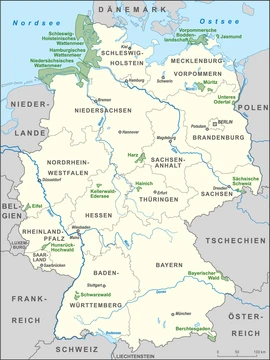
Jasmund National Park
Smallest German national park, home to Rügen's chalk cliffs.

Jasmund National Park sits on the Jasmund peninsula, in the northeastern part of the island of Rügen in the German state of Mecklenburg-Vorpommern. It is Germany’s smallest national park, with an area of just 30 square kilometers. The park is best known for its chalk cliffs—the largest of their kind on Rügen—the most prominent being the Königsstuhl, which reaches 118 meters above the Baltic Sea. The highest point in the park, however, is the Piekberg, at 161 meters. Behind the cliffs, the park also protects beech forests. It was established in September 1990 by the last government of East Germany, shortly before German reunification. On 25 June 2011, the park’s beech forest was added to the UNESCO World Heritage List as an extension of the Primeval Beech Forests of Europe site, recognized for its undisturbed condition and its record of Europe’s ecological history since the last Ice Age.
The park’s geography includes the Stubnitz ridge, north of the city of Sassnitz. This ridge is covered with primeval beech forest and cliffs, covering 2,200 hectares. The park also includes a 500-meter-wide corridor of water leading to the Baltic Sea (603 hectares), and 200 hectares in the west that contain the former Quoltitz chalk quarries, meadows, moors, and dry grasslands.
The chalk cliffs belong to the Rügen Chalk unit and are constantly eroding. During storms, sections break off, carrying rocks and fossils of sponges, oysters, and sea urchins. The most dramatic part of the cliffs is the Königsstuhl. One of the most scenic chalk outcrops, the Wissower Klinken, collapsed into the Baltic Sea on 24 February 2005 due to a landslide caused by spring-thaw conditions.
Because of its unique geology, the park hosts many rare plants and animals. In the Stubnitz woods behind the cliffs, there are numerous water-filled hollows and dells, most formed as dead-ice holes from the Ice Age. Plants found here include black alder, European crab apple, wild service tree, yew, and orchids such as the lady’s slipper orchid (Cypripedium calceolus). Bird species in the park include white-tailed eagles, common kingfishers, house martins, and peregrine falcons.
Since its creation in 1934, the park has drawn hundreds of thousands of visitors each year.
Quick Facts
- Iucn Category
- II
- Location
- Germany Mecklenburg-Vorpommern, Germany
- Nearest City
- Sassnitz, Stralsund
- Established
- 12 September 1990
Facts from the source article.
Lore & Background
The park includes the ridge of the Stubnitz north of Sassnitz, covered with primeval beech forest and cliffs. It also contains a 500-meter water corridor toward the Baltic Sea and areas with former chalk quarries, meadows, moors, and dry grasslands. The chalk cliffs face constant erosion, with parts falling during storms, revealing fossils of sponges, oysters, and sea urchins. On 24 February 2005, the scenic Wissower Klinken collapsed in a landslide caused by spring-thaw weather conditions.
Reader's Guide
Jasmund National Park is significant as the smallest national park in Germany, yet it preserves a unique landscape of chalk cliffs and ancient beech forests. Its beech forest was added to the UNESCO World Heritage List on 25 June 2011 as an extension of the Primeval Beech Forests of Europe, recognized for its undisturbed nature and testimony to ecological history since the last Ice Age. The park attracts hundreds of thousands of visitors annually, and since March 2004, the Königsstuhl National Park Centre has served as a visitor center. The park's management aims to keep habitats largely undisturbed while allowing public access. Its flora includes rare plants like black alder, European crab apple, yew, and orchids such as Cypripedium calceolus, and its fauna includes white-tailed eagles, common kingfishers, house martins, and peregrine falcons. The park's legacy lies in its role as a protected area for a fragile coastal ecosystem and a key site for understanding post-glacial forest development.
Did You Know?
- The park was founded in September 1990 by the last government of East Germany prior to German reunification.
- The highest point in the park is Piekberg at 161 m above sea level.
- The Wissower Klinken chalk outcrop collapsed into the Baltic Sea on 24 February 2005 due to spring-thaw weather conditions.
The Chalk Cliffs and Their Slow Dissolution
The dramatic white cliffs of Jasmund rise from the Baltic Sea in the northeast corner of Rügen island, forming the largest chalk outcrop of its kind in Germany. These formations belong to the Rügen Chalk unit and stretch across roughly 2,200 hectares of coastline. The most iconic of them all is the Königsstuhl—literally "king's chair"—which towers 118 metres above the waterline. Yet the park's true summit is actually Piekberg, reaching 161 metres inland. These cliffs are not static monuments. They erode with every passing storm, shedding fragments of rock and ancient fossils of sponges, oysters, and sea urchins back into the sea. The most dramatic loss came on 24 February 2005, when the Wissower Klinken, one of the most photographed chalk outcrops in the region, gave way in a landslide triggered by spring-thaw conditions and plunged into the Baltic. The event served as a stark reminder that Jasmund's cliffs are a living, slowly vanishing landscape rather than a fixed backdrop.
Beech Woods and Ice-Age Relics
Behind the white cliffs, the Stubnitz ridge is draped in primeval beech forest, a woodland so undisturbed that it testifies to the ecological history of Europe stretching back to the last Ice Age. Scattered throughout these woods are numerous water-filled dells and hollows, most of which originated as dead-ice holes left behind when glacial ice melted millennia ago. These micro-habitats nurture a remarkable assemblage of plants, including black alder, European crab apple, wild service tree, yew, and orchids such as Cypripedium calceolus. The park's biodiversity extends well beyond its flora. White-tailed eagles circle above the canopy, peregrine falcons hunt along the cliff edges, common kingfishers dart over the water corridors, and house martins nest in the open spaces. Together, these species paint a picture of a landscape where geology, glacial legacy, and living ecosystems intertwine in a way that few places in Germany can match.
A Tiny Park, A Giant Legacy
At just 30 square kilometres, Jasmund National Park is the smallest of Germany's national parks, yet its story carries outsized weight. Situated on the Jasmund peninsula in the northeast of Rügen island, in the state of Mecklenburg-Vorpommern, the park was formally established in September 1990 by the final government of the German Democratic Republic, just weeks before reunification. The area had been under some form of protection since 1934, but the 1990 designation gave it full national-park status. The park's international recognition came on 25 June 2011, when its beech forests were inscribed on the UNESCO World Heritage List as an extension of the Primeval Beech Forests of Europe site. UNESCO cited the woodland's undisturbed character and its value as a record of European ecological history since the last Ice Age. For a reserve barely larger than a small town, that distinction places Jasmund among the most significant natural heritage sites on the continent.
Guardians of a Crowded Paradise
Since the area first attracted visitors in 1934, Jasmund has drawn hundreds of thousands of people each year to its cliffs and forests. Managing that flow while preserving fragile habitats is the central challenge facing the National Park Authority. The park's landscape is a mosaic: alongside the 2,200 hectares of cliffs and the 603-hectare water corridor that reaches the Baltic, the western portion contains 200 hectares of former Quoltitz chalk quarries, meadows, moors, and dry grasslands. Each of these zones demands a different conservation approach. To help visitors understand what they are seeing without trampling it, the authority opened the Königsstuhl National Park Centre in March 2004. The centre serves as both an interpretive hub and a practical gateway, allowing people to appreciate the region's natural heritage while the park's core habitats remain largely undisturbed. The balance between public access and ecological integrity remains the defining tension of Jasmund's management.
Frequently Asked Questions
Where is Jasmund National Park located?
It occupies the Jasmund peninsula in the northeastern corner of Rügen island, in the German state of Mecklenburg-Vorpommern.
What is the Königsstuhl and how tall is it?
The Königsstuhl is the park's most iconic chalk cliff, soaring 118 meters above the Baltic Sea. It is the largest formation of its kind on Rügen and draws the vast majority of visitors to the area.
Why is Jasmund National Park considered unique among German parks?
At only 30 square kilometers it is the smallest national park in Germany, yet it shelters both Rügen's most dramatic coastal cliffs and ancient beech woodland. In 2011 its beech forest was added to the UNESCO Primeval Beech Forests of Europe listing.
When was Jasmund National Park established?
The park was created in September 1990 by the last government of East Germany, just weeks before the country's reunification.
What is the highest point in Jasmund National Park?
The Piekberg, at 161 meters above sea level, is the park's summit. It lies inland behind the more photogenic coastal cliffs and is reached via a short forest trail.
More in National parks of Germany 1-19
Spotted an error? Know more?
Reader corrections go straight into our review queue. Suggest an edit · How this site is sourced