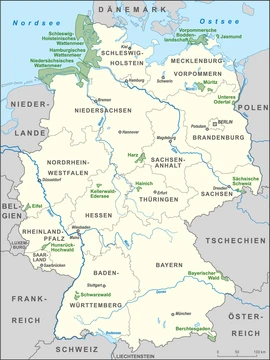
Bavarian Forest National Park
Germany's first national park, where nature takes its course in the largest contiguous forest area of Central Europe.

The Bavarian Forest National Park is a national park in the Eastern Bavarian Forest immediately on Germany's border with the Czech Republic. It was founded on 7 October 1970 as the first national park in Germany. Since its expansion on 1 August 1997 it has covered an area of 24,250 hectares. Together with the neighbouring Czech Bohemian Forest the Bavarian Forest forms the largest contiguous area of forest in Central Europe.
Quick Facts
- Iucn Category
- II
- Area Ha
- 24217
- Established
- 7 Oct 1970
- Location
- [http: · www.nationalpark-bayerischer-wald.de/ Webseiten des Nationalparks] / Freyunger Straße 2 / 94481 Grafenau
Facts from the source article.
Lore & Background
Especially protected are the Norway spruce–dominated highland forests, mixed mountain forests of European silver fir, European beech and spruce trees and water meadow spruce woods in the valleys. Although a few remnants of ancient forest remain, the National Park area is still heavily influenced by the former forestry industry. Since nature is now left to take its course again, there is no human intervention when there are catastrophic events such as large scale bark beetle infestation. This resulted in the death of a portion of the high elevation forests in the 1990s and triggered controversial discussions amongst the residents of the National Park, which highlighted differing attitudes to the wilderness. As the result of a compromise, bark beetle is now fought in the buffer area. The highest peaks in the National Park are the Großer Falkenstein (1305 m), the Lusen (1373 m) and the Großer Rachel (1453 m). In addition to the forests, there are also ecologically valuable raised bogs with bog lakes such as the Latschensee and former high meadows, the so-called Schachten, which spread even further on the Czech side of the border in the Bohemian Forest. With over 700,000 visitors per year, the National Park is an important economic factor in the economically underdeveloped region of the Bavarian Forest.
Reader's Guide
The National Park runs along the main ridge of the Bavarian Forest from the Großer Falkenstein (1,305 m) in the northwest past the Großer Rachel (1,453 m) to the Lusen (1,373 m) in the southeast. According to the classification of the major natural regions of Germany it is part of the Rear Bavarian Forest (Hinterer Bayerischer Wald) in the Upper Palatine-Bavarian Forest. On the other side of the border in the Czech Republic, the Bavarian Forest National Park is bounded by the Šumava National Park which is 68,064 hectares in area. The national park is located in the eastern part of Bavaria in the counties of Regen and Freyung-Grafenau along the border with the Czech Republic and covers an area of 24,250 hectares of forest covering the low mountain range of the Bavarian Forest. It borders on the municipalities of (from north to south): Bayerisch Eisenstein, Zwiesel, Lindberg, Frauenau, Spiegelau, Sankt Oswald-Riedlhütte, Neuschönau, Hohenau and Mauth. Parts of the National Park are located on the territory of the respective communities and parts also lie in unparished areas. There are many enclaves in the national park, especially around the edges: Zwieslerwaldhaus at the foot of the Großer Falkenstein belongs to the municipality Lindberg. Schleicher and Kreuzstraßl belong to Lindberg. Neuhütte and Jägerfleck in Spiegelau. Guglöd, belongs to St. Oswald-Riedlhütte. Waldhäuser on the Lusen, is part of Neuschönau, the largest enclave in the national park. Altschönau, is part of Neuschönau. Sagwasser-Säge and Weidhütte form a joint functional enclave belonging to Hohenau and which is joined to the rest of the country, but can only be accessed on a road passing through the national park. Glashütte is part of Hohenau. In addition, there are several other enclaves that comprise just one or a few small plots. These numerous enclaves, especially in the Altgebiet make the border very long there, and the buffer zone, where bark beetle control is allowed, extends far into the interior of the park.
Did You Know?
- The highest peak in the park is Großer Rachel at 1,453 m.
- Over 700,000 visitors per year visit the park.
Pioneering a New Conservation Era
When the Bavarian Forest National Park opened on 7 October 1970, it marked a watershed moment for German environmental policy, becoming the very first national park established within the country's borders. Situated in the eastern reaches of Bavaria, spanning the counties of Regen and Freyung-Grafenau, the protected area stretches along the German-Czech border. Following a significant territorial expansion on 1 August 1997, the park encompassed 24,250 hectares of forested low-mountain terrain. Its true scale becomes apparent from a continental perspective: together with the adjacent Bohemian Forest on the Czech side, the two regions create the largest unbroken expanse of woodland anywhere in Central Europe. Across the border, the Šumava National Park, covering 68,064 hectares, forms a natural counterpart, and the combined landscape of Norway spruce, European beech, and silver fir forests has long served as a living laboratory for understanding how human-managed woodlands can gradually return to a more natural state.
The Wild Philosophy and Its Discontents
The park's governing principle is one of radical non-intervention: nature is permitted to follow its own trajectory, free from the management practices of the forestry industry that once dominated the landscape. Although only scattered remnants of truly ancient woodland survive, the area still bears the imprint of centuries of commercial timber harvesting. Under this hands-off doctrine, even catastrophic natural events go unaddressed within the core zone. The most dramatic consequence unfolded in the 1990s, when a massive bark beetle outbreak killed a substantial portion of the high-elevation spruce forests. The spectacle of dying trees sparked fierce and often bitter debate among local residents, exposing deep divisions over what wilderness should mean in a region whose economy and identity were built on managed forestry. A political compromise eventually emerged: bark beetle control measures are now permitted in the designated buffer zone surrounding the park, while the interior remains untouched. This delicate balance between ecological purity and community tolerance continues to define the park's character.
A Living Menagerie
The park shelters an extraordinary roster of wildlife, from apex predators to the smallest invertebrates. The Eurasian lynx, wiped out locally around 1850, was brought back in the 1970s when five to ten individuals were released, with an additional seventeen introduced into the neighboring Šumava park a decade later. The population initially surged but then declined sharply between 1995 and 2008, a drop attributed in part to illegal killing on both sides of the border. In 2016, a pair of wolves made a remarkable appearance, adding another chapter to the region's recolonization story. Other notable residents include the wildcat, beaver, Eurasian otter, and several bat species, while red deer are managed through partial overwintering in enclosures to prevent overgrazing. Even moose have been spotted, likely straying from the Lipno Reservoir population in the Czech Republic. The avian community includes capercaillie, peregrine falcon, black stork, and the elusive Eurasian pygmy owl. In the soil and dead wood, more than 1,800 beetle species have been catalogued, among them fourteen specialists dependent on ancient woodland, alongside rare plants like the Hungarian gentian.
A Patchwork of Borders and Enclaves
The park's geography is far more intricate than a simple block of protected forest. It traces the main ridge of the Bavarian Forest from the Großer Falkenstein at 1,305 metres in the northwest, past the Großer Rachel at 1,453 metres, down to the Lusen at 1,373 metres in the southeast. Interspersed throughout are numerous small enclaves belonging to surrounding municipalities: the Zwieslerwaldhaus at the Falkenstein's foot, the hamlets of Schleicher and Kreuzstraßl, Neuhütte and Jägerfleck, Guglöd, and the largest enclave of all, Waldhäuser on the Lusen, which belongs to Neuschönau. Some settlements, like Sagwasser-Säge and Weidhütte, are functional enclaves of Hohenau accessible only by a road threading through the park itself. These scattered pockets of human settlement make the park's internal borders extraordinarily long and cause the buffer zone, where beetle control is permitted, to reach deep into what is nominally protected territory. Beyond the forests, ecologically precious raised bogs with their small lakes, such as the Latschensee, and remnants of former high meadows called Schachten add further layers of complexity. With over 700,000 visitors annually, the park also serves as a vital economic engine for an otherwise underdeveloped region.
Frequently Asked Questions
When was Bavarian Forest National Park established and what makes it a first?
It opened on 7 October 1970, earning the distinction of being Germany's very first national park. Its boundaries were later enlarged on 1 August 1997 to reach its current size.
How big is Bavarian Forest National Park and where exactly is it located?
The park covers 24,250 hectares in eastern Bavaria, spread across the counties of Regen and Freyung-Grafenau. It sits right along the border with the Czech Republic.
What is the highest point in Bavarian Forest National Park?
Großer Rachel, which rises to 1,453 meters above sea level, is the park's tallest peak.
What kinds of trees and forest types are found in Bavarian Forest National Park?
Norway spruce dominates the upper elevations, while mid-slopes carry mixed stands of silver fir, European beech, and spruce. Valley floors hold water meadow spruce woods, and a small number of ancient forest patches still remain.
How does Bavarian Forest National Park relate to the Czech Republic?
It shares a border with the Bohemian Forest (Šumava) in the Czech Republic, and the two together form the largest contiguous forested area in all of Central Europe.
More in National parks of Germany 1-19
Spotted an error? Know more?
Reader corrections go straight into our review queue. Suggest an edit · How this site is sourced