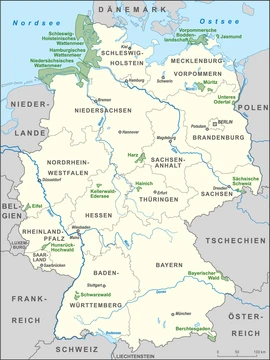
Kellerwald-Edersee National Park
Beech-forest national park tucked into Hesse, Germany — and part of a UNESCO World Heritage Site.

South of the Edersee lake, in the northern stretch of the Kellerwald low mountain range, you'll find this national park strung across the North Hessian county of Waldeck-Frankenberg, Germany. The beech stands here earned a major designation on 25 June 2011: they became part of the UNESCO World Heritage Site called Ancient and Primeval Beech Forests of the Carpathians and Other Regions of Europe, credited with documenting the ecological history of the beech family and forest dynamics stretching back to the Last Glacial Period.
Quick Facts
- Nearest City
- Bad Wildungen, Frankenau, Frankenberg, Fritzlar, Korbach, Waldeck
- Designation
- Rotbuchenwälder
- Area
- 57.38 km2
- Established
- 1 January 2004
- Location
- [http: · www.nationalpark-kellerwald-edersee.de/ Webseite des Nationalparks] / Nationalpark Kellerwald-Edersee / Laustr. 8 / D–34537 Bad Wildungen
Facts from the source article.
Lore & Background
The national park, established in the Kellerwald low mountain range, covers 57.38 km² and is administered from the small town of Bad Wildungen. Its beech forests were inscribed as part of the UNESCO World Heritage Site Ancient and Primeval Beech Forests of the Carpathians and Other Regions of Europe on 25 June 2011, due to their ecological significance. The park also contains the Edersee game park, which houses local wildlife species and species that no longer inhabit the landscape, including a bird of prey station featuring eagle owls, hawks, red kites, golden and imperial eagles.
Reader's Guide
Kellerwald-Edersee National Park represents a key example of protected beech forest ecosystems in Central Europe. Its inclusion in the UNESCO World Heritage Site highlights its role in illustrating the ecological history of the beech family and forest dynamics since the Last Glacial Period. The park's administration in Bad Wildungen coordinates conservation efforts, while the Edersee game park provides a refuge for both current and extirpated species. The park's significance lies in its preservation of ancient beech forests and its contribution to understanding post-glacial forest regeneration. A 2005 documentary, 'Im Nationalpark Kellerwald-Edersee,' produced by MDR, further documents the area. The park's literature, including works by Norbert Panek and others, explores its history and natural features.
Did You Know?
- The national park has a CDDA number of 318077.
- Its beech forest area became part of a UNESCO World Heritage Site on 25 June 2011.
- The park administration is located in Bad Wildungen, east of the park.
- The Edersee game park includes a bird of prey station with eagle owls, hawks, red kites, golden and imperial eagles.
Geographic Setting and Administrative Framework
Nestled in the northern reaches of the Kellerwald low mountain range, this 57.38-square-kilometre protected area occupies a distinctive position in the landscape of Hesse. Situated in the North Hessian county of Waldeck-Frankenberg, the park stretches along the southern shore of the Edersee reservoir, creating a natural boundary between open water and dense woodland. The administrative heart of the park beats in Bad Wildungen, a small town positioned just to the east of the protected boundary, where day-to-day management and visitor services are coordinated. This compact yet ecologically rich territory represents a concentrated slice of the broader Kellerwald region, where the interplay of low mountain terrain, water, and forest creates a landscape that has drawn both scientific interest and public curiosity. The park's relatively modest size belies the depth of its ecological significance, as the beech-dominated woodlands within its borders carry stories stretching back millennia. The CDDA designation number 318077 further anchors the park within international conservation databases, linking this Hessian woodland to a global network of protected areas.
UNESCO World Heritage Recognition
On 25 June 2011, the beech-forested heartland of this park received a designation that elevated its standing on the world stage. The woodland was inscribed as part of the UNESCO World Heritage Site titled Ancient and Primeval Beech Forests of the Carpathians and Other Regions of Europe, a transnational listing that groups together outstanding examples of beech ecosystems across the continent. The justification for inclusion centres on what these forests reveal about the ecological history of the beech family and the broader dynamics of European woodland since the Last Glacial Period. In other words, the trees standing in the Kellerwald are not merely a scenic backdrop; they are living archives of post-glacial forest succession, recording how beech populations expanded, adapted, and shaped their environments over tens of thousands of years. This recognition places the park alongside Carpathian primeval forests in a shared narrative of botanical heritage. For visitors and researchers alike, the UNESCO label underscores that the quiet understory of a Hessian beech wood carries the same scientific weight as ancient forests on other continents, and that protecting such stands is a matter of preserving irreplaceable evidence of Europe's deep ecological past.
The Edersee Game Park and Avian Experience
Beyond the protected forest itself, the Edersee area offers a hands-on wildlife experience through its game park, a facility dedicated to showcasing the animals of the local woodland as well as species that once roamed this landscape but have since disappeared from the wild. The park brings together creatures that visitors might otherwise only encounter in distant reserves, creating an educational bridge between the present-day ecosystem and the region's richer historical fauna. At the centre of this offering sits a bird of prey station, where visitors can observe a remarkable array of raptors up close. The collection includes eagle owls, various hawks, red kites, and the impressive stone and imperial eagles. These encounters allow people to appreciate the power and grace of predators that are increasingly rare in the wild. The game park thus serves a dual purpose: it provides a tangible, sensory connection to the natural heritage of the Kellerwald region while simultaneously raising awareness about species that have been lost to habitat change and other pressures. For families and nature enthusiasts, it transforms an abstract conservation message into a vivid, memorable experience.
Cultural Documentation and Community Stewardship
The park has a surprisingly solid body of work behind it. In print: Norbert Panek wrote books covering the often-thorny road to national park status as well as a practical, on-the-ground look at the region's trails. Delpho and Lübcke, and separately Hücker and Kalden, both put out volumes focused squarely on the natural beauty of the area. On screen, MDR produced a 45-minute documentary in 2005, written and directed by Ina Knobloch, Manfred Praxl, and Hiltrud Jäschke, that put the park in front of a television audience across Germany. Off-camera, a dedicated foundation runs community life around the park, and there's a sheep-grazing project that uses traditional land management to keep open clearings maintained within the woodland. The Frankfurter Allgemeine Zeitung has covered the park, and hr4 radio has run features that keep it in public conversation. Between the books, the film, the foundation, and the sheep, you get a pretty complete community memory of the Kellerwald that reaches well past the tree line.
Frequently Asked Questions
Where is Kellerwald-Edersee National Park located?
It sits in the Waldeck-Frankenberg district of northern Hesse, Germany, positioned just south of the Edersee reservoir within the Kellerwald low mountain range.
Why is Kellerwald-Edersee National Park a UNESCO World Heritage Site?
Since 25 June 2011, its beech forests have been included in the 'Ancient and Primeval Beech Forests' listing because they document the ecological development of the beech family and natural forest processes stretching back to the end of the last Ice Age.
How big is Kellerwald-Edersee National Park?
The protected area covers approximately 57.38 square kilometers of forested lowland terrain.
What kind of ecosystem does Kellerwald-Edersee National Park protect?
The park is primarily a beech forest landscape, preserving old-growth and primeval stands of Fagus sylvatica across the Kellerwald uplands.
Where is the administrative office for Kellerwald-Edersee National Park?
The park's management is based in Bad Wildungen, a town situated to the east of the protected area.
More in National parks of Germany 1-19
Spotted an error? Know more?
Reader corrections go straight into our review queue. Suggest an edit · How this site is sourced