Hainich National Park
Germany's 13th national park, protecting ancient beech forests.

Hainich National Park, Germany’s 13th national park and the only one in the state of Thuringia, was established on December 31, 1997. Its primary purpose is safeguarding an ancient native beech forest. In 2011, the park became part of the UNESCO World Heritage site “Ancient and Primeval Beech Forests of the Carpathians and Other Regions of Europe,” recognized for illustrating the ecological history of the beech tree and European forest dynamics since the Last Glacial Period.
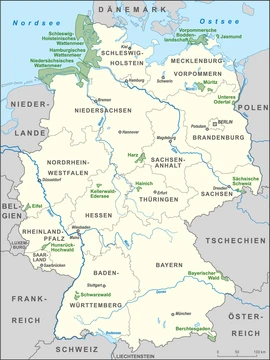
Covering 75 square kilometers (29 square miles), the park lies in western Thuringia, east of the Werra River, within the larger Eichsfeld-Hainich-Werratal Nature Park. It occupies much of the triangular area between Eisenach, Mühlhausen, and Bad Langensalza. The park forms the southern section of the roughly 160-square-kilometer (62-square-mile) Hainich, the largest continuous deciduous forest in Germany.
The park hosts a wide range of wildlife, including wildcats, 15 bat species, 7 woodpecker species, and more than 500 types of wood beetles. Over 1,600 species of fungi have been recorded so far, with the eventual total—including lichen-forming species—expected to exceed 3,000. Around 300 of these fungi are endangered or threatened with extinction; some are found nowhere else in Thuringia or are extremely rare across Germany, and their protection is a recognized responsibility of the park. About 900 plant species have been documented. European beech dominates the forest, alongside ash, hornbeam, lime, and maple trees. Notable spring plants include spring snowflake, corydalis, liverleaf, early dog-violet, anemone, buttercup anemone, wild garlic, and Turk’s cap lily.
The park’s goal is to restore a large section of central European forest to its primordial state. It covers an area once used for military training, with about 50 square kilometers (19 square miles) of deciduous forest. In the future, beech forest is expected to expand to cover most of the park.
Quick Facts
- Location
- Thuringia, Germany
- Nearest City
- Bad Langensalza
- Area
- 75 km2
- Established
- 31 December 1997
- Governing Body
- Nationalpark Hainich / Bei der Marktkirche 9 / 99947 Bad Langensalza
Facts from the source article.
Lore & Background
The park lies in the western part of Thuringia, east of the Werra River, and occupies much of the triangular area between Eisenach, Mühlhausen, and Bad Langensalza. It is part of the greater Eichsfeld-Hainich-Werratal Nature Park and covers the southern portion of the roughly 160 km² Hainich, the largest contiguous deciduous forest in Germany. The park was established on land formerly used for military training, with about 50 km² of deciduous forest.
Reader's Guide
Hainich National Park is significant as the only national park in Thuringia and as a key site for the protection of ancient beech forests in central Europe. Its inclusion in the World Heritage Site in 2011 underscores its global importance for understanding the ecological history of beech trees and post-glacial forest dynamics. The park's biodiversity includes wildcats, 15 bat species, 7 woodpecker species, over 500 wood beetle types, and more than 1,600 recorded fungi species, with an expected total exceeding 3,000. About 900 plant species have been recorded, with European beech dominating. The park's goal is to restore a large section of central European forest to its primordial state, with beech forest eventually covering most of the area. Its protection of endangered fungi and rare species highlights its conservation responsibility.
Did You Know?
- Hainich National Park is the only national park in the German state of Thuringia.
- The park was added to the Ancient and Primeval Beech Forests World Heritage Site in 2011.
- Over 1,600 species of fungi have been recorded in the park, with an expected total exceeding 3,000.
- The park covers part of the Hainich, the largest contiguous deciduous forest in Germany.
A Singular Designation in German Conservation
Established at the very close of 1997, Hainich National Park holds a singular place in Germany's protected-landscape portfolio. As the thirteenth national park granted that title in the country, it is also the sole one located within the state of Thuringia, making it a one-of-a-kind designation for the region. From its inception, the park's central mission has been the safeguarding of an ancient native beech woodland, a forest community whose ecological story stretches back to the end of the Last Glacial Period. That deep temporal significance earned the park a prestigious international recognition in 2011, when it was incorporated into the UNESCO World Heritage listing for the Ancient and Primeval Beech Forests of the Carpathians and Other Regions of Europe. This designation underscores that the Hainich is not merely a local green space but a living archive of European forest dynamics, offering tangible evidence of how beech ecosystems have evolved over millennia. For Thuringia, the park represents the highest tier of nature protection available under German law, a distinction no other site in the state can claim.
A Forest Heart in Western Thuringia
The park stretches across 75 square kilometres in the western reaches of Thuringia, positioned just east of the Werra River. Its boundaries largely fill the triangular zone bounded by the towns of Eisenach, Mühlhausen, and Bad Langensalza, weaving a continuous green corridor between these three communities. Hainich sits within the broader Eichsfeld-Hainich-Werratal Nature Park, a larger conservation landscape that frames the national park's core. What makes the geography especially remarkable is that the protected area occupies the southern portion of the Hainich, a roughly 160-square-kilometre expanse that stands as the largest unbroken stretch of deciduous woodland in all of Germany. In other words, the national park is the crown jewel of an already extraordinary forest region. This concentration of mature broadleaf forest in a single contiguous block is rare in central Europe, where centuries of agriculture and logging have fragmented most woodland into smaller patches. The Hainich's scale and continuity give it a character closer to primeval wilderness than to managed commercial forest.
A Living Catalogue of Species
The biological inventory of Hainich reads like a compendium of central European woodland life. On the animal side, wildcats roam the undergrowth, fifteen distinct bat species navigate the canopy at night, seven woodpecker species drum on the trunks, and more than five hundred kinds of wood-boring beetles work through the timber. The fungal record is equally staggering: over 1,600 species have been catalogued to date, and researchers anticipate the final count, once lichen-forming species are fully accounted for, will surpass 3,000. Roughly three hundred of the already documented fungi are classified as endangered or facing extinction, and a number of them occur nowhere else in Thuringia or are exceptionally rare across Germany, placing a specific stewardship duty on the park's management. The plant community numbers around 900 recorded species. European beech is the undisputed dominant, but ash, hornbeam, lime, and maple form important secondary layers. The spring undergrowth is particularly showy, with snowflakes, corydalis, liverleaf, early dog-violets, anemones, buttercup anemones, wild garlic, and Turk's cap lilies carpeting the forest floor in a brief, vivid display.
Restoring the Primordial Woodland
The overarching conservation philosophy of Hainich is to return a substantial tract of central European forest to a state as close as possible to its original, unmanaged condition. A key part of that story is the land's past: much of the park's roughly 50-square-kilometre deciduous woodland was formerly a military training ground, meaning that decades of human activity had already shaped the landscape before the park's 1997 establishment. The founding legislation and management plans therefore set a clear long-term trajectory: allow the beech forest to regenerate and expand until it eventually covers the majority of the park's total area. This is not a static preservation model but an active process of ecological succession, where the park essentially steps back and lets natural processes—seed dispersal, canopy gaps, soil development—rebuild the forest toward its primeval character. The protection of rare and endangered fungi, some of which are unique to Thuringia, is explicitly framed as a responsibility of the park, reinforcing that the goal is not merely to maintain what exists but to create the conditions under which the full spectrum of the beech ecosystem can reassert itself over time.
Frequently Asked Questions
Who is Hainich National Park?
Hainich National Park is Germany's 13th national park and the only one situated in the state of Thuringia. It was formally established on December 31, 1997, and spans 75 square kilometers of forested terrain in the western part of the state.
What are Hainich National Park's powers/role?
The park's core function is to shield an old-growth native beech forest and the ecological community it sustains. It operates as a strict wilderness reserve where natural succession, animal migration, and forest dynamics are left to run undisturbed by human management.
Why is Hainich National Park important?
It acts as a long-term living archive of how European beech forests have developed since the close of the Last Glacial Period. Its 2011 World Heritage inscription highlights its value in documenting continental forest ecology and guiding conservation policy.
Where is Hainich National Park located?
The park occupies roughly 75 square kilometers (about 29 square miles) in western Thuringia, sitting just to the east of the Werra River. It is nestled in the central German lowland, far from the more famous Alpine or coastal parks.
More in National parks of Germany 1-19
Spotted an error? Know more?
Reader corrections go straight into our review queue. Suggest an edit · How this site is sourced