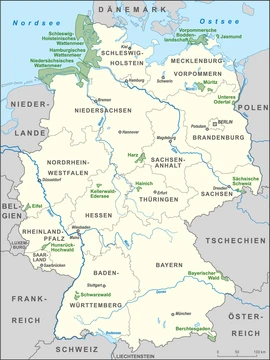
Berchtesgaden National Park
Germany's only Alpine national park, protecting the Berchtesgaden Alps since 1978.

Berchtesgaden National Park is in the south of Germany, on its border with Austria, in the municipalities of Ramsau bei Berchtesgaden and Schönau am Königsee, Berchtesgadener Land in Bavaria. The national park was established in 1978 to protect the landscapes of the Berchtesgaden Alps and is the only German national park in the Alps. Headquartered in the town of Berchtesgaden, the park was designated a Biosphere Reserve by UNESCO in 1990.
Quick Facts
- Iucn Category
- II
- Designation
- National park
- Location
- Berchtesgadener Land, Bavaria, Germany
- Area
- 210 km2
- Established
- 1978-08-01
- Visitation Num
- 345,005
- Visitation Year
- 1998
Facts from the source article.
Lore & Background
The first nature conservation area in the Berchtesgaden Alps was created in what is currently the southeastern part of the park in 1910. It had an area of 8600 ha and was organized according to the model of National Parks in the United States. In 1919, the mountain hotel of St. Bartolomew was built. In March 1921, the area was expanded to 20400 ha. During World War II, Hermann Göring declared the area around Obersee a particularly protected natural conservation area. The initiative to create a national park was first introduced in 1953. In the 1960s, a concurrent initiative to build an aerial lift to the summit of Watzmann was put forward, but was abandoned in 1972 by the decision of the Free State of Bavaria, which also decided to create a national park. The park was opened on 1 August 1978, and had a total area of 208.08 km2. In 1990, the national park was recognized by UNESCO as a Biosphere Reserve. In 2010, the park was expanded. As of 2012, its area was 210 km2.
Reader's Guide
The park covers an area of 208 km² and is part of the UNESCO Berchtesgadener Land Biosphere Reserve. It is also designated as a protected area under the Birds Directive. The park is located in the mountainous area south of the town of Berchtesgaden. The eastern, southern, and western boundaries coincide with the state border between Germany and Austria. The area is economically undeveloped, with no settlements. In the center is Lake Königssee, elongated from south to west, source of the Königsseer Ache. A smaller lake, the Obersee, is above the Königssee and drains into it. The whole area belongs to the drainage basin of the Salzach and the Danube. West of the lake is the massif of Watzmann (2713 m), and beyond that, separated by the Wimbachtal valley, the massif of Hochkalter (2607 m). The Watzmann is the third highest mountain massif in Germany. The Watzmann Glacier and the Blaueis are two of the five glaciers in Germany. The park also contains the Hintersee. Large herbivores include roe deer, red deer, and Alpine chamois. Alpine ibex were reintroduced in 1936. The alpine marmot is commonly seen. Apex predators (Eurasian lynx, grey wolf, Eurasian brown bear) are locally extinct since the 19th century. Smaller predators include red fox, ermine, stone marten, and pine marten. Native bats include lesser horseshoe bat, Geoffroy's bat, greater mouse-eared bat, and northern bat. There are four breeding pairs of golden eagles. A bearded vulture reintroduction program began in 2021; 12 bearded vultures have been released. Other notable birds include Eurasian three-toed woodpecker, Eurasian eagle-owl, western capercaillie, hazel grouse, great horned owl, Eurasian pygmy owl, black woodpecker, black grouse, ring ouzel, common redpoll, Alpine accentor, rock ptarmigan, and wallcreeper.
Did You Know?
- The Watzmann-Mittelspitze is the highest point in the German part of the Berchtesgaden Alps at 2,713 m above sea level.
- Alpine ibex were reintroduced in 1936 after going extinct in Germany in the early 18th century.
- Since 2014, the park has collaborated with Yosemite National Park in California.
Geography and Defining Landmarks
Nestled in the southernmost reaches of Germany, Berchtesgaden National Park stretches along the border with Austria, spanning the municipalities of Ramsau bei Berchtesgaden and Schönau am Königsee within Bavaria's Berchtesgadener Land district. Covering roughly 210 square kilometres, the park is a settlement-free, economically undeveloped wilderness where the only human presence is the administrative headquarters in the town of Berchtesgaden. The landscape is dominated by two colossal massifs: the Watzmann, whose Mittelspitze peak rises to 2,713 metres and makes it the third-highest mountain range in Germany, and the Hochkalter at 2,607 metres, separated from its neighbour by the Wimbachtal valley. Between and below these giants lie the Königssee—an elongated body of water running from south to west and feeding the Königsseer Ache, a tributary of the Salzach—and the smaller Obersee above it, which drains directly into the larger lake. The Hintersee adds another glacial jewel to the scene. Two of Germany's only five surviving glaciers, the Watzmann Glacier on the eastern face and the Blaueis beside the Hochkalter, cling to the high slopes. The entire watershed ultimately feeds the Danube.
A Century of Conservation Struggles
The story of protecting these mountains stretches back to 1910, when an 8,600-hectare nature conservation zone was established in what is now the park's southeastern sector, deliberately modelled on the American national park concept. A decade later, in 1921, the protected area nearly tripled to 20,400 hectares, encompassing both the Watzmann and Hochkalter ranges. World War II brought a dark chapter: Hermann Göring, serving as State Minister of Forestry and Hunting, designated zones around the Obersee as specially protected, yet in practice these areas functioned as hunting grounds. The modern national park idea first surfaced in 1953, but its path was far from smooth. During the 1960s, a proposal to build an aerial lift to the Watzmann summit directly clashed with conservation plans. Bavaria's government ultimately rejected the lift in 1972 and committed to creating a national park instead. On 1 August 1978, Berchtesgaden National Park officially opened at 208 square kilometres, becoming the only German national park situated in the Alps. UNESCO elevated its status in 1990 by designating it a Biosphere Reserve, and a modest expansion in 2010 brought the total to approximately 210 square kilometres.
Wildlife: From Extinction to Reintroduction
The park's animal community tells a story of loss and recovery. Large herbivores such as roe deer, red deer, and Alpine chamois roam freely, while the alpine marmot is a familiar sight in the high meadows. The Alpine ibex, which vanished from Germany in the early 1700s, was brought back in 1936 and now numbers around 150 individuals within the park. At the top of the food chain, however, the Eurasian lynx, grey wolf, and brown bear have all been locally extinct since the 19th century; they have reappeared in surrounding regions and are expected to migrate back naturally. In their absence, mid-level predators—red fox, ermine, stone marten, and pine marten—flourish. The skies belong to four breeding pairs of golden eagles, alongside a rich roster of other birds including the Eurasian eagle-owl, western capercaillie, rock ptarmigan, and Alpine accentor. Perhaps most symbolically, a bearded vulture reintroduction programme launched in 2021 aims to restore a species that disappeared from Germany in 1879; twelve birds have been released so far. Native bat species, including the lesser horseshoe and Geoffroy's bat, round out the park's biodiversity, which is further safeguarded under the EU Birds Directive.
Global Partnerships and Scientific Collaboration
Berchtesgaden National Park has increasingly positioned itself at the intersection of international cooperation and applied research. Since 2014, the park has maintained a formal collaboration with Yosemite National Park in California, under which the two administrations exchange scientists and staff and jointly refine best practices in species conservation and tourism management—a pairing that bridges two major national park systems across continents. In December 2019, the park signed a cooperation agreement with the Technical University of Munich (TUM) to broaden and promote scientific research within the protected area. A key element of this partnership links the park's research leadership to TUM's newly created Chair of Ecosystem Dynamics in Mountain Landscapes, ensuring that findings can be translated directly into day-to-day management decisions. These academic and international ties complement the park's broader recognition: it sits within the UNESCO Berchtesgadener Land Biosphere Reserve, a designation granted in 1990, and its status under the EU Birds Directive reinforces the legal framework protecting its avian populations. Together, these layers of partnership and protection underscore the park's role as both a local wilderness and a node in a global network of conservation science.
Frequently Asked Questions
What is Berchtesgaden National Park?
It is a protected wilderness area in Bavaria, Germany, set up in 1978 to safeguard the alpine landscapes of the Berchtesgaden Alps. It holds the distinction of being the country's sole national park located in the Alps.
Where exactly is Berchtesgaden National Park?
The park sits in the far south of Bavaria, right along the German-Austrian border. Its terrain is dominated by the dramatic peaks and valleys of the Berchtesgaden Alps.
What is the highest point in Berchtesgaden National Park?
The Watzmann-Mittelspitze, reaching 2,713 metres above sea level, is the park's tallest peak. It is part of the famous Watzmann massif that forms the park's northern boundary.
Is Berchtesgaden National Park a UNESCO World Heritage site?
Not directly — the park itself does not carry a UNESCO World Heritage title. However, the wider Berchtesgaden region was named a UNESCO Biosphere Reserve in 1990, and the national park forms just one section within that larger designated zone.
How large is Berchtesgaden National Park?
The protected area covers roughly 210 square kilometres, a figure that grew slightly from its original 208 km² at the time of its 1978 founding. For context, that makes it one of the larger national parks in Germany.
More in National parks of Germany 1-19
Spotted an error? Know more?
Reader corrections go straight into our review queue. Suggest an edit · How this site is sourced