Schleswig-Holstein Wadden Sea National Park
Largest German national park, protecting Wadden Sea intertidal ecosystem.

Stretching from the Danish border to the Elbe estuary, the Schleswig-Holstein Wadden Sea National Park is Germany’s largest national park, covering 4,410 square kilometers. Established by the state parliament on July 22, 1985, and officially founded on October 1, 1985, before being expanded in 1999, it protects the mudflats surrounding the geest-based and marsh islands as well as the undyked Halligen. The park is part of a larger German Wadden Sea network that includes the Lower Saxon and Hamburg national parks, plus sections of the Elbe estuary not already designated as nature reserves. In the North Frisian area, the mudflats can reach 40 kilometers in width, while southern areas feature extensive sandbanks. Notable species found here include porpoises, shelducks, and eelgrass in particularly high numbers. About 68% of the park is permanently underwater, 30% dries out periodically, and the land portion is mostly salt marshes. The wider Wadden Sea area was designated a UNESCO Biosphere Reserve in 1990, though the national park itself is not the biosphere; the reserve includes additional areas beyond the park's boundaries. On June 26, 2009, the park became part of a UNESCO World Heritage Site alongside other German and Dutch Wadden Sea areas, valued for its undisturbed intertidal ecosystem and unique biodiversity.
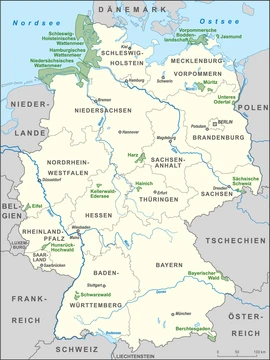
The park runs from the Danish border south to the Elbe. In the north, roughly as far as Amrum, its seaward boundary reaches the twelve-mile territorial limit; farther south it extends to about the three-mile line. Landward, the boundary lies 150 meters offshore, excluding sea dykes, foreland, and most beaches. Inhabited areas—including the five German North Frisian Islands and the larger Halligen such as Langeness, Hooge, Gröde, Oland, and Nordstrandischmoor—are also excluded. Uninhabited islands, islets, and Halligen like Trischen, Blauort, and the North Frisian Barrier Island are part of the park. Geographically, it belongs to the “Schleswig-Holstein Wadden Sea, Islands and Halligen” region within the Schleswig-Holstein Marshes and the German Bight. The park splits into two parts: the North Frisian section from the Danish border to the Eiderstedt peninsula, and the Dithmarschen section from Eiderstedt’s south coast to the Elbe.
Quick Facts
- Nearest City
- Westerland, Husum. Tönning. Heide
- Area Ha
- 441500
- Established
- 1 October 1985
- Visitation Num
- 1,746,293
- Visitation Year
- 2002
- Location
- North Sea coast, Schleswig-Holstein, / Address: / [http: · www.wattenmeer-nationalpark.de/main.htm Webseiten des Nationalparks] / Schlossgarten 1 / 25382 Tönning
Facts from the source article.
Lore & Background
The national park covers an area from the North Sea coast of Schleswig-Holstein by the Danish border in the north to the Elbe estuary in the south. In the northern area, the boundary extends to the twelve mile territorial limit; to the south it reaches to about the three mile line. Sea dykes and the foreland immediately in front of the dykes are not part of the national park; beaches are thus largely excluded. Inhabited areas in the sea, including the five German North Frisian Islands and the larger Halligen islands, are also excluded. Part of the park comprises uninhabited islands, islets and Halligen, such as Trischen, Blauort or the North Frisian Barrier Island.
Reader's Guide
The national park divides into two zones with different protection levels. Zone 1 covers a third of the park and is principally closed to the public, with exceptions for mudflat areas bordering the coastline, guided mudflat hiking tours, and fishery. South of the Hindenburgdamm, facing the landside of Sylt, human use is completely prohibited in a 12,500 ha area. Zone 2 forms a buffer around Zone 1, where sustainable use is possible. West of Sylt's coast, a 124,000 ha protection area for small whales, including the common porpoise, is designated as an important reproduction area. Activities like swimming, sailing, and traditional crab fishing are allowed, while international industry fishing, jet-skis, ship velocities over 12 knots, military activities, and resource exploitation are prevented. The park's salt marshes cover over 10,000 ha, and the Wadden Sea hosts about 700 plant and 2500 animal species, of which 10% are endemic.
More in National parks of Germany 1-19
Spotted an error? Know more?
Reader corrections go straight into our review queue. Suggest an edit · How this site is sourced