Saxon Switzerland National Park
A German sandstone national park adjoining the Bohemian Switzerland Protected Landscape Area.

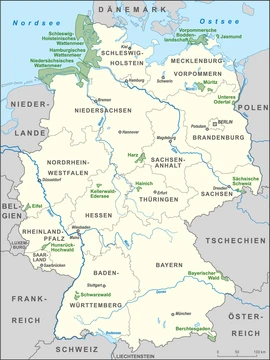
Saxon Switzerland National Park is a protected area in the German Free State of Saxony, near Dresden. Established in 1990, it covers 93.5 km² in the Elbe Sandstone Mountains and lies adjacent to the Czech Republic's Bohemian Switzerland Protected Landscape Area to the east and southeast. It is notable for its rocky canyon landscape, high biodiversity, and strict conservation status.
Quick Facts
- Iucn Category
- II
- Location
- Germany Saxony, Germany
- Nearest City
- Dresden
- Area
- 93.5 km2
- Established
- 1990
Facts from the source article.
Lore & Background
The national park lies in the heart of the German part of the Elbe Sandstone Mountains, a region called Saxon Switzerland. It is divided into two geographically separate areas within the district of Sächsische Schweiz-Osterzgebirge. The landscape is intensively fissured and rocky, with the highest peak, Großer Winterberg, at 556 meters above sea level, only a short distance from the Elbe river valley at 110–120 meters. About 40% of the park is covered by woodland, and it hosts some forms of forest without human intervention, unusual in central Europe. The special mountain and gorge forests are endangered in Europe generally, and many areas are drier than normal for the temperate zone due to sabulous soil and fissures.
The western region includes the Bastei area, Lilienstein, and Polenz valley, with important peaks such as Lilienstein (415 m), Bastei (305 m), Hockstein, and Brand (317 m). The eastern region includes the Schrammsteine rocks, Großer Winterberg, Großer Zschand valley, and the hinterland of Saxon Switzerland. It borders the Czech Republic's Bohemian Switzerland Protected Landscape Area to the east and southeast. The Kirnitzsch is the only noteworthy body of water in the eastern region, while the Grünbach, Amselsee lake, and Polenz are in the west.
The park's network of paths was developed in the first half of the 19th century and completed at the beginning of the 20th century. Hiking restrictions began in the 1980s. Today, the park has 400 km of marked hiking trails, about 50 km of cycling trails, and numerous mountain restaurants. The Painters' Trail (Malersweg) is a 116 km hiking trail starting in Pirna, following the Elbe eastwards to Schmilka and looping back. Rock climbing is popular, with strict rules introduced at the beginning of the 20th century to preserve the sandstone, including bans on climbing when wet, metal safety equipment, and chemical aids.
Reader's Guide
Saxon Switzerland National Park represents a significant conservation area in central Europe, protecting a unique sandstone canyon landscape and rare forest ecosystems. Its designation as a national park in 1990 grants the highest natural protection in Germany, with an objective to raise the inviolate area to 75% by limiting hiking and climbing zones. The park's strong vertical division creates diverse habitats and microclimate zones, and its forests without human intervention are unusual in the region. The park is a major destination for tourism and recreation, with a well-developed network of trails and climbing opportunities, though these activities are regulated to balance conservation. The Painters' Trail and the Bastei bridge are iconic features. The park adjoins Bohemian Switzerland National Park in the Czech Republic, forming a cross-border protected area. Its historical route guides, such as Meinhold's route guide, document the development of the path network. The park's climbing rules, established in the early 20th century, are among the oldest in Europe and aim to preserve the fragile sandstone. Overall, the park serves as a model for balancing human recreation with strict environmental protection in a temperate zone.
Did You Know?
- The national park covers 93.5 km² in two geographically separate areas.
- The highest peak is Großer Winterberg at 556 meters above sea level.
- The park adjoins the Bohemian Switzerland Protected Landscape Area in the Czech Republic to the east and southeast.
- Climbing is forbidden when the rock is wet or crumbling, and metal safety equipment is prohibited.
Frequently Asked Questions
Where is Saxon Switzerland National Park located?
It sits in eastern Saxony, Germany, just outside Dresden, within the Elbe Sandstone Mountains. The park's eastern and southeastern edges run right up to the Czech border.
When was Saxon Switzerland National Park established?
The park was officially designated in 1990, shortly after German reunification. It was set apart from the surrounding Elbe Sandstone Mountains to receive the strictest tier of nature protection in Germany.
What landscape is Saxon Switzerland National Park famous for?
The park is best known for its dramatic sandstone rock formations, deep canyons, and sheer cliff faces along the Elbe River. These towering pillars and gorges make it one of the most striking geological landscapes in central Europe.
How large is Saxon Switzerland National Park?
The protected area covers roughly 93.5 square kilometres. Despite that modest footprint, it sustains an unusually rich variety of plant and animal life within its rocky terrain.
Does Saxon Switzerland National Park border a protected area in another country?
Yes. Its eastern and southeastern boundaries adjoin the Bohemian Switzerland Protected Landscape Area in the Czech Republic, so the two zones together form one continuous sandstone landscape that crosses the international border.
More in National parks of Germany 1-19
Spotted an error? Know more?
Reader corrections go straight into our review queue. Suggest an edit · How this site is sourced