Uranus XXVIII
A tiny inner moon of Uranus discovered by JWST in 2025.

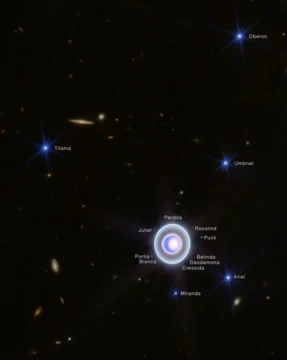
Uranus XXVIII, originally designated S/2025 U 1, is a tiny moon of Uranus, measuring between 8 and 10 kilometers across. It became the 29th moon found in the Uranian system. Its discovery was announced in August 2025 by a team led by Maryame El Moutamid, who spotted it in images from the James Webb Space Telescope’s NIRCam instrument taken on 2 February 2025.
The moon orbits Uranus at a distance of about 57,844 kilometers from the planet’s center, placing it between the orbits of Ophelia and Bianca. Its orbital period is 9.6 hours. Like Uranus’s other inner moons, its path is nearly circular and lies along the planet’s equatorial plane. Because it is so small, it is extremely faint, with an apparent magnitude of 25.5 in the near-infrared H-band—too dim for the Hubble Space Telescope or the Voyager 2 spacecraft to detect.
The International Astronomical Union’s Minor Planet Center assigned the permanent Roman numeral designation Uranus XXVIII (or Uranus 28) on 24 March 2026. Before that, it was known by the temporary provisional designation S/2025 U 1. Following convention, Uranian moons are named after characters from the plays of William Shakespeare and Alexander Pope, but a proper name has not yet been approved by the IAU. Co-discoverer Mark R. Showalter noted in a 2025 New Scientist article that discussions about a name have occurred, but no shortlist exists.
Uranus XXVIII is the 14th known inner moon of Uranus—small moons that orbit closer to the planet than its five largest moons (Miranda, Ariel, Umbriel, Titania, and Oberon). Its nearly circular orbit, located just outside Uranus’s inner ring system, suggests it formed near its current position, according to El Moutamid.
- Permanent designation
- Uranus XXVIII (or Uranus 28)
- Provisional designation
- S/2025 U 1
- Estimated diameter
- 8–10 km (5–6 mi)
- Discovery date announced
- August 2025
- Discovery team lead
- Maryame El Moutamid
- Discovery instrument
- James Webb Space Telescope NIRCam
- Discovery image date
- 2 February 2025
- Orbital distance
- 57,844 km (35,943 mi) from Uranus center
- Orbital period
- 9.6 hours (0.402 days)
- Apparent magnitude
- 25.5 (H-band, near-infrared)
Lore & Background
Uranus XXVIII was discovered by a team of astronomers led by Maryame El Moutamid, who found the moon in James Webb Space Telescope NIRCam images taken on 2 February 2025. The discovery was announced in August 2025. It is the 14th known member of Uranus's inner moons, which are small moons that orbit interior to the planet's five largest moons (Miranda, Ariel, Umbriel, Titania, and Oberon).
The moon orbits about 57,844 km from the center of Uranus, between the orbits of Ophelia and Bianca, with an orbital period of 9.6 hours. Like the other inner moons of Uranus, it follows a nearly circular orbit along Uranus's equatorial plane. Due to its small size, it appears extremely faint with a near-infrared apparent magnitude of 25.5—too faint to be seen by the Hubble Space Telescope and the Voyager 2 spacecraft.
The nearly circular orbit of Uranus XXVIII suggests that it formed near its current location, according to El Moutamid. The moon was given its permanent Roman numeral designation by the IAU Minor Planet Center on 24 March 2026. By convention, the moons of Uranus are named after characters from the plays of William Shakespeare and Alexander Pope; a proper name will be given once approved by the IAU. Co-discoverer Mark R. Showalter stated in a 2025 New Scientist article that 'there have been discussions [of a name for the moon] but no shortlist as yet.'
Reader's Guide
Uranus XXVIII is significant as the 29th moon identified in the Uranian system and the 14th known inner moon of Uranus. Its discovery using the James Webb Space Telescope's NIRCam instrument demonstrates the advanced capabilities of JWST in detecting extremely faint objects—this moon has an apparent magnitude of 25.5, making it invisible to both the Hubble Space Telescope and the Voyager 2 spacecraft. The moon's nearly circular orbit, located between the orbits of Ophelia and Bianca and outside Uranus's inner ring system, suggests it formed near its current location, providing clues about the formation and evolution of Uranus's inner moon system. The discovery was announced in August 2025 by a team led by Maryame El Moutamid, and the moon received its permanent Roman numeral designation on 24 March 2026. As an unnamed moon, it awaits a proper name from characters in Shakespeare or Pope, with discussions ongoing but no shortlist yet.
Did You Know?
- The moon's nearly circular orbit suggests it formed near its current location, according to co-discoverer Maryame El Moutamid.
- It received its permanent Roman numeral designation on 24 March 2026 from the IAU Minor Planet Center.
Frequently Asked Questions
What is Uranus XXVIII?
Uranus XXVIII is the 29th confirmed natural satellite of Uranus, a small inner moon roughly 8 to 10 kilometers across. Before receiving its permanent name it carried the provisional label S/2025 U 1.
Who discovered Uranus XXVIII and how?
A research group led by Maryame El Moutamid identified the object in NIRCam images the James Webb Space Telescope captured on 2 February 2025. The team made the find public in August 2025.
Where does Uranus XXVIII orbit and how long does one lap take?
It circles Uranus at about 57,844 kilometres from the planet's centre, fitting neatly between the orbital tracks of Ophelia and Bianca. Its nearly circular path is completed in roughly 9.6 hours.
How large is Uranus XXVIII?
The satellite is estimated at 8 to 10 kilometres (5 to 6 miles) in diameter, placing it among the smaller of Uranus's inner moons.
Why is Uranus XXVIII considered a notable find?
It adds a new member to Uranus's dense cluster of small inner satellites and demonstrates the James Webb Space Telescope's capability to pick out faint, distant objects that earlier ground-based surveys overlooked.
More in Moons of Uranus and Neptune 1-24
Spotted an error? Know more?
Reader corrections go straight into our review queue. Suggest an edit · How this site is sourced