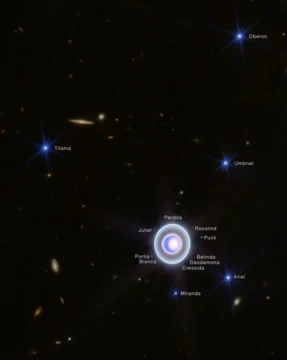
Portia (moon)
Second-largest inner Uranian moon, namesake of the Portia group.

Portia is an inner satellite of Uranus, discovered from images taken by Voyager 2 on 3 January 1986. It is the second-largest inner satellite of Uranus after Puck and is the largest member and namesake of the Portia group of satellites, which includes Bianca, Cressida, Desdemona, Juliet, Rosalind, Cupid, Belinda, and Perdita. The moon is named after Portia, the heroine of William Shakespeare's play The Merchant of Venice, and is also designated Uranus XII.
- Discovery date
- 3 January 1986
- Discovery mission
- Voyager 2
- Temporary designation
- S/1986 U 1
- Designation
- Uranus XII
- Dimensions
- 156 km × 126 km (97 mi × 78 mi)
- Geometric albedo
- 0.069
- Axis ratio
- 0.8 ± 0.1
Lore & Background
Portia was discovered from Voyager 2 images taken on 3 January 1986 and given the temporary designation S/1986 U 1. It is named after the heroine of Shakespeare's The Merchant of Venice and is also designated Uranus XII. The moon is the second-largest inner satellite of Uranus after Puck, and its orbit lies inside Uranus's synchronous orbital radius, causing it to slowly decay due to tidal deceleration; it will one day either break up into a planetary ring or hit Uranus. Portia is the largest member and namesake of the Portia group, which includes Bianca, Cressida, Desdemona, Juliet, Rosalind, Cupid, Belinda, and Perdita, all of which have similar orbits and photometric properties. Little is known about Portia beyond its dimensions of about 156 km × 126 km, orbit, and geometric albedo of about 0.069. In Voyager 2 imagery, Portia appears as an elongated object whose major axis points toward Uranus, with a prolate spheroid axis ratio of 0.8 ± 0.1. Its surface is grey or slightly reddish in color, and fellow Portia group members Juliet, Belinda, Cressida, Desdemona, and Rosalind have particularly similar spectra to Portia.
Reader's Guide
Portia's significance lies in its role as the largest member and namesake of the Portia group, a set of inner Uranian satellites with similar orbits and photometric properties. Its orbit is slowly decaying due to tidal deceleration, meaning it will eventually either break up into a planetary ring or collide with Uranus, providing a dynamic example of satellite evolution. The moon's surface composition has been a subject of study and dispute: observations with the Hubble Space Telescope in 1997 tentatively suggested water ice, and 1998 Hubble observations of Portia were incomplete but extrapolated from similar results for Puck to suggest water ice. However, 2003 observations with the W.M. Keck II telescope failed to find water ice absorption features, and later Keck observations in 2019 suggested the absence of water ice, though they acknowledged they could have missed a small feature. Most recently, observations with the James Webb Space Telescope in 2023 found evidence for water ice or hydrated minerals on Portia's surface, leaving the question unresolved. Portia's legacy is tied to Voyager 2's discovery and the ongoing investigation of its composition and fate.
A Small Body in a Dark Family
Portia belongs to the group of fourteen inner moons that orbit close to Uranus. These small, dark bodies share common physical properties and a common origin story with the planet's ring system, suggesting they formed from or are intimately related to the same material that constitutes those rings. Unlike the five larger, ellipsoidal moons that reached hydrostatic equilibrium and display evidence of geological activity such as canyon formation and volcanism, the inner moons remain modest in size and geologically quiet. They all follow prograde orbits and are classified collectively as regular moons, meaning their paths are relatively orderly compared to the distant, highly inclined, and mostly retrograde trajectories of the ten irregular moons. Their orbits lie nearly in the same plane as Uranus's equator, which itself is tilted a remarkable 97.77 degrees relative to the planet's orbital path around the Sun, giving the entire system an unusual sideways orientation in space.
A Name Drawn from Shakespeare's Court
The naming of Uranus's moons carries a distinctly English literary flavor. When John Herschel, son of the planet's discoverer, took on the task of assigning names in 1852, he deliberately turned away from the conventional Greek mythology used for most other solar-system bodies. Instead, he drew from the world of magical spirits in English literature — fairies, sylphs, and gnomes found in Shakespeare's plays and Alexander Pope's verse. Portia, a character from The Merchant of Venice, fits squarely within this broader Shakespearean tradition that extends across the named moons. While the earliest designations emphasized supernatural beings, later names such as Miranda shifted toward human characters from the same source material. The overall effect is a satellite family whose identities are woven from the fabric of English drama and poetry rather than classical myth, a choice that sets Uranus apart from every other planetary system in the Solar System.
Found in the Age of Spaceflight
Portia's discovery belongs to the modern era of Uranian satellite exploration. After the five large, ellipsoidal moons were identified between 1787 and 1948, a long gap of nearly four decades followed before the remaining inner moons came to light. The breakthrough arrived after 1985, when the Voyager 2 space probe flew past Uranus in January 1986 and revealed ten additional inner moons in a single mission. Other inner satellites were later identified through advanced Earth-based telescopes, and even older Voyager photographs were re-examined to catch faint bodies such as Perdita in 1999. This wave of discoveries transformed Uranus from a planet with only five known satellites into one possessing a rich family of small inner companions. Portia, like her inner-moon siblings, emerged from this later generation of finds, made possible by the more sensitive instruments and data-reprocessing techniques that defined late-twentieth-century planetary astronomy.
Orbiting in a Sideways World
The orbital geometry of Uranus's regular moons, including Portia, is shaped by the planet's extraordinary axial tilt. Uranus's equator is inclined 97.77 degrees to its orbital plane, giving the planet a sideways orientation as it circles the Sun. The inner and major moons all orbit in prograde directions, and their paths lie nearly in the same plane as that tilted equator. This orderly, equatorial alignment is a defining feature of the regular moons and reflects their shared origin. It stands in stark contrast to the ten irregular moons, which trace elliptical, strongly inclined, and predominantly retrograde paths at much greater distances from the planet. For an observer far from the system, the regular moons appear to sweep around Uranus in a plane almost perpendicular to the ecliptic, a direct consequence of the planet's unusual tilt. Portia's orbit, like those of its inner-moon companions, is a quiet, prograde path within this dramatically oriented family.
Frequently Asked Questions
What is Portia (moon)?
Portia is an inner satellite orbiting Uranus, ranking as the second-largest of the planet's inner moons after Puck. It was identified in Voyager 2 imagery on 3 January 1986 and holds the official designation Uranus XII.
How big is Portia and how reflective is its surface?
The moon spans roughly 156 by 126 kilometres, giving it a noticeably elongated profile. Its geometric albedo of 0.069 means it bounces back only about seven percent of incoming sunlight, making it an extremely dark body.
What is the Portia group of satellites?
The Portia group is a cluster of small inner Uranian moons that includes Bianca, Cressida, Desdemona, Juliet, Rosalind, Cupid, Belinda, and Perdita. Portia is both the largest member and the namesake of this family.
Why is the moon called Portia?
The name honours Portia, the resourceful heroine of Shakespeare's The Merchant of Venice, continuing the convention of drawing Uranian moon names from his plays. Before receiving that name, it was catalogued under the temporary label S/1986 U 1.
How was Portia discovered?
Voyager 2 detected the satellite in photographs taken during its January 1986 flyby of Uranus. It was initially logged with the provisional designation S/1986 U 1 before being formally named and assigned the number Uranus XII.
More in Moons of Uranus and Neptune 1-24
Spotted an error? Know more?
Reader corrections go straight into our review queue. Suggest an edit · How this site is sourced