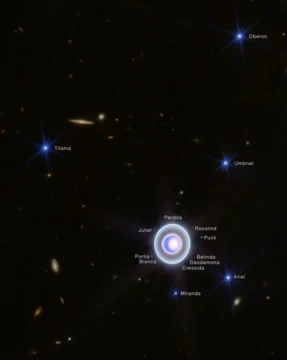
Margaret (moon)
The only prograde irregular moon of Uranus.

Margaret, designated Uranus XXIII and originally called S/2003 U 3, is an irregular moon orbiting Uranus. It stands out as the only known irregular moon of Uranus with a prograde orbit—meaning it travels around the planet in the same direction that Uranus orbits the Sun. The moon was officially discovered by Scott S. Sheppard and David C. Jewitt on August 29, 2003, using the Mauna Kea Observatory, though it had been briefly spotted earlier by Matthew J. Holman and JJ Kavelaars on August 13, 2001. Its name comes from Margaret, the servant of Hero in William Shakespeare’s *Much Ado About Nothing*, and also nods to the discoverers’ own family members.
Margaret orbits Uranus at a great distance—about 14.4 million km (8.9 million mi) on average—taking roughly 4.53 years (1,655 days) to complete one revolution. Its path is highly eccentric and steeply inclined, giving it one of the most stretched-out orbits of any known moon in the Solar System. The Sun’s gravitational pull puts the moon in a Kozai resonance, causing large, synchronized swings in its orbital eccentricity and inclination over a 500-year cycle. Margaret is estimated to be about 20 km (12 mi) in diameter, but most of its physical traits remain unknown.
**Discovery** Margaret was first detected on August 13, 2001, by astronomers Matthew J. Holman and JJ Kavelaars at Cerro Tololo Inter-American Observatory while they searched for distant Uranian moons. They planned to reobserve it by September, but poor observing conditions prevented that. With only a single night’s data, its orbit could not be determined, and the moon was lost. It wasn’t seen again until August 29, 2003, when Scott S. Sheppard and David C. Jewitt began a Uranian moon hunt using the 8.3-meter Subaru Telescope at Mauna Kea. After they reobserved Margaret with the Gemini North telescope on September 20, Minor Planet Center head Brian G. Marsden realized it matched the 2001 sighting. Kavelaars confirmed this by identifying a single Canada–France–Hawaii Telescope image from August 25, 2001. Follow-up observations ended on September 30, 2003, and the Minor Planet Center announced the discovery on October 7. NASA and the International Astronomical Union credit Sheppard and Jewitt as the official discoverers.
For years after its discovery, Margaret remained poorly tracked, with an uncertain orbit that risked losing it again.
- Discovery date
- 29 August 2003
- Discoverers
- Scott S. Sheppard and David C. Jewitt
- Discovery site
- Mauna Kea Observatory
- Provisional designation
- S/2003 U 3
- Permanent designation
- Uranus XXIII
- Average orbital distance
- 14.4 million km (8.9 million mi)
- Orbital period
- 4.53 years (1,655 days)
- Average orbital eccentricity
- 0.64
- Average orbital inclination
- 61°
- Estimated diameter
- 20 km (12 mi)
Lore & Background
Margaret was initially spotted on 13 August 2001 by astronomers Matthew J. Holman and JJ Kavelaars during their search for distant moons of Uranus at Cerro Tololo Inter-American Observatory. The group had planned to reobserve Margaret by September, but poor observational circumstances prevented them from doing so. With only one night of observations, the moon's orbit could not be determined and it became lost. Margaret was not spotted again until 29 August 2003, when Scott S. Sheppard and David C. Jewitt began searching for Uranian moons using the 8.3-meter Subaru Telescope at Mauna Kea Observatory. After they reobserved Margaret with Mauna Kea's Gemini North telescope on 20 September, Brian G. Marsden recognized that it was the same moon observed by Holman and Kavelaars in 2001. Kavelaars confirmed Marsden's suspicion after he identified a single Canada–France–Hawaii Telescope image of Margaret from 25 August 2001. NASA and the International Astronomical Union consider Sheppard and Jewitt as the official discoverers of Margaret.
Margaret follows a distant, highly inclined, and eccentric orbit around Uranus, revolving at an average distance of 14.4 million km with an orbital period of 4.53 years. It has one of the most eccentric orbits of any known moon in the Solar System. The Sun's gravitational influence places the moon in the Kozai resonance, which causes large, synchronized variations in its orbital eccentricity and inclination over a 500-year period. Margaret is estimated to have a diameter of 20 km, though most of its physical properties are unknown. The moon is formally named after Margaret, the servant of Hero in William Shakespeare's play Much Ado About Nothing, while also alluding to the discoverers' family members.
Reader's Guide
Margaret's significance lies in its unique status as the only known prograde irregular moon of Uranus, setting it apart from all other Uranian irregular moons which are retrograde. Its highly eccentric and inclined orbit, subject to the Kozai resonance, makes it a key object for studying dynamical processes in the outer Solar System. The moon's discovery history illustrates the challenges of observing faint, distant objects: it was initially lost after a single observation in 2001 and only recovered in 2003, with its orbit remaining uncertain for years afterward. Margaret's orbit is considered stable under the Kozai resonance, but it is near the edge of stability; Jet Propulsion Laboratory astrophysicists speculated in 2009 that Margaret may become ejected from the Uranus system in the far future. The moon has not been imaged at close range by a space probe, though it is planned as a distant observation target for the proposed Uranus Orbiter and Probe. Its naming story is notable for combining literary reference with personal connections: Sheppard chose the name because it matched his mother's name, and Kavelaars supported it because it matched the middle name of his elder daughter.
Did You Know?
- Margaret has the fifth-highest average orbital eccentricity of any known moon in the Solar System as of 2026.
- Due to the Kozai resonance, Margaret's eccentricity oscillates from 0.41 to 0.89 over a period of about 520 years.
- Margaret was initially observed in 2001 but was lost for two years before being rediscovered in 2003.
- The moon's name alludes to both Shakespeare's Much Ado About Nothing and the discoverers' family members.
A Two-Century Hunt Across the Sky
The search for Uranus's satellites stretches across nearly two and a half centuries, marked by long stretches of silence between finds. Sir William Herschel spotted Titania and Oberon on January 11, 1787, only six years after identifying the planet. For almost fifty years his telescope was the only instrument that had ever revealed those two faint companions. Better equipment and more favorable sky positions in the 1840s produced sporadic hints of additional satellites, but it took until 1851 for William Lassell to confirm Ariel and Umbriel. Another near-century of quiet followed before Gerard Kuiper, at McDonald Observatory in 1948, identified Miranda, the smallest of the five large spherical moons. The pace then accelerated: Voyager 2's January 1986 flyby revealed ten inner moons, and Erich Karkosch extracted Perdita from old Voyager imagery in 1999. Ground-based telescopes added Sycorax and Caliban in 1997, seven more irregular satellites between 1999 and 2003, and Hubble found Cupid and Mab in 2003. The hunt continues—Scott Sheppard's team announced S/2023 U 1 in 2024, and in August 2025 Maryame El Moutamid's group at Southwest Research Institute identified a new inner moon, Uranus XXVIII, in James Webb Space Telescope images, one too small and faint for earlier missions to detect.
Names Borrowed from Shakespeare and Pope
When John Herschel—son of the planet's discoverer—finally assigned names to the four known satellites in 1852, he deliberately bypassed the conventional Greek mythological tradition. Instead, he drew from English literature: Oberon and Titania, the fairy king and queen of Shakespeare's A Midsummer Night's Dream, and Ariel (a sylph) and Umbriel (a gnome) from Alexander Pope's The Rape of the Lock. Ariel also appears as a spirit in Shakespeare's The Tempest. It remains unclear whether John Herschel originated these choices or whether William Lassell, who had discovered Ariel and Umbriel, selected the names and merely sought his permission. Subsequent naming largely followed the same literary wellspring rather than the airy-spirits motif—only Puck and Mab carried that thread forward. In 1949, Gerard Kuiper named the fifth large moon, Miranda, after a human character in The Tempest. Of the twenty-seven named moons in the system, all draw their titles from characters appearing in or referenced by Shakespeare's plays or Pope's poem, making Uranus's satellite family one of the Solar System's most distinctly literary collections.
Three Families, Three Orbital Personalities
Uranus's twenty-nine known moons fall into three distinct groups, each with its own orbital character. The fourteen inner moons are small, dark bodies that share common physical properties and likely origins with the planet's ring system. The five major moons—Titania, Oberon, Ariel, Umbriel, and Miranda—are ellipsoidal in shape, a signature suggesting they reached hydrostatic equilibrium at some point in their history and may still be in that state. Four of them display evidence of internally driven geological activity, including canyon formation and volcanism. Titania, the largest at 1,578 kilometers in diameter, ranks as the eighth-largest moon in the Solar System and carries roughly one-twentieth the mass of Earth's Moon. All nineteen regular moons orbit in prograde directions and lie nearly coplanar with Uranus's equator, which itself is tilted a dramatic 97.77 degrees to its orbital plane. In stark contrast, the ten irregular moons travel on distant, highly inclined, and mostly retrograde orbits, setting them apart as a fundamentally different population.
The Four Moons That Never Were
One of the most enduring puzzles in Uranian astronomy involves four satellites that never existed. After his 1787 discovery of Titania and Oberon, Herschel reported observing two additional moons in 1790 and two more in 1794, leading the astronomical community to believe for decades that Uranus possessed six satellites. The four extra bodies were assigned sidereal periods of 5.89 days, 10.96 days, 38.08 days, and 107.69 days, placing them at various positions relative to the two confirmed moons. The matter was finally settled when Lassell discovered Ariel and Umbriel in 1851. His observations revealed that these two new satellites did not match any of Herschel's four claimed extras in orbital characteristics—if Herschel's telescope had been capable of seeing any additional moons, it certainly would have caught Ariel and Umbriel. The conclusion was inescapable: the four spurious satellites were almost certainly misidentified faint stars near Uranus. Credit for Ariel and Umbriel was duly assigned to Lassell, and the official count returned to two, later four, and eventually the twenty-nine moons known today.
Frequently Asked Questions
What is Margaret (moon)?
Margaret is an irregular satellite of Uranus, carrying the permanent designation Uranus XXIII and the earlier provisional name S/2003 U 3. It circles the planet at a mean distance of roughly 14.4 million kilometres (about 8.9 million miles).
What makes Margaret (moon) unique among Uranus's moons?
Margaret is the only irregular moon of Uranus confirmed to have a prograde orbit, meaning it revolves around the planet in the same direction that Uranus itself travels around the Sun. Every other irregular satellite of Uranus follows a retrograde path.
Who discovered Margaret (moon) and when?
Scott S. Sheppard and David C. Jewitt made the official discovery on 29 August 2003 from the Mauna Kea Observatory. The object had been glimpsed briefly a couple of years earlier, on 13 August 2001, by Matthew J. Holman and JJ Kavelaars.
How far is Margaret (moon) from Uranus?
Margaret orbits at an average distance of about 14.4 million kilometres (roughly 8.9 million miles) from the centre of Uranus. This places it well beyond the planet's main ring system and its group of regular satellites.
Why is it called Margaret (moon)?
The name honours Margaret, the loyal servant of Hero in Shakespeare's comedy Much Ado About Nothing. It follows the long-standing convention of naming Uranian moons after characters from Shakespeare's plays.
More in Moons of Uranus and Neptune 1-24
Spotted an error? Know more?
Reader corrections go straight into our review queue. Suggest an edit · How this site is sourced