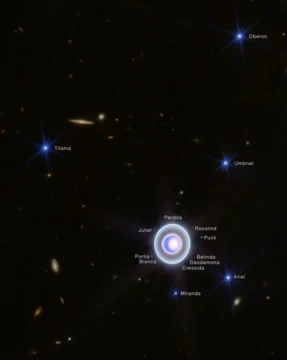
Caliban (moon)
Second-largest irregular moon of Uranus, discovered in 1997.

Caliban is Uranus’s second-largest irregular moon. A team of astronomers—Brett J. Gladman, Philip D. Nicholson, Joseph A. Burns, and John J. Kavelaars—spotted it on September 6, 1997, through the 200-inch Hale Telescope, alongside another moon called Sycorax. Its orbit sits more than ten times farther from Uranus than Oberon, the outermost regular moon, and it moves in a retrograde direction with a moderate tilt and a slight oval shape. Based on its orbital traits, Caliban might share a common origin with Stephano and Francisco, possibly belonging to the same dynamic cluster.
The moon’s diameter is roughly 42 kilometers, according to a single thermal measurement by the Herschel Space Observatory, though an alternative estimate of 50 kilometers with a different albedo is also plausible. Its albedo of about 0.22 is unusually high for a Uranian irregular satellite, similar to Neptune’s largest irregular moon, Nereid. Color readings place Caliban in the light-red range, redder than Jupiter’s moon Himalia but less red than most Kuiper belt objects, and it may be slightly redder than Sycorax. It absorbs light at 0.7 micrometers, which some astronomers think could indicate liquid water once modified its surface. Data from the Kepler space telescope suggest Caliban rotates once every 9.9 hours.
Caliban likely didn’t form in the accretion disk around Uranus; instead, it’s thought to be a captured object. Exactly how it was captured isn’t known, but possible mechanisms include gas drag in the protoplanetary disk, interactions among multiple bodies, or a “pull-down” capture during Uranus’s rapid mass growth.
- Designation
- Uranus XVI
- Discovery date
- 6 September 1997
- Discoverers
- Brett J. Gladman, Philip D. Nicholson, Joseph A. Burns, John J. Kavelaars
- Discovery telescope
- 200-inch Hale Telescope
- Diameter estimate
- around 42 km (26 mi), with an alternate solution of 50 km also possible
- Albedo estimate
- around 0.22, with an alternate solution of 0.15 also possible
- Rotation period
- about 9.9 hours
Lore & Background
Caliban was discovered on 6 September 1997 by Brett J. Gladman, Philip D. Nicholson, Joseph A. Burns, and John J. Kavelaars using the 200-inch Hale Telescope, along with Sycorax. It was given the temporary designation S/1997 U 1 and later named after the monster character in William Shakespeare's play The Tempest. The moon is designated Uranus XVI.
Caliban follows a distant orbit more than 10 times further from Uranus than Oberon, the outermost regular moon. Its orbit is retrograde, moderately inclined, and slightly eccentric. The orbital parameters suggest it may belong to the same dynamic cluster as Stephano and Francisco, indicating a common origin. Based on a single measurement point, its diameter is estimated at around 42 km, with an albedo of about 0.22, though an alternate solution of 50 km diameter and 0.15 albedo is also possible. Its color is light-red, possibly slightly redder than Sycorax, and it absorbs light at 0.7 μm, which some astronomers think may result from liquid water modifying the surface. Measurements by the Kepler space telescope indicate a rotation period of about 9.9 hours.
Caliban is hypothesized to be a captured object, not formed in the accretionary disk around Uranus. The exact capture mechanism is unknown, but possible processes include gas drag in the protoplanetary disk, many body interactions, or capture during the fast growth of Uranus's mass.
Reader's Guide
Caliban's significance lies in its role as one of the first irregular satellites of Uranus discovered in the modern era, expanding understanding of the Uranian system beyond its regular moons. Its distant, retrograde orbit and membership in a possible dynamic cluster with Stephano and Francisco suggest a common origin, likely from a captured object. The moon's relatively high albedo, comparable to Neptune's largest irregular satellite Nereid, is unusual among Uranian irregular satellites and may indicate surface processes such as modification by liquid water. The uncertainty in its diameter and albedo, with two equally possible solutions, highlights the challenges in characterizing distant small bodies. Its discovery using the 200-inch Hale Telescope, alongside Sycorax, marked a significant observational achievement. The hypothesis that Caliban is a captured object, with several possible capture mechanisms, contributes to broader theories of planetary system formation and the origins of irregular satellites around giant planets.
Did You Know?
- Caliban is the second-largest irregular satellite of Uranus.
- It was discovered on 6 September 1997 using the 200-inch Hale Telescope.
- Its orbit is retrograde and more than 10 times further from Uranus than Oberon.
- Caliban's rotation period is about 9.9 hours, measured by the Kepler space telescope.
Discovery & the End of Uranus's Isolation
Caliban's identification in 1997 represented a watershed moment for Uranus, which until that year remained the last of the giant planets without any confirmed irregular satellites. Astronomers using ground-based telescopes detected both Caliban and its companion Sycorax, shattering a long period of silence in the planet's outer satellite population. The finding immediately opened a new chapter: from 1999 through 2003, more powerful ground-based instruments revealed seven additional irregular moons, rapidly expanding the known Uranian family. Caliban thus anchors a group of ten distant, eccentrically orbiting bodies that had been entirely unknown before the late 1990s. Prior to this discovery wave, the outer reaches of Uranus's gravitational domain had remained uncharted, while the inner moons had only been catalogued through the Voyager 2 flyby of January 1986 and later Hubble Space Telescope observations. Caliban's confirmation helped establish that the Uranian system harbors a population of outer satellites comparable in character to those orbiting the other giant planets, fundamentally reshaping the planet's known satellite architecture.
Orbital Architecture & Dynamical Classification
Caliban belongs to the group of ten irregular moons that circle Uranus at great distances from the planet. This classification sets it apart from the fourteen inner moons and five major moons, all of which trace prograde orbits nearly coplanar with Uranus's equator, a plane tilted 97.77 degrees relative to the planet's orbital path. In sharp contrast, the irregular moons follow elliptical, strongly inclined trajectories that are predominantly retrograde, meaning they orbit in the opposite direction to Uranus's rotation. Caliban's orbital geometry thus places it in a fundamentally different dynamical regime from the regular satellite population. Where the inner moons are small, dark bodies sharing common properties with Uranus's rings, and the five major moons are ellipsoidal shapes that reached hydrostatic equilibrium, Caliban occupies the outermost tier of the system. Its distant, tilted, and retrograde path marks it as part of a small, dynamically distinct family that extends the known architecture of Uranus's satellite system far beyond the compact inner group.
Naming & the Literary Tradition
Caliban's name continues a distinctive literary tradition that sets Uranus's moons apart from most other solar system bodies. In 1852, John Herschel, son of the planet's discoverer, chose to honor characters from English literature rather than the Greek mythological figures typically used elsewhere. The first four moons, Titania, Oberon, Ariel, and Umbriel, were drawn from Shakespeare's A Midsummer Night's Dream and Alexander Pope's The Rape of the Lock. When Gerard Kuiper named the fifth major moon Miranda in 1949, he returned to Shakespeare, selecting a character from The Tempest. The broader naming pool thus spans both Shakespeare's dramatic works and Pope's verse, creating a literary constellation around the planet. Caliban, as one of the later-discovered irregular moons identified in 1997, extends this tradition, linking a distant, retrograde satellite to a character from the Shakespearean canon. The result is a satellite family whose names evoke fairies, sylphs, and gnomes, making Uranus's moons distinctive in the solar system's nomenclature.
Place in the Full Uranian System
Uranus hosts twenty-nine known moons, organized into three distinct groups: fourteen small inner moons, five larger major moons, and ten irregular satellites of which Caliban is one. The inner moons are small, dark bodies that share common physical properties and origins with Uranus's ring system. The five major moons, by contrast, are ellipsoidal in shape, indicating they achieved hydrostatic equilibrium at some point in their geological past, and four of them display evidence of internally driven processes such as canyon formation and volcanism. The largest of these, Titania, spans 1,578 kilometers in diameter and ranks as the eighth-largest moon in the entire Solar System, with a mass roughly one-twentieth that of Earth's Moon. Caliban, as a member of the irregular group, stands in stark contrast to this inner population. Its discovery in 1997, alongside Sycorax, was the first identification of any irregular moon for Uranus, and it triggered a wave of further discoveries that added seven more outer satellites between 1999 and 2003, fundamentally expanding the known architecture of the planet's satellite family.
Frequently Asked Questions
What is Caliban (moon)?
Caliban, formally designated Uranus XVI, is the second-largest irregular satellite known to orbit Uranus. It is far smaller than Uranus's major regular moons such as Titania and Oberon.
Who discovered Caliban (moon) and when?
Brett J. Gladman, Philip D. Nicholson, Joseph A. Burns, and John J. Kavelaars identified Caliban on September 6, 1997, using the 200-inch Hale Telescope. They detected it at the same time as another Uranian moon, Sycorax.
How large is Caliban (moon) and what is its surface like?
Caliban's diameter is estimated at roughly 42 kilometers (about 26 miles), though an alternative calculation suggests it could be closer to 50 kilometers. Its surface albedo is estimated around 0.22, with a lower value near 0.15 also considered a viable solution.
How does Caliban (moon) orbit Uranus?
Caliban travels in a retrograde direction at a distance more than ten times greater than that of Oberon, Uranus's outermost regular moon. Its path is moderately tilted and slightly elliptical rather than a perfect circle.
Is Caliban (moon) linked to any other Uranus moons?
Orbital analyses suggest Caliban likely shares a common origin with the irregular moons Stephano and Francisco. The three are thought to form part of the same dynamically linked cluster of captured or formed satellites.
More in Moons of Uranus and Neptune 1-24
Spotted an error? Know more?
Reader corrections go straight into our review queue. Suggest an edit · How this site is sourced