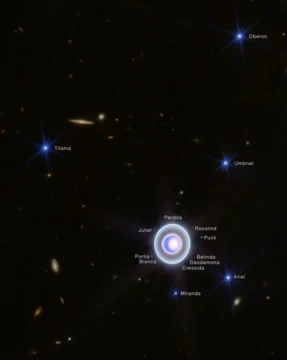
Miranda (moon)
Uranus's innermost round moon with extreme topography.

Miranda is the smallest and innermost of Uranus's five round satellites, discovered by Gerard Kuiper on 16 February 1948 at McDonald Observatory in Texas. It is named after Miranda from William Shakespeare's play The Tempest. Miranda is notable for having one of the most extreme and varied topographies of any object in the Solar System, including Verona Rupes, a roughly 20-kilometre-high scarp that may be the highest cliff in the Solar System, and chevron-shaped tectonic features called coronae.
- Discovery date
- 16 February 1948
- Discoverer
- Gerard Kuiper
- Diameter
- 470 km (290 mi)
- Orbital distance from uranus surface
- roughly 129,000 km
- Orbital period
- 34 hours
- Density
- 1.15 g/cm3
- Apparent magnitude
- +16.6
Lore & Background
Miranda was discovered by Gerard Kuiper on 16 February 1948 using the McDonald Observatory's 82-inch Otto Struve Telescope, and its motion around Uranus was confirmed on 1 March 1948. It was the first satellite of Uranus discovered in nearly 100 years. Kuiper named it Miranda after the character in Shakespeare's The Tempest, continuing the tradition of naming Uranian moons after Shakespearean or Pope characters. The moon is also designated Uranus V.
Miranda orbits close to Uranus's equatorial plane at roughly 129,000 km from the surface, with an orbital period of 34 hours that is synchronous with its rotation, meaning it always shows the same face to Uranus (tidal locking). Its orbital inclination of 4.34° is unusually high for a body so close to its planet, roughly ten times that of the other major Uranian satellites. The reason for this is still uncertain, though it may involve past resonances with Umbriel.
At just 470 km in diameter, Miranda is one of the smallest closely observed objects in the Solar System that might be in hydrostatic equilibrium. Its total surface area is roughly equal to that of Texas. The only close-up images are from the Voyager 2 probe during its Uranus flyby in January 1986, which studied only the southern hemisphere. Miranda likely formed from an accretion disc and is probably differentiated, with an inner core of rock surrounded by a mantle of ice.
Reader's Guide
Miranda's significance lies in its extreme and varied geology, which is the most of any Uranian satellite, despite its small size. The Voyager 2 flyby in January 1986 provided the only close-up images, revealing a mosaic of highly varied zones including fractures, faults, valleys, craters, ridges, gorges, depressions, cliffs, and terraces. The origin and evolution of this varied geology are still not fully understood, with multiple hypotheses including tidal heating from a past 3:1 orbital resonance with Umbriel, which could have warmed Miranda's interior by 20 K and triggered melting for up to 100 million years. A 2024 study suggested Miranda might have had a liquid ocean of about 100 km thickness beneath the surface within the last 100–500 million years. Miranda's legacy includes being the round moon with the smallest orbit around a major planet, and its unique surface features such as Verona Rupes, the highest cliff in the Solar System, and chevron-shaped coronae. The moon's discovery ended a nearly 100-year gap in finding new Uranian satellites.
Discovery and the Century-Long Gap
Miranda was identified in 1948 by Gerard Kuiper working at the McDonald Observatory, making it the smallest and the final member of Uranus's five large, spherical moons to be found. Its discovery closed a remarkable gap: nearly a full century had elapsed since William Lassell spotted Ariel and Umbriel in 1851, and more than sixteen decades since William Herschel first resolved Titania and Oberon in 1787. Kuiper's find completed the set of five major moons, all of which are ellipsoidal in shape, a geometry that points to each body having reached hydrostatic equilibrium at some stage in its history. The remaining satellites of Uranus—fourteen small inner moons and ten irregular outer bodies—would not be identified until after 1985, either during the Voyager 2 flyby of January 1986 or through the use of increasingly powerful Earth-based telescopes. Miranda's late arrival in the catalog thus marked the end of an era in which the major moons were being pieced together one by one over more than a century and a half.
Physical Profile Among the Five Major Moons
Miranda is the smallest of Uranus's five major moons, a group whose members all share an ellipsoidal shape. That rounded geometry signals that each body achieved hydrostatic equilibrium at some point in the past and may still be in that state today. Four of the five display surface evidence of internally driven geological activity, ranging from canyon formation to volcanism. For scale, the largest of the group, Titania, spans 1,578 km in diameter and holds the distinction of being the eighth-largest moon in the entire Solar System, with a mass roughly one-twentieth that of Earth's Moon. All five major moons, together with the fourteen inner satellites, trace prograde orbits that lie nearly in the same plane as Uranus's equator—a plane tilted a striking 97.77 degrees relative to the planet's orbital path around the Sun. This collective set is classified as regular moons, standing in sharp contrast to the ten irregular satellites whose distant, highly inclined, and predominantly retrograde orbits set them apart from the rest of the system.
Naming and the Shakespeare-Pope Literary Lineage
In 1949, Gerard Kuiper named his newly discovered satellite Miranda after a human character in Shakespeare's The Tempest, extending a literary naming tradition that had been in place since 1852. That year, John Herschel—son of the planet's discoverer—assigned the names Oberon and Titania, drawn from the fairies of A Midsummer Night's Dream, and Ariel and Umbriel, a sylph and gnome from Alexander Pope's The Rape of the Lock. Ariel also appears as a spirit in The Tempest, creating a subtle cross-link between the two source texts. It remains unclear whether John Herschel originated these names or whether William Lassell, who had discovered Ariel and Umbriel, selected them and simply asked Herschel for permission. After Miranda, the naming convention largely shifted away from the airy-spirits motif—only Puck and Mab continued that particular thread—and instead drew more broadly from the same Shakespeare and Pope source material that John Herschel had originally tapped.
The Broader Discovery Timeline and Spurious Claims
The catalog of Uranus's 29 known moons was built over nearly two and a half centuries, and not every entry was straightforward. Herschel spotted Titania and Oberon on January 11, 1787, just six years after finding the planet, and for almost fifty years his instrument was the only one capable of resolving them. He later claimed four additional satellites in 1790 and 1794, but none were ever confirmed by other observers; Lassell's 1851 work showed that the orbital characteristics did not match, and the four were ultimately dismissed as misidentifications of faint background stars. After Kuiper's 1948 discovery of Miranda, no new moons were reported until Voyager 2's 1986 flyby revealed ten inner satellites. The pace then quickened: Sycorax and Caliban in 1997, Perdita in 1999, seven more irregular moons between 1999 and 2003, Cupid and Mab via Hubble in 2003, an irregular moon announced in 2024 from Subaru observations, and a new inner moon, Uranus XXVIII, revealed in 2025 from James Webb Space Telescope images.
Frequently Asked Questions
Who is Miranda (moon)?
Miranda is the smallest and innermost of Uranus's five round satellites, orbiting at roughly 129,000 km from the planet's surface with a period of about 34 hours. It takes its name from the character in Shakespeare's The Tempest.
What is Miranda (moon) famous for?
It boasts one of the most dramatic and varied surfaces of any body in the Solar System, featuring chevron-shaped tectonic regions called coronae alongside a massive fault scarp known as Verona Rupes. That scarp stands roughly 20 km tall and is a leading candidate for the tallest cliff anywhere in the Solar System.
How was Miranda (moon) discovered?
Gerard Kuiper identified it on 16 February 1948 while observing from McDonald Observatory in Texas.
What is Verona Rupes and why does it matter?
Verona Rupes is a towering fault scarp on Miranda's surface, estimated at about 20 kilometres in height, which makes it a contender for the single highest cliff in the entire Solar System.
What are Miranda (moon)'s basic physical stats?
The moon measures roughly 470 km in diameter, has a bulk density of 1.15 g/cm³, and completes one full orbit around Uranus in approximately 34 hours.
More in Moons of Uranus and Neptune 1-24
Spotted an error? Know more?
Reader corrections go straight into our review queue. Suggest an edit · How this site is sourced