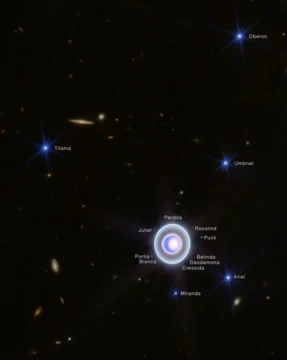
Francisco (moon)
Innermost irregular moon of Uranus, discovered in 2001.

Francisco, also known as Uranus XXII and previously as S/2001 U 3, is the innermost known irregular moon of Uranus. It was discovered on 13 August 2001 by a team of astronomers at Cerro Tololo Inter-American Observatory in Chile and is named after a lord in William Shakespeare's play The Tempest. Francisco is notable for its retrograde orbit and for being one of the first Uranian irregular moons identified in the 2001 survey.
- Discovery date
- 13 August 2001
- Discoverers
- JJ Kavelaars, Matthew J. Holman, Dan Milisavljevic, Tommy Grav
- Discovery site
- Cerro Tololo Inter-American Observatory, Chile
- Average distance from uranus
- 4.3 million km (2.7 million mi)
- Orbital period
- 267 Earth days (0.73 Earth years)
- Diameter
- 22 km (14 mi)
- Orbital inclination
- 147° (with respect to the ecliptic)
Lore & Background
Francisco was discovered on 13 August 2001 by astronomers JJ Kavelaars, Matthew J. Holman, Dan Milisavljevic, and Tommy Grav using the 4-meter Víctor M. Blanco Telescope at Cerro Tololo Inter-American Observatory in Chile. The team identified Francisco and three other Uranian irregular moons (Trinculo, Ferdinand, and Margaret) in telescope images processed with the shift-and-add technique. Follow-up observations to determine its orbit were conducted at Palomar Observatory and the Very Large Telescope at Paranal Observatory, lasting until 5 September 2002. The Minor Planet Center announced the discovery on 6 October 2003.
Francisco orbits Uranus at an average distance of 4.3 million km (2.7 million mi) and takes about 267 Earth days to complete one orbit. Its orbit is retrograde, moving opposite to Uranus's orbit around the Sun, with an average eccentricity of 0.14 and an average inclination of 147° relative to the ecliptic. Over a 10,000-year span, perturbations cause its semi-major axis to vary by ±700 km and its orbital period by ±1 day. Francisco is not known to be part of any collisional family; its orbit appears unique among known Uranian irregular moons.
Physically, Francisco is estimated to have a diameter of 22 km (14 mi), based on an assumed low albedo of 0.04 typical of other Uranian irregular moons. Its surface is expected to be dark, composed of water ice, hydrated silicates, and organic compounds. The moon has not been studied up close by any spacecraft, though Voyager 2 passed within 2.4 million km of it during its 1986 Uranus flyby.
Reader's Guide
Francisco holds significance as the innermost known irregular moon of Uranus, a class of moons thought to have been captured during the Solar System's formation. Its discovery in 2001, alongside three other irregular moons, expanded the known Uranian system and highlighted the effectiveness of the shift-and-add imaging technique for detecting faint objects. The moon's retrograde orbit and high inclination distinguish it from Uranus's regular moons, and its orbit is notably perturbed by the Sun and other planets, causing variations in its semi-major axis, eccentricity, and inclination over thousands of years. Francisco's unique orbit—not part of any known collisional family—suggests that any related moons are likely small and undiscovered. Although no spacecraft has imaged it closely, Voyager 2's coincidental passage in 1986 remains the closest encounter. The proposed Uranus Orbiter and Probe (UOP) has identified Francisco as a distant observation target, though a close flyby may be challenging due to its orbit far from the ecliptic plane. The moon's naming, chosen by Kavelaars to resemble his daughter's middle name, adds a personal note to its scientific legacy.
Did You Know?
- Francisco's orbit is retrograde, meaning it moves opposite to Uranus's orbit around the Sun.
- The moon's name was chosen by Kavelaars because it resembled his younger daughter's middle name, Frances.
A Two-and-a-Half-Century Hunt for Faint Companions
The story of Uranus's satellite system spans nearly two and a half centuries of astronomical progress. Sir William Herschel first identified Titania and Oberon on January 11, 1787, just six years after his own discovery of the planet. For almost half a century, his telescope remained the sole instrument capable of resolving these faint companions. In the 1840s, improved optics and a more favorable sky position of Uranus prompted sporadic hints of additional satellites, culminating in William Lassell's 1851 identification of Ariel and Umbriel. Gerard Kuiper then added Miranda in 1948 from the McDonald Observatory, completing the set of five large, roughly spherical moons. The pace of discovery accelerated dramatically in the modern era: Voyager 2's January 1986 flyby revealed ten small inner satellites, and Erich Karkosch extracted one more, Perdita, from archival Voyager imagery in 1999. Ground-based telescopes uncovered Sycorax and Caliban in 1997, followed by seven additional irregular moons between 1999 and 2003. Hubble detected Cupid and Mab in 2003, Scott Sheppard's team announced S/2023 U 1 in 2024 using Subaru data, and Maryame El Moutamid's group identified Uranus XXVIII in 2025 from James Webb Space Telescope images, a body too faint for earlier missions to catch.
Three Families of Moons and Their Distinct Natures
Uranus hosts twenty-nine known satellites, twenty-seven of which carry formal names. Astronomers divide them into three distinct categories: fourteen small inner moons, five major moons, and ten irregular moons. The inner and major groups are collectively termed regular moons because their orbits are prograde and lie nearly in the same plane as Uranus's equator, which itself is tilted a dramatic 97.77 degrees relative to its orbital path around the Sun. The irregular moons, by contrast, trace elliptical, strongly inclined, and predominantly retrograde paths at great distances from the planet. The inner moons are small, dark bodies whose composition and origin appear linked to Uranus's ring system. The five major moons are ellipsoidal in shape, a geometry that signals they achieved hydrostatic equilibrium at some point in their history and may still be settling into it. Four of these five display evidence of internally driven geological activity, including canyon formation and volcanic processes. Titania, the largest of the five, measures 1,578 kilometers across, making it the eighth-largest moon in the entire Solar System and roughly one-twentieth the mass of Earth's Moon.
Fairies, Sylphs, and a Literary Naming Tradition
Although Titania and Oberon had been known since 1787, none of the early Uranian satellites received formal names until 1852, a year after Lassell's discoveries of Ariel and Umbriel. John Herschel, son of the planet's discoverer, took on the naming task. Rather than drawing from the conventional Greek mythological pool, he reached into English literature: Oberon and Titania are the fairy king and queen of Shakespeare's A Midsummer Night's Dream, while Ariel and Umbriel are the sylph and gnome of Alexander Pope's The Rape of the Lock. Ariel also appears as a spirit in Shakespeare's The Tempest. It remains unclear whether John Herschel originated these choices or whether Lassell selected them and merely sought his approval. When Gerard Kuiper named the fifth major moon in 1949, he chose Miranda, a human character from The Tempest, continuing the Shakespearean thread. Later designations largely abandoned the airy-spirit motif, with only Puck and Mab retaining that flavor, and instead drew more broadly from the same literary sources. The Roman numeral numbering scheme itself was unsettled for years, with publications alternating between Herschel's and Lassell's ordering before Lassell's outward-from-Uranus sequence became standard.
The Spurious Moons and the Price of Early Observation
Perhaps no episode in Uranian satellite history illustrates the fragility of early observational astronomy more vividly than the so-called spurious moons affair. After his 1787 discovery of Titania and Oberon, Herschel reported four additional satellites: two on January 18 and February 9, 1790, and two more on February 28 and March 26, 1794. For decades, the astronomical community accepted that Uranus possessed a system of six satellites. The proposed sidereal periods ranged from 5.89 days, interior to Titania, through 10.96 days between the two known moons, to 38.08 and 107.69 days beyond Oberon. When Lassell observed Uranus in 1851, the two moons he actually found—Ariel and Umbriel—did not match any of Herschel's four claimed bodies in their orbital characteristics. If Herschel's instruments had been sensitive enough to detect satellites at those orbital positions, he certainly would have seen Ariel and Umbriel as well. The consensus settled on the conclusion that the four extra satellites were misidentified faint background stars. Credit for the true discovery of the second and third moons was accordingly awarded to Lassell, and the spurious entries were quietly removed from the official catalogue.
Frequently Asked Questions
What is Francisco (moon)?
Francisco is the innermost irregular satellite orbiting Uranus, officially designated Uranus XXII. Before receiving its permanent name, it was catalogued under the provisional label S/2001 U 3.
How was Francisco (moon) discovered?
A four-person team led by J.J. Kavelaars, Matthew J. Holman, Dan Milisavljevic, and Tommy Grav identified Francisco on 13 August 2001 from the Cerro Tololo Inter-American Observatory in Chile. It was one of the first Uranian irregular moons found during that 2001 survey campaign.
What is Francisco (moon)'s orbit like?
Francisco circles Uranus in a retrograde path at a mean distance of roughly 4.3 million kilometers, taking about 267 Earth days to complete one revolution. That backward orbital direction is characteristic of irregular moons thought to have been gravitationally captured from the outer solar system.
How big is Francisco (moon)?
Francisco has an estimated diameter of approximately 22 kilometers, making it a small, rocky body. For perspective, that is roughly the size of a modest mountain range rather than a true planetary body.
Why is Francisco (moon) called Francisco?
The name honors a lord character from Shakespeare's comedy The Tempest, in line with the tradition of naming Uranian moons after figures from his works. It replaced the earlier provisional designation S/2001 U 3 once the discovery was confirmed and published.
More in Moons of Uranus and Neptune 1-24
Spotted an error? Know more?
Reader corrections go straight into our review queue. Suggest an edit · How this site is sourced