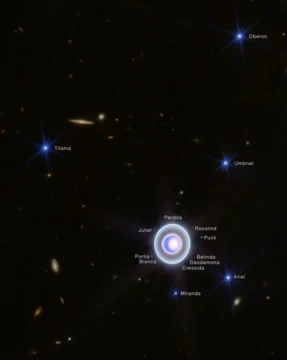
Puck (moon)
Largest inner moon of Uranus, discovered by Voyager 2.

Puck, the largest of Uranus’s inner moons and the sixth-largest overall, was spotted by the Voyager 2 spacecraft in December 1985. Its name comes from the mischievous sprite in Shakespeare’s *A Midsummer Night’s Dream*, continuing the tradition of naming Uranian moons after characters from the playwright’s works. The moon is roughly spherical, measuring about 162 km (101 mi) across, and its dark, heavily cratered surface bears spectral evidence of water ice.
- Discovery date
- December 1985
- Discoverer
- Voyager 2 spacecraft
- Diameter
- about 162 km (101 mi)
- Radius
- about 81 km (50 mi)
- Designation
- Uranus XV
- Geometric albedo
- approximately 10%
- Largest crater diameter
- about 45 km (28 mi)
Lore & Background
Puck was discovered from images taken by Voyager 2 on 30 December 1985, and given the temporary designation S/1985 U 1. It was later named after the character Puck from Shakespeare's A Midsummer Night's Dream, a little sprite who travels around the globe at night with the fairies. In Celtic mythology and English folklore, a Puck is a mischievous sprite, imagined as an evil demon by Christians. Of the moons discovered by the Voyager 2 imaging team, only Puck was discovered early enough that the probe could be programmed to image it in some detail.
Puck's orbit lies between the rings of Uranus and the first of Uranus's large moons, Miranda. Its surface is heavily cratered and grey in color, with three named craters: Bogle, Butz, and Lob, named after mischievous spirits from Scottish, German, and British folklore respectively. The surface is coated with a dark material similar to that found in the main rings, probably made of rocks or radiation-processed organics. Observations with the Hubble Space Telescope and large terrestrial telescopes found water-ice absorption features in its spectrum.
Little is known about Puck's internal structure. It is probably made of a mixture of water ice and rocks, and may have been collisionally disrupted and reaccreted as a rubble pile. The absence of craters with bright rays implies that Puck is not differentiated, meaning ice and non-ice components have not separated into a core and mantle. Puck, as well as the other inner satellites of Uranus, is darker than the average inner Neptunian satellite, which could be due to a higher level of solar irradiation at Uranus or a distinct composition.
Reader's Guide
Puck is notable as the largest inner moon of Uranus and the only moon discovered by Voyager 2 early enough for the probe to be programmed to image it in detail. Its discovery in December 1985 added to the understanding of Uranus's satellite system, which follows the convention of naming moons after Shakespearean characters. Puck's orbit between the rings of Uranus and Miranda places it in a unique region, and its surface composition—showing water ice and a dark coating similar to the rings—provides clues about the material exchange between rings and moons. The moon's heavily cratered surface and lack of differentiation suggest a primitive, unaltered body, possibly a rubble pile. Its darker appearance compared to Neptunian inner satellites raises questions about the effects of solar irradiation and composition differences in the outer solar system. Puck's three named craters, after mischievous spirits, continue the folklore theme of its name. Overall, Puck serves as a key object for studying the inner Uranian system and the processes shaping small icy moons.
Did You Know?
- Puck is the largest inner moon of Uranus, with a diameter of about 162 km.
- Puck's surface is coated with dark material similar to that found in Uranus's main rings.
Discovery and Shakespearean Heritage
Puck first entered humanity's awareness on 30 December 1985, when the Voyager 2 spacecraft captured images of the Uranian system during its flyby. Among all the moons the imaging team identified during that brief window, Puck was the only one spotted early enough for the probe's operators to reprogram the spacecraft and obtain detailed photographs. It was initially catalogued under the provisional label S/1985 U 1 before receiving its permanent identity. Following the long-standing tradition of drawing names for Uranus's satellites from Shakespeare's dramatic and poetic works, the moon was christened after the mischievous sprite in A Midsummer Night's Dream, a little fairy who darts around the globe at night. The name also echoes older Celtic and English folklore, where a Puck is a playful, sometimes malevolent trickster figure. In the International Astronomical Union's formal catalogue, Puck carries the designation Uranus XV, cementing its place as the eleventh confirmed satellite of the ice giant.
Size, Shape, and Orbital Neighborhood
At roughly 162 kilometers in diameter and 81 kilometers in radius, Puck holds the title of Uranus's largest inner satellite, sitting comfortably between the second-largest inner moon Portia and the smallest of the five major moons, Miranda. It ranks as the sixth-largest moon in the entire Uranian family. A single high-resolution frame from Voyager 2 proved detailed enough to measure the body's dimensions along all three axes, revealing a shape that is, within measurement uncertainty, essentially spherical. The equatorial axis ratio falls between 0.93 and 1.0, while the polar axis is at least 95 percent of the equatorial dimension. In terms of orbital position, Puck traces its path in the narrow gap between Uranus's ring system and the orbit of Miranda, making it the outermost of the inner satellites. This placement means it is bathed in material from the rings and sits just inside the gravitational domain of the larger moons.
A Dark, Cratered World with Hints of Ice
Puck presents a somber face to the cosmos. Its surface is grey, heavily pockmarked with impact craters, and reflects only about ten percent of the visible light that strikes it, making it a relatively dark body. Interestingly, the trailing hemisphere appears roughly ten percent brighter than the leading side. Three craters have been formally named—Bogle, Butz, and Lob—each honoring a mischievous spirit drawn from Scottish, German, and British folklore respectively. The largest of these measures approximately 45 kilometers across. Despite the overall darkness, observations from the Hubble Space Telescope and large ground-based instruments have detected absorption features in Puck's spectrum that point to the presence of water ice or hydrated minerals, including a distinctive 3.0-micron band associated with the O-H stretching vibration. The surface is also coated with a dark layer of material resembling that found in Uranus's main rings, likely composed of rocky debris or radiation-altered organic compounds. Notably, no bright-rayed craters have been observed, suggesting the moon has never undergone internal differentiation into separate ice and rock layers.
Internal Mysteries and the Ring-Moon Interface
Very little is known about what lies beneath Puck's battered exterior. The prevailing hypothesis is that the moon is a heterogeneous mix of water ice and rock, and it may have been shattered by an ancient impact and later reassembled into a rubble-pile structure rather than remaining a single coherent body. The lack of evidence for differentiation—no bright-rayed craters, no clear separation of ice from silicate material—supports the idea that Puck has never heated enough to sort its constituents into a core and mantle. Its darkness, which exceeds that of the average inner Neptunian satellite, may stem from the stronger solar irradiation it receives closer to the Sun than Neptune's moons, or from a genuinely different composition. Puck's orbit, nestled between the rings and Miranda, places it in a dynamic environment where material spiraling inward from the μ ring may periodically dust its leading hemisphere, further darkening an already shadowed world and blurring the boundary between ring particles and solid moon.
Frequently Asked Questions
What is Puck (moon)?
Puck is the largest of Uranus's inner moons and the sixth-largest in the entire Uranian satellite family. It is a roughly spherical body about 162 km (101 mi) across, with a dark, heavily cratered surface that spectral data links to water ice.
How was Puck discovered?
Puck was first identified by the Voyager 2 spacecraft during its flyby of Uranus in December 1985. No ground-based observations had detected the small moon before that single pass.
Why is it called Puck?
Uranus's moons are named after characters from Shakespeare's works, and Puck is the mischievous sprite from *A Midsummer Night's Dream*. The name continues that established naming tradition for the Uranian system.
What is Puck's official designation and how big is it?
Puck carries the formal designation Uranus XV and has a radius of roughly 81 km (50 mi). Its geometric albedo is only about 10%, making it a notably dark and low-reflectivity body.
What does Puck's surface look like?
Puck's surface is dark and densely pocked with impact craters, giving it a weathered, ancient appearance. Despite the overall darkness, spectroscopic readings reveal water ice mixed in with the surface material.
More in Moons of Uranus and Neptune 1-24
Spotted an error? Know more?
Reader corrections go straight into our review queue. Suggest an edit · How this site is sourced