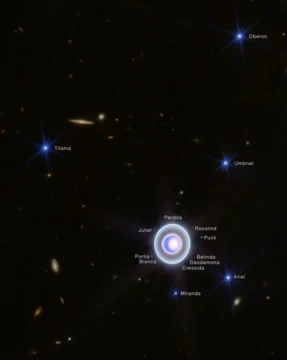
Mab (moon)
Source of Uranus's blue μ ring, a tiny icy moon.

Mab, also designated Uranus XXVI, is an inner satellite of Uranus discovered in 2003 using the Hubble Space Telescope. It is notable as the source of the μ ring, a dusty ring around Uranus, and is the outermost of the planet's inner moons. Its physical size is among the smallest of the Uranian satellites, and it likely has an ice-rich surface comparable to that of Miranda.
- Designation
- Uranus XXVI
- Discovery year
- 2003
- Discoverers
- Mark R. Showalter and Jack J. Lissauer
- Discovery telescope
- Hubble Space Telescope
- Temporary designation
- S/2003 U 1
- Orbital position
- between Puck and Miranda, outermost inner moon
- Radius range
- 6–12 km (inferred, depending on albedo)
Lore & Background
Mab was discovered by Mark R. Showalter and Jack J. Lissauer in 2003 using the Hubble Space Telescope. It was named after Queen Mab, a fairy queen from English folklore mentioned in William Shakespeare's play Romeo and Juliet. Because the moon is very small, it was not seen in images taken by Voyager 2 during its Uranus flyby in 1986, though it is brighter than another moon, Perdita, which was discovered from Voyager's photos in 1997. This led scientists to re-examine the old photos, and the satellite was finally found in the images. Following its discovery, Mab was given the temporary designation S/2003 U 1.
Mab orbits between the moons Puck and Miranda and is the outermost inner moon of Uranus. It orbits at the same distance from Uranus as the μ ring, a dusty ring discovered around the same time. The μ ring is blue in colour, attributed to the small size of the particles rather than the material's intrinsic colour, and is the only blue ring in the Solar System known other than Saturn's E Ring. Mab is presumably the source of this ring, likely composed of small water ice particles lifted off Mab's surface by micrometeoroid impacts. The moon is nearly the optimal size for dust production, as larger moons can recollect escaping dust and smaller moons have too small surface areas. No rings associated with Perdita and Cupid have been found, probably because Belinda limits the lifetimes of dust they generate. Mab's orbit was thought to be heavily perturbed, with its location shifting by 100 km in as little as six days, but later it was found that the apparent orbital variation was due to an instrumental error.
Mab's size is not precisely known and has not been measured; it is inferred by assuming the albedo to be similar to that of Puck or Miranda. If as dark as Puck (albedo 10%), it would be about 12 km in radius; if as bright as Miranda (albedo 46%), it would have a radius of 6 km. A 2006 study using the Keck telescope failed to detect Mab in the near-infrared (2.2 μm), hypothesizing it was covered in ice, making its radius 6–8 km. Another group in 2019 again failed to find Mab at ~1.6 μm, proposing that non-detection could be explained by water ice absorption bands. Infrared observations in 2023 finally detected Mab in the near-infrared with the Keck telescope, using the shift-and-stack method, favouring a 6 km radius body with a brighter, Miranda-like surface rich in water ice, though it could not fully exclude a 12 km radius body with a dark, Puck-like surface. Mab appears spectrally blue, like Miranda, indicative of water ice, and its spectral slope is the only one among the inner moons of Uranus similar to Miranda's.
Reader's Guide
Mab's significance lies in its role as the source of the μ ring, one of only two known blue rings in the Solar System (the other being Saturn's E Ring). The ring's blue colour is due to the small size of its particles, not intrinsic material colour, and Mab is considered nearly optimal for dust production: larger moons recollect escaping dust, while smaller moons lack sufficient surface area. This makes Mab a key object for understanding ring-moon interactions. Its discovery in 2003 using the Hubble Space Telescope, after being missed by Voyager 2, highlights the challenges of detecting small moons. The moon's size remains uncertain, with estimates ranging from 6 to 12 km in radius depending on albedo assumptions, and infrared observations favour a brighter, ice-rich surface similar to Miranda. Mab's spectral blueness and water ice signature further link it to Miranda, distinguishing it from other inner Uranian moons. The initial misinterpretation of its orbital perturbation as due to undetected moonlets, later corrected to an instrumental error, underscores the importance of careful data analysis. Overall, Mab provides insights into the composition and dynamics of Uranus's inner satellite system and the generation of planetary rings.
Did You Know?
- Mab was discovered in 2003 using the Hubble Space Telescope by Mark R. Showalter and Jack J. Lissauer.
- Mab is the source of the μ ring, the only blue ring in the Solar System other than Saturn's E Ring.
- Mab's size is uncertain: if as dark as Puck it would be about 12 km in radius, but if as bright as Miranda it would be about 6 km.
- Mab was not seen in Voyager 2 images from 1986, but was later found in those photos after its discovery.
Discovery in the Hubble Era
Mab joined the catalog of Uranian satellites in 2003, when astronomers using the Hubble Space Telescope identified it alongside another small inner moon, Cupid. This discovery came at the tail end of a long stretch of quiet in Uranus's satellite system. After Gerard Kuiper found Miranda in 1948, the next major wave of new moons arrived during the Voyager 2 flyby in January 1986, which revealed ten additional inner moons. A single satellite, Perdita, was later pulled from old Voyager imagery in 1999. Then came the Hubble findings of 2003. Following that, the system went silent again until 2024, when Scott Sheppard and colleagues announced an irregular moon from Subaru Telescope observations, and in 2025, Maryame El Moutamid's team revealed yet another inner moon in James Webb Space Telescope data. Mab's identification thus belongs to a brief, productive window in which space-based imaging finally resolved objects too faint for earlier ground-based surveys.
A Fairy Spirit's Name
When John Herschel assigned names to the four known Uranian moons in 1852, he deliberately bypassed Greek mythology in favor of magical spirits drawn from English literature. Oberon and Titania came from Shakespeare's A Midsummer Night's Dream, while Ariel and Umbriel were taken from Alexander Pope's The Rape of the Lock. This established a naming tradition rooted in the world of fairies, sylphs, and gnomes. As more moons were found, the convention shifted toward human characters from Shakespeare's plays, as seen with Miranda in 1949. Among the later additions, only Puck and Mab carried forward the original airy-spirits theme. Mab's name thus places it in a small, distinctive subset of Uranus's satellite family—one that harks back to the whimsical, otherworldly beings of early modern English verse rather than to the mortal figures who dominate the rest of the roster.
A Small Dark World
Mab belongs to the group of fourteen inner moons that orbit close to Uranus. These bodies are small and dark, and they share common physical properties and a common origin story with Uranus's ring system, suggesting they may be fragments or remnants tied to the same formative processes that built the rings. Unlike the five major moons—Titania, Oberon, Ariel, Umbriel, and Miranda—which are large enough to be ellipsoidal and show evidence of past geological activity such as canyon formation and volcanism, the inner moons like Mab lack any such internal complexity. They do not appear to have reached hydrostatic equilibrium, nor do they display surface features driven by internal heat. Mab's modest size and dark composition mark it as a relatively simple, undifferentiated body, more akin to a large ring particle than to a true planetary satellite with a differentiated interior.
Orbiting in a Sideways System
Like all of Uranus's inner and major moons, Mab follows a prograde orbit and is classified as a regular satellite. Its orbital plane lies nearly coplanar with Uranus's equator, which itself is tilted an extraordinary 97.77 degrees relative to the planet's orbital path around the Sun. This means that from a distant vantage point, Mab appears to circle a planet that is essentially rolling on its side, producing extreme seasonal illumination patterns across the Uranian system. This orbital architecture stands in sharp contrast to the ten irregular moons of Uranus, which trace distant, highly inclined, and predominantly retrograde paths. Mab's orderly, equatorial orbit places it firmly within the regular-moon category, binding its motion to the same primordial angular momentum that shaped Uranus's unusual axial tilt and the flat, ring-like geometry of its inner satellite family.
Frequently Asked Questions
What is Mab (moon)?
Mab, formally designated Uranus XXVI, is a tiny inner satellite of Uranus and the outermost member of that inner-moon group. It orbits between Puck and Miranda and ranks among the smallest known moons of the planet.
Who discovered Mab (moon) and how?
Mark R. Showalter and Jack J. Lissauer identified the moon in 2003 using images captured by the Hubble Space Telescope. It was first logged under the temporary label S/2003 U 1 before being given its permanent name.
What is Mab (moon)'s connection to Uranus's μ ring?
Mab is widely regarded as the gravitational shepherd that confines the dusty μ ring encircling Uranus. The ring's fine particles are thought to be debris generated by, or held in place by, the small moon's gravity.
Where does Mab (moon) sit in Uranus's moon system?
Mab orbits in a narrow band between Miranda and Puck, placing it at the outer edge of Uranus's inner satellite family. This position is what gives it the role of anchoring the μ ring.
What is Mab (moon) made of and how big is it?
Mab is one of the tiniest Uranian satellites, and its surface is likely dominated by water ice much like that seen on Miranda. Its extremely small size makes detailed surface mapping challenging with present-day instruments.
More in Moons of Uranus and Neptune 1-24
Spotted an error? Know more?
Reader corrections go straight into our review queue. Suggest an edit · How this site is sourced