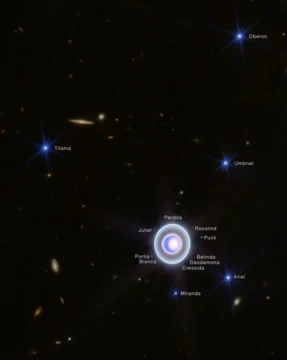
Cressida (moon)
Inner Uranian moon discovered by Voyager 2 in 1986.

Cressida is an inner satellite of Uranus, discovered from images taken by Voyager 2 on 9 January 1986. It is named after the Trojan daughter of Calchas, a tragic heroine in William Shakespeare's play Troilus and Cressida and in tales by Geoffrey Chaucer and others. Cressida is notable as one of the few small satellites of Uranus for which the mass has been directly measured, and it may collide with Desdemona within the next 100 million years.
- Discovery date
- 9 January 1986
- Temporary designation
- S/1986 U 3
- Designation
- Uranus IX
- Group
- Portia group
- Size
- 92 km × 74 km
- Geometric albedo
- 0.069
- Mass
- (1.839±0.212)×10^17 kg
Lore & Background
Cressida was discovered from images taken by Voyager 2 on 9 January 1986, and was given the temporary designation S/1986 U 3. It was named after Cressida, the Trojan daughter of Calchas, a tragic heroine who appears in William Shakespeare's play Troilus and Cressida (as well as in tales by Geoffrey Chaucer and others). It is also designated Uranus IX.
Cressida belongs to the Portia group of satellites, which includes Bianca, Desdemona, Juliet, Portia, Rosalind, Cupid, Belinda, and Perdita. These satellites have similar orbits and photometric properties. Other than its orbit, size of 92 km × 74 km, and geometric albedo of 0.069, little is known about it. In Voyager 2 imagery Cressida appears as an elongated object, with its major axis pointing towards Uranus. The ratio of axes of Cressida's prolate spheroid is 0.8 ± 0.3. Its surface is grey in color.
Cressida orbits close to a 3:2 resonance with the η ring, one of the rings of Uranus. Perturbations of the ring's shape provide a way to measure the mass of Cressida, which in 2024 was found to be (1.839±0.212)×10^17 kg. Cressida is one of the few small satellites of Uranus for which the mass has been directly measured. Cressida may collide with Desdemona within the next 100 million years.
Reader's Guide
Cressida's significance lies in its role as one of the few small Uranian satellites with a directly measured mass, determined in 2024 from perturbations of the η ring's shape caused by a 3:2 orbital resonance. This measurement provides a rare constraint on the density and internal structure of a small moon in the Uranian system. As a member of the Portia group, Cressida shares similar orbital and photometric properties with eight other satellites, suggesting a common origin or dynamical evolution. Its elongated shape, with a major axis pointing toward Uranus, and grey surface color were observed by Voyager 2. The potential collision with Desdemona within the next 100 million years highlights the dynamical instability of the inner Uranian satellite system. Despite limited knowledge beyond its orbit, size, and albedo, Cressida remains a key object for understanding the composition and history of Uranus's inner moon system.
Orbital Classification and Distinctive Trajectory
Cressida belongs to the group of ten irregular moons that orbit Uranus, a category that stands in sharp contrast to the planet's fourteen inner moons and five major satellites. While the regular moons—comprising both the inner and major groups—follow prograde paths that lie nearly in the same plane as Uranus's equator (itself tilted a dramatic 97.77 degrees relative to its orbital path), the irregular moons trace very different trajectories. Their orbits are characterized by large distances from the planet, high orbital inclinations, and predominantly retrograde motion, meaning they travel in the opposite direction to Uranus's rotation. These orbital signatures set them apart dynamically from the regular moons. The inner moons, for their part, are small and dark, sharing physical properties with Uranus's ring system, while the five major moons are ellipsoidal bodies that achieved hydrostatic equilibrium at some point in their history. Cressida, as an irregular satellite, occupies a distinctly separate dynamical niche within this layered architecture of twenty-nine known moons surrounding the planet.
A Product of the Ground-Based Telescope Era
Uranus held the distinction of being the last giant planet in the Solar System without any confirmed irregular moons until 1997, when astronomers using ground-based telescopes identified Sycorax and Caliban. That breakthrough opened a window of intensive searching, and from 1999 through 2003, more powerful ground-based instruments continued to sweep the skies around Uranus, yielding the discovery of seven additional irregular satellites. Cressida is one of those seven, a product of this concentrated observational campaign that expanded Uranus's known satellite family considerably. This era of discovery followed a long quiet period: after Gerard Kuiper identified Miranda in 1948, no new moons were found for nearly four decades until the Voyager 2 flyby in January 1986 revealed ten inner moons. The subsequent decades saw further additions, including Perdita in 1999, Cupid and Mab via the Hubble Space Telescope in 2003, and most recently S/2023 U 1 in 2024 and Uranus XXVIII in 2025. Cressida's discovery thus sits within a broader, accelerating pattern of finding ever-smaller and more distant companions to the ice giant.
A Name Drawn from the Literary Canon
The twenty-seven named moons of Uranus follow a naming convention established in 1852 by John Herschel, son of the discoverer of the planet. Rather than drawing from Greek or Roman mythology, the Uranian moons take their names from characters in William Shakespeare's plays and from Alexander Pope's poem The Rape of the Lock. The original four—Titania, Oberon, Ariel, and Umbriel—were chosen from A Midsummer Night's Dream and The Rape of the Lock, with Ariel also appearing in The Tempest. Subsequent names continued to pull from these same literary sources, with only Puck and Mab carrying forward the earlier theme of airy spirits. Cressida's name, like those of her fellow satellites, follows this established tradition of literary allusion, connecting a distant, faint satellite to a figure from English dramatic or poetic literature. This naming scheme gives Uranus's satellite family a distinctive cultural identity, embedding a thread of English literary heritage into the taxonomy of the outer Solar System and linking each small world to a character readers may recognize from the stage or the page.
One of Twenty-Nine: Cressida in the Broader System
Cressida is one of twenty-nine known moons orbiting Uranus, a number that reflects decades of increasingly sensitive observation. The system is organized into three distinct groups: fourteen small, dark inner moons that share common properties and origins with the planet's rings; five larger, ellipsoidal major moons that reached hydrostatic equilibrium and show evidence of internally driven geological processes such as canyon formation and volcanism; and ten irregular moons like Cressida, whose distant, inclined, and mostly retrograde orbits set them apart. The largest of the major moons, Titania, measures 1,578 kilometers in diameter and ranks as the eighth-largest moon in the entire Solar System, with roughly one-twentieth the mass of Earth's Moon. The discovery timeline spans nearly two and a half centuries, from Herschel's 1787 identification of Titania and Oberon through the 2025 announcement of Uranus XXVIII. Cressida occupies a small but meaningful place in this richly diverse family, representing the outermost, most dynamically distinct tier of Uranus's satellite system.
Frequently Asked Questions
What is Cressida (moon)?
Cressida is a small inner satellite of Uranus, officially designated Uranus IX, and it belongs to the Portia group of moons. It measures roughly 92 by 74 kilometers across.
How was Cressida discovered?
Voyager 2 captured images of Cressida on 9 January 1986 during its flyby of the Uranian system. It was initially catalogued under the temporary designation S/1986 U 3 before receiving its permanent name.
Where does Cressida's name come from?
The moon takes its name from Cressida, the Trojan daughter of the seer Calchas, a tragic heroine in Shakespeare's Troilus and Cressida. The character also appears in works by Geoffrey Chaucer and other earlier storytellers.
What makes Cressida notable among Uranus's moons?
Cressida is one of the few small Uranian satellites whose mass has been directly measured, a distinction that sets it apart from many of its neighbors. Orbital projections also suggest it could collide with the moon Desdemona within roughly 100 million years.
What are Cressida's physical characteristics?
Cressida has a very low geometric albedo of about 0.069, meaning it reflects only a small fraction of the sunlight that strikes it. Its irregular shape spans approximately 92 by 74 kilometers, consistent with other small inner Uranian moons.
More in Moons of Uranus and Neptune 1-24
Spotted an error? Know more?
Reader corrections go straight into our review queue. Suggest an edit · How this site is sourced