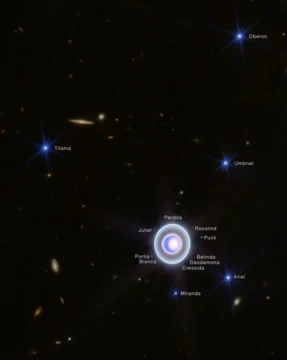
Belinda (moon)
Inner Uranian moon discovered by Voyager 2 in 1986.

Belinda is one of Uranus’s inner moons. It was first spotted in images captured by Voyager 2 on January 13, 1986, and initially labeled S/1986 U 5. The moon takes its name from the heroine of Alexander Pope’s poem *The Rape of the Lock*, and it is also known as Uranus XIV.
Belinda is part of the Portia group, a cluster of satellites that includes Bianca, Cressida, Desdemona, Portia, Juliet, Cupid, Rosalind, and Perdita. All these moons share similar orbits and photometric characteristics. Within this group, Belinda orbits especially close to Cupid and Perdita.
Not much is known about Belinda beyond its orbit, its dimensions—128 km by 64 km (80 mi by 40 mi)—and its geometric albedo of 0.067. Voyager 2 images show it as an elongated body, with its long axis pointing toward Uranus. The moon is quite stretched: its short axis is only 0.5 ± 0.1 times the length of its long axis. Its surface appears grey.
Belinda is locked in a stable 44:43 mean-motion resonance with Perdita. From this resonance, its mass has been estimated to be about 26 or 27 times that of Perdita.
The Portia group is unstable over timescales of a few million years. A 2012 study suggested that Belinda and Cupid would likely be the first pair of moons to collide, within 100,000 to 10 million years, depending on the densities of the group’s satellites, due to resonant interactions with the much smaller Cupid. However, a later analysis in 2022 indicated that Cupid’s orbit is protected by the 44:43 resonance between Belinda and Perdita, so Cupid might survive for at least 50 million years. Contradicting that, another 2022 study found that Belinda and Perdita were not in resonance, and that Cupid is unlikely to survive the next 50,000 years. A 2026 study then concluded that Belinda and Perdita are indeed in resonance.
- Discovery date
- 13 January 1986
- Discovery mission
- Voyager 2
- Temporary designation
- S/1986 U 5
- Permanent designation
- Uranus XIV
- Group
- Portia group
- Size
- 128 km × 64 km (80 mi × 40 mi)
- Geometric albedo
- 0.067
- Mass ratio to perdita
- roughly 26 or 27 times that of Perdita
Lore & Background
Belinda is an elongated object, with Voyager 2 images showing its major axis pointing towards Uranus. The moon is very elongated, with its short axis 0.5 ± 0.1 times the long axis. Its surface is grey in color. Other than its orbit, size, and geometric albedo of 0.067, little is known about it.
Belinda orbits particularly closely to Cupid and Perdita. It is in a stable 44:43 mean-motion resonance with Perdita, and from this its mass has been determined to be roughly 26 or 27 times that of Perdita. The Portia group is unstable over timescales of several millions of years.
A 2012 study found that Belinda and Cupid will probably be the first pair of moons to collide, in 100,000 to 10 million years' time depending on the densities of the Portia-group satellites, due to resonant interactions with the much smaller Cupid. However, a later analysis in 2022 indicated that Cupid's orbit is protected by the 44:43 orbital resonance between Belinda and Perdita, so it is likely to survive for at least 50 million years. Contradicting this, another study in 2022 found that Belinda and Perdita were not in the resonance, and that Cupid is not likely to survive the next 50,000 years. Another study in 2026 found that Belinda and Perdita were indeed in resonance.
Reader's Guide
Belinda's significance lies in its role within the Portia group of Uranian inner satellites, a set of moons with similar orbits and photometric properties. Its discovery by Voyager 2 in 1986 added to the known inventory of Uranus's small moons. The moon's elongated shape and grey surface color, as seen in Voyager 2 images, provide limited but valuable data about the physical characteristics of these inner satellites.
The moon's most notable legacy is its contested orbital dynamics. The 44:43 mean-motion resonance with Perdita has been used to determine Belinda's mass relative to Perdita. However, studies disagree on the stability and future of the system: a 2012 study predicted a collision between Belinda and Cupid within 100,000 to 10 million years, while a 2022 analysis argued that Cupid's orbit is protected by the Belinda–Perdita resonance, extending its survival to at least 50 million years. Another 2022 study contradicted the existence of that resonance and predicted Cupid's demise within 50,000 years, while a 2026 study reaffirmed the resonance. This ongoing debate highlights the complexity of modeling the long-term evolution of tightly packed moon systems and underscores Belinda's importance as a test case for orbital stability theories.
Did You Know?
- Belinda was discovered from Voyager 2 images taken on 13 January 1986.
- It is named after the heroine of Alexander Pope's The Rape of the Lock.
Physical Nature and Shared Origins
Belinda belongs to the group of fourteen inner moons orbiting Uranus, a collection of small, dark celestial bodies that share both common physical properties and a common origin story with the planet's ring system. Unlike the five major moons, which are ellipsoidal and show evidence of having reached hydrostatic equilibrium along with signs of internal geological activity such as canyon formation and volcanism, Belinda and her inner-moon companions are far more modest in scale and character. They are not the large, rounded bodies that dominate Uranus's satellite family; rather, they occupy a distinct category of small, dark objects whose formation is intertwined with the rings. This shared provenance with ring material sets the inner moons apart from both the major satellites and the ten distant, irregular moons, placing Belinda in a unique niche within Uranus's twenty-nine known satellites.
Orbital Architecture
As a regular moon, Belinda follows a prograde orbit that lies nearly in the same plane as Uranus's equator. This is a defining feature shared by all inner and major moons of the planet, distinguishing them sharply from the ten irregular satellites, whose orbits are distant, highly inclined, and predominantly retrograde. The near-coplanar alignment of Belinda's path with the equatorial plane is itself remarkable because Uranus's equator is tilted a staggering 97.77 degrees relative to its orbital plane around the Sun. In practical terms, this means Belinda's orbit is almost perpendicular to the ecliptic, a direct consequence of Uranus's extreme axial tilt. This orbital geometry places Belinda firmly in the regular-moon category, grouping it with the other thirteen inner moons and the five major satellites, all of which share this prograde, equator-aligned orbital architecture.
Discovery Era and Observational Context
Belinda's identification as a satellite of Uranus falls within the broader wave of discoveries that transformed our understanding of the planet's moon system after 1985. Prior to that era, only the five large, ellipsoidal moons were known: Titania and Oberon spotted by William Herschel in 1787, Ariel and Umbriel found by William Lassell in 1851, and Miranda located by Gerard Kuiper in 1948. The remaining inner moons, including Belinda, were uncovered either during the Voyager 2 flyby mission in January 1986 or through the use of increasingly powerful Earth-based telescopes in the years that followed. This discovery window marked a dramatic expansion of Uranus's known satellite count, revealing a population of small inner moons invisible to earlier, less capable instruments. The era also saw the identification of additional inner satellites such as Perdita in 1999 and Cupid and Mab in 2003, underscoring how much remained hidden until modern observational technology caught up.
Literary Naming Tradition
Belinda's name, like those of all twenty-seven named Uranian moons, draws from the literary world rather than classical mythology. The naming convention was established by John Herschel in 1852, when he assigned the first four moons their titles from William Shakespeare's A Midsummer Night's Dream (Oberon, Titania) and Alexander Pope's The Rape of the Lock (Ariel, Umbriel). Rather than reaching for Greek or Roman figures, Herschel chose magical spirits from English literature, setting a precedent that subsequent discoverers largely followed. Later names continued to mine these two source texts, with Gerard Kuiper naming the fifth moon Miranda after a human character in Shakespeare's The Tempest in 1949. Belinda thus occupies a place in a naming tradition that deliberately evokes the fairy and spirit worlds of Shakespeare and Pope, connecting a small, dark satellite orbiting a tilted gas giant to the imaginative landscapes of early modern English poetry and drama.
Frequently Asked Questions
What is Belinda (moon)?
Belinda is a small inner satellite of Uranus, officially catalogued as Uranus XIV. It was first identified in Voyager 2 imagery in January 1986 and later given its permanent name.
How was Belinda discovered?
The moon was spotted in photographs captured by the Voyager 2 spacecraft on January 13, 1986, during its flyby of the Uranian system. It was initially assigned the provisional label S/1986 U 5 before receiving its official designation.
What is the Portia group, and does Belinda belong to it?
The Portia group is a family of eight inner Uranian moons that share nearly identical orbital parameters and surface brightness. Belinda is a member of this cluster and orbits in close proximity to Cupid and Perdita.
How big is Belinda compared to other moons?
Belinda measures roughly 128 by 64 kilometres, making it a small, elongated body. It is comparable in size to its fellow Portia-group companions, all of which are relatively minor satellites.
Where does the name 'Belinda' come from?
The moon is named after the central character in Alexander Pope's 1712 mock-heroic poem *The Rape of the Lock*. Like several other Uranian moons, it bears a name drawn from 18th-century English literature.
More in Moons of Uranus and Neptune 1-24
Spotted an error? Know more?
Reader corrections go straight into our review queue. Suggest an edit · How this site is sourced