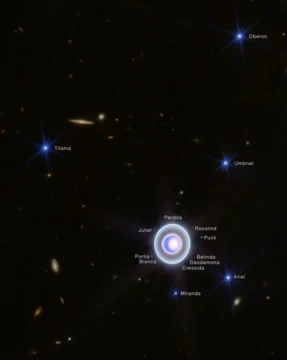
Perdita (moon)
A small Uranian moon with a complicated discovery history.

Perdita is a small inner satellite of Uranus. Its discovery was notably complicated: first photographed by the Voyager 2 spacecraft in 1986, it was not recognized from those images for more than a decade. It was noticed and reported by Erich Karkoschka in 1999, but because no further pictures could be taken to confirm its existence, it was officially demoted in 2001. In 2003, pictures from the Hubble Space Telescope finally confirmed its existence.
- Discovery year
- 1999
- Discoverer
- Erich Karkoschka
- Temporary designation
- S/1986 U 10
- Designation
- Uranus XXV
- Orbital position
- between Belinda and Puck
- Estimated radius
- 13.3 km
- Group
- Portia group
Lore & Background
Perdita's discovery was very complicated. The first photographs were taken by the Voyager 2 spacecraft in 1986, but the moon was not recognized from them for more than a decade. In 1999, Erich Karkoschka noticed it and reported it, leading to the temporary designation S/1986 U 10. However, because no further pictures could be taken to confirm its existence, it was officially demoted in 2001. In 2003, the Hubble Space Telescope managed to pick up an object where Perdita was supposed to be, finally confirming its existence.
Perdita was named after the daughter of Leontes and Hermione in William Shakespeare's play The Winter's Tale; Perdita is Latin for 'lost'. The moon orbits between Belinda and Puck. Hubble measurements showed that Perdita does not follow a direct Keplerian motion around Uranus; instead, it is caught in a 43:44 orbital resonance with Belinda, from which Belinda's mass was determined to be roughly 26 or 27 times that of Perdita. It is also close to an 8:7 resonance with Rosalind. A 2022 study found that Perdita and Belinda were not actually in resonance, but two other studies contradicted this, finding that the resonance does exist and is stable.
Perdita belongs to the Portia group of satellites, which also includes Bianca, Cressida, Desdemona, Portia, Juliet, Cupid, Rosalind, and Belinda. These satellites have similar orbits and photometric properties. Little is known about Perdita apart from its orbit and intrinsic brightness. By assuming its geometric albedo is similar to that of the other Portia group members, its radius can be estimated at 13.3 km.
Reader's Guide
Perdita's significance lies in its unusual discovery history and its role in understanding the dynamics of Uranus's inner moon system. Its initial detection in Voyager 2 images from 1986, followed by a decade of unrecognized existence, then a brief promotion and demotion before final confirmation by the Hubble Space Telescope in 2003, illustrates the challenges of identifying small moons from limited data. The moon's orbital resonance with Belinda (43:44) and its proximity to an 8:7 resonance with Rosalind have made it a subject of dynamical studies. The dispute over whether the resonance with Belinda actually exists—with one 2022 study contradicting it and two others supporting its stability—highlights ongoing scientific debate. As a member of the Portia group, Perdita shares similar orbital and photometric properties with eight other inner Uranian satellites, and its estimated radius of 13.3 km, derived from assumed albedo, provides a baseline for understanding the group's physical characteristics. Its name, meaning 'lost' in Latin and taken from Shakespeare, fittingly reflects its lost-and-found discovery story.
Did You Know?
- Perdita was first photographed by Voyager 2 in 1986 but not recognized until 1999.
- It was officially demoted in 2001 before being confirmed by the Hubble Space Telescope in 2003.
- Perdita is in a 43:44 orbital resonance with the moon Belinda, though a 2022 study disputed this.
- Its name, meaning 'lost' in Latin, comes from a character in Shakespeare's The Winter's Tale.
Discovery from Archival Imagery
Perdita's identification came not from a fresh observation but from a careful re-examination of existing data. In January 1986, the Voyager 2 space probe flew past Uranus, capturing images that would later reveal ten additional inner moons. One of those satellites, however, eluded detection at the time. It was not until 1999 that Erich Karkoschka, working through old Voyager photographs, identified the small body. This pattern of delayed recognition highlights how the Uranian system continued to yield surprises long after the flyby. Further inner moons such as Cupid and Mab were not confirmed until 2003 via the Hubble Space Telescope, and a new inner moon, designated Uranus XXVIII, surfaced in James Webb Space Telescope imagery in 2025. Perdita's story thus sits within a broader narrative of incremental revelation, in which each successive generation of instruments and analytical techniques peels back another layer of the planet's satellite family, ensuring that even decades-old data can still produce a first discovery.
Classification and Physical Character
Perdita belongs to the group of fourteen inner moons that orbit close to Uranus. These small, dark bodies are thought to share a common origin with the planet's ring system, a distinction that sets them apart from the five larger, ellipsoidal moons that may have achieved hydrostatic equilibrium at some point in their history. Like all regular Uranian moons, Perdita follows a prograde orbit lying nearly in the plane of Uranus's equator, a plane tilted a remarkable 97.77 degrees relative to the planet's orbital path around the Sun. This extreme axial tilt means the inner moons trace paths almost perpendicular to the ecliptic, a geometry unlike anything in the other major planetary systems. The inner moons' dark surfaces and modest sizes contrast sharply with the five major satellites, four of which display evidence of geological activity such as canyon formation and volcanism. Perdita, by contrast, is a small and unremarkable body in appearance, yet its existence enriches the overall picture of how material in Uranus's immediate vicinity has evolved over billions of years.
A Literary Naming Tradition
The naming of Uranus's moons carries a distinctive literary pedigree that sets it apart from most other planetary satellite families. In 1852, John Herschel, son of the discoverer of the planet, assigned the first four moons their names, drawing not from Greek mythology but from English literature. Oberon and Titania came from Shakespeare's A Midsummer Night's Dream, while Ariel and Umbriel were taken from Alexander Pope's The Rape of the Lock. When Gerard Kuiper named the fifth major moon Miranda in 1949, he continued the Shakespearean thread, choosing a human character from The Tempest. The broader convention of sourcing names from Shakespeare's plays and Pope's poem has governed the naming of all twenty-seven named Uranian moons to date. Perdita fits squarely within this tradition, following the established pattern of drawing from the English literary imagination rather than the classical mythological reservoir used for Jupiter's and Saturn's satellites, anchoring the entire Uranian family in a distinctly British cultural context.
A Slowly Assembled Inventory
The Uranian satellite system represents one of the most gradually assembled inventories in Solar System science. William Herschel spotted the first two moons, Titania and Oberon, in 1787, and for nearly half a century his instrument remained the only one capable of confirming them. William Lassell added Ariel and Umbriel in 1851, and Gerard Kuiper found Miranda in 1948. Then came a gap of nearly four decades before Voyager 2's 1986 flyby revealed ten additional inner moons. Perdita's 1999 identification from those same Voyager images, followed by the Hubble discoveries of Cupid and Mab in 2003, and the James Webb detection of a new inner moon in 2025, illustrate that the system is still not fully catalogued. The twenty-nine known moons, spanning fourteen inner, five major, and ten irregular, cover a vast range of orbital characteristics, from the tight equatorial paths of the inner group to the distant, mostly retrograde, highly inclined orbits of the irregulars first found in 1997.
Frequently Asked Questions
What is Perdita (moon)?
Perdita is a tiny inner satellite of Uranus with an estimated radius of about 13.3 km, carrying the official designation Uranus XXV. It belongs to the group of small moons that circle close to the planet.
How was Perdita discovered?
The moon was first captured in Voyager 2 images during the 1986 flyby but went unnoticed for over a decade. Erich Karkoschka finally identified it in those archived photographs in 1999, and it was initially given the temporary label S/1986 U 10.
Why was Perdita demoted in 2001 and later restored?
After the 1999 identification, no new imagery could be obtained to verify the object, so its confirmed status was revoked in 2001. Hubble Space Telescope pictures taken in 2003 provided the independent confirmation that brought Perdita back onto the official list.
Where does Perdita orbit among Uranus's moons?
Perdita travels in an orbit positioned between Belinda and Puck, placing it squarely within Uranus's cluster of small inner satellites. Its roughly 13.3 km radius makes it comparable in size to its immediate neighbors in that region.
Why is Perdita's discovery story considered unusual?
A thirteen-year gap between the original photographs and their recognition, followed by a formal demotion and then a later vindication, gives Perdita one of the most dramatic lost-and-found histories in the Uranian system. Few other moons have endured that full cycle of identification, removal, and reconfirmation.
More in Moons of Uranus and Neptune 1-24
Spotted an error? Know more?
Reader corrections go straight into our review queue. Suggest an edit · How this site is sourced