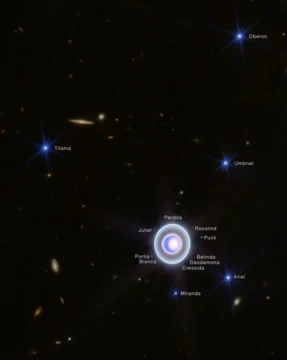
Cupid (moon)
Small Uranian moon with a disputed orbital fate.

Cupid is an inner satellite of Uranus, discovered in 2003 by Mark R. Showalter and Jack J. Lissauer using the Hubble Space Telescope. It is one of the smaller known inner Uranian moons and belongs to the Portia group, a set of satellites that orbit very close together and share similar physical properties. Cupid is notable for its potentially unstable orbit, which has been the subject of conflicting studies regarding its likelihood of colliding with the larger moon Belinda.
- Discovery year
- 2003
- Discoverers
- Mark R. Showalter and Jack J. Lissauer
- Temporary designation
- S/2003 U 2
- Designation
- Uranus XXVII
- Diameter
- about 17.8 km
- Orbital separation from belinda
- 863 km
- Age
- at most 500 million years
Lore & Background
Cupid was discovered in 2003 by Mark R. Showalter and Jack J. Lissauer using the Hubble Space Telescope. Following its discovery, it received the temporary designation S/2003 U 2 and is also designated Uranus XXVII. It was named after a character in William Shakespeare's play Timon of Athens. Cupid orbits within the Portia group, a set of moons that orbit very close together and have similar physical properties. Its orbit is particularly close to Belinda and Perdita, separated by only 863 km from the orbit of the larger moon Belinda.
Cupid is thought to have one of the least stable orbits of Uranus's inner moons. A 2012 study deemed it likely to collide with Belinda in the next 100,000–10 million years due to resonance interactions. However, a later analysis in 2022 indicated that Cupid's orbit is protected by a 44:43 orbital resonance between Belinda and Perdita, suggesting it could survive for at least 50 million years. Contradicting this, another study in 2022 found that Belinda and Perdita were not in that resonance, and that Cupid is not likely to survive the next 50,000 years.
Cupid is one of the smaller known inner Uranian satellites, crudely estimated to be only about 17.8 km in diameter, assuming its geometric albedo is the same as other Portia group moons. Its faintness made it too dim to be detected by the Voyager 2 cameras during its Uranus flyby in 1986. Cupid's trailing side is 2.3 times brighter than its leading side. The moon is at most 500 million years old.
Reader's Guide
Cupid's significance lies in its status as one of the smallest known inner Uranian satellites and its membership in the Portia group, a tightly packed cluster of moons with similar physical properties. Its discovery in 2003 using the Hubble Space Telescope highlighted the ability of advanced telescopes to detect faint objects that eluded the Voyager 2 flyby in 1986. The moon's orbital dynamics have drawn particular attention due to conflicting studies about its stability. A 2012 study predicted a collision with Belinda within 100,000 to 10 million years, but a 2022 analysis suggested a protective 44:43 resonance between Belinda and Perdita could extend Cupid's survival to at least 50 million years. However, another 2022 study contradicted this, finding no such resonance and estimating a collision within 50,000 years. This unresolved dispute underscores the complexity of orbital mechanics in Uranus's inner moon system. Cupid's legacy is also tied to its naming from Shakespeare's Timon of Athens, continuing the tradition of naming Uranian moons after literary characters. Its estimated age of at most 500 million years and its brightness asymmetry—its trailing side being 2.3 times brighter than its leading side—provide clues about its surface composition and history.
Discovery Through the Hubble Space Telescope
Cupid was identified in 2003 as part of a pair of small inner satellites found using the Hubble Space Telescope, the other being Mab. This detection came at the tail end of a productive stretch for Uranus's satellite system, during which astronomers had been searching with increasingly powerful ground-based instruments from 1999 onward, yielding seven additional irregular moons. The Hubble-based detection of Cupid and Mab represented a different observational approach, leveraging the space telescope's resolution to spot faint objects close to the planet. Prior to this, the most recent inner-moon find had been Perdita in 1999, when Erich Karkoschka re-examined archival Voyager photographs. Before that, the major wave of inner-moon discoveries had come during the Voyager 2 flyby in January 1986, which revealed ten additional small satellites. Cupid's identification thus extended a long chain of incremental discoveries that began with William Herschel's 1787 detection of Titania and Oberon, with no new inner moons found for nearly a century between Lassell's 1851 work and Kuiper's 1948 finding of Miranda.
Physical Character and Orbital Behavior
Cupid belongs to the group of fourteen small inner moons that orbit close to Uranus, and it shares the defining traits of this family: it is a small, dark body whose composition and origin are closely linked to the planet's ring system. Unlike the five major moons, which are ellipsoidal in shape, suggesting they once achieved hydrostatic equilibrium and may still be doing so, with four of them showing evidence of internally driven geological activity such as canyon formation and volcanism, Cupid is far more modest in size and lacks any indication of such dynamic processes. Its orbit is prograde, meaning it circles Uranus in the same direction the planet rotates, and it is classified as a regular moon. The orbital plane of all regular moons, including Cupid, lies nearly coplanar with Uranus's equator. This is a remarkable geometric arrangement given that Uranus's equator itself is tilted approximately 97.77 degrees relative to its orbital path around the Sun, meaning Cupid's orbit is essentially sideways relative to the ecliptic.
Naming and Literary Heritage
Cupid carries its name as part of a distinctive naming tradition unique to Uranus's satellite system. Of the 29 known moons, 27 bear names drawn not from Greek or Roman mythology but from English literary sources, specifically characters in William Shakespeare's plays and Alexander Pope's poem The Rape of the Lock. This convention was established in 1852 by John Herschel, son of the discoverer of Uranus, who assigned the names Oberon and Titania, fairies from A Midsummer Night's Dream, and Ariel and Umbriel, a sylph and a gnome from The Rape of the Lock, to the four moons known at the time. Subsequent discoveries continued to draw from these same literary wellsprings, with later names like Miranda, a human character from The Tempest named by discoverer Gerard Kuiper in 1949, and the fairy-spirit names Puck and Mab extending the theme. Cupid, like its fellow inner-moon companions, takes its identity from this rich tapestry of English literature, linking a small dark satellite orbiting a distant ice giant to the imaginative worlds of Shakespeare and Pope.
Cupid's Place Among Uranus's Twenty-Nine Moons
Cupid is one of fourteen inner moons in Uranus's satellite family, which also includes five major moons and ten irregular moons, bringing the total to twenty-nine. The inner moons, including Cupid, are the smallest and darkest members of the system, sharing physical properties and a common origin with Uranus's rings. The five major moons, Titania, Oberon, Ariel, Umbriel, and Miranda, are dramatically different: they are ellipsoidal, large enough to have reached hydrostatic equilibrium, and four of them display surface features like canyons and volcanic activity driven by internal heat. Titania, the largest, spans 1,578 kilometers and ranks as the eighth-largest moon in the Solar System, though it is still only about one-twentieth the mass of Earth's Moon. The ten irregular moons occupy a completely different orbital regime, with distant, highly inclined, and mostly retrograde paths, unlike the prograde, nearly equatorial orbits of Cupid and its inner-moon peers. This three-tiered structure of inner, major, and irregular satellites makes Uranus's system one of the most architecturally diverse in the Solar System.
Frequently Asked Questions
What is Cupid (moon)?
Cupid is a tiny inner satellite of Uranus, roughly 17.8 kilometers in diameter, officially designated Uranus XXVII. Before receiving its mythological name, it carried the provisional label S/2003 U 2.
How was Cupid discovered?
Astronomers Mark R. Showalter and Jack J. Lissauer identified Cupid in 2003 using observations from the Hubble Space Telescope. It was found as part of a tight cluster of small moons orbiting close together in Uranus's inner satellite region.
Is Cupid's orbit stable, or will it crash into Belinda?
Cupid orbits only about 863 kilometers from the larger moon Belinda, and some studies have suggested its path is unstable enough to eventually produce a collision. Other analyses have disputed that prediction, so the moon's long-term orbital fate remains genuinely unresolved.
What is the Portia group, and does Cupid belong to it?
The Portia group is a set of small inner Uranian moons that share similar sizes, compositions, and closely spaced orbits. Cupid is a member of this group, circling Uranus in the crowded neighborhood of these companion satellites.
Why do astronomers care about a moon as small as Cupid?
Cupid's tight orbital spacing relative to Belinda makes it a natural laboratory for testing how closely packed satellite systems behave over time. Its potentially unstable trajectory offers a concrete case for studying the long-term evolution of Uranus's inner moon family.
More in Moons of Uranus and Neptune 1-24
Spotted an error? Know more?
Reader corrections go straight into our review queue. Suggest an edit · How this site is sourced