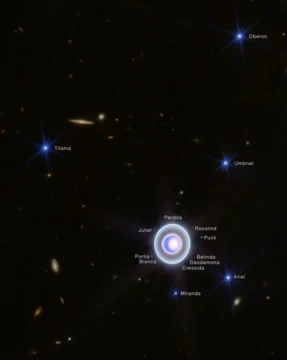
Sycorax (moon)
Largest irregular moon of Uranus, discovered in 1997.

Sycorax is the largest irregular moon of Uranus, with a diameter of approximately 157 km. It was discovered on 6 September 1997 using the 200-inch Hale Telescope in California, and is notable for its retrograde, irregular orbit far beyond Uranus's regular moons.
- Designation
- Uranus XVII
- Discovery date
- 6 September 1997
- Discoverers
- Brett J. Gladman, Philip D. Nicholson, Joseph A. Burns, JJ Kavelaars
- Diameter
- approximately 157 km
- Orbital type
- retrograde, irregular
- Rotation period
- estimated 6.9 hours
- Color
- light-red in visible spectrum
Lore & Background
Sycorax was discovered by Brett J. Gladman, Philip D. Nicholson, Joseph A. Burns, and JJ Kavelaars using the 200-inch Hale Telescope, together with Caliban. It was given the temporary designation S/1997 U 2 and later officially confirmed as Uranus XVII, named after Sycorax, Caliban's mother in William Shakespeare's play The Tempest. The name was approved by the IAU no later than March 1999.
Sycorax follows a distant orbit more than 20 times further from Uranus than the furthest regular moon, Oberon. Its orbit is retrograde, moderately inclined and eccentric. The orbital parameters suggest it may belong, together with Setebos and Prospero, to the same dynamic cluster, implying a common origin, though Sycorax has a much redder color than the other moons, which tend to be gray.
The diameter of Sycorax is estimated at 157 km based on thermal emission data from the Herschel Space telescopes, making it the largest irregular satellite of Uranus, comparable in size with Puck and with Himalia, the biggest irregular satellite of Jupiter. It is the seventh largest moon of Uranus. The satellite appears light-red in the visible spectrum, redder than Himalia but still less red than most Kuiper belt objects. In the near infrared, the spectrum turns blue between 0.8 and 1.25 μm and becomes neutral at longer wavelengths. Its rotation period is estimated at 6.9 hours, causing periodic variations in visible magnitude with an amplitude of 0.12. The rotation axis is unknown, though light curve measurements suggest it is likely being viewed from Earth at a near equator-on configuration.
Reader's Guide
Sycorax is significant as the largest irregular moon of Uranus, providing insight into the capture processes that may have brought it into orbit around the planet. Its retrograde, distant orbit suggests it did not form with Uranus but was captured, though the exact capture mechanism remains unknown—possible processes include gas drag in the protoplanetary disk, many-body interactions, or capture during the rapid growth of Uranus's mass. The moon's redder color compared to other irregular moons in its proposed dynamic cluster (Setebos and Prospero) hints at a distinct origin or surface composition. Sycorax has not been imaged up close by any space probe; all observations have been limited to Earth-based telescopes since its discovery. Its study contributes to understanding the population of irregular satellites in the outer solar system and the history of Uranus's satellite system.
More in Moons of Uranus and Neptune 1-24
Spotted an error? Know more?
Reader corrections go straight into our review queue. Suggest an edit · How this site is sourced