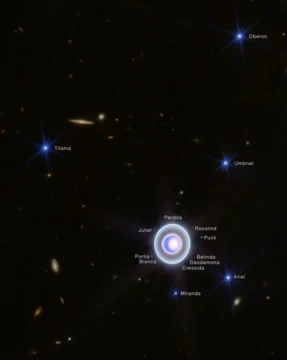
Stephano (moon)
Irregular moon of Uranus, member of the Caliban group.

Stephano (Uranus XX, formerly S/1999 U 2) is an irregular moon of Uranus. Discovered on 18 July 1999 by Brett J. Gladman and his team, it was named after the drunken butler from Shakespeare's *The Tempest*. It belongs to the Caliban group, the first recognized cluster of irregular Uranian moons with similar orbits.
The moon orbits Uranus at an average distance of roughly 8 million km (5.0 million mi), completing one lap every 677 Earth days (about 1.8 Earth years). Its orbit is retrograde, with an inclination near 144° and an eccentricity of 0.200. These orbital elements shift over time due to solar and planetary gravitational pulls. The Caliban group's orbits range from 7–8 million km (4.3–4.9 million mi) with inclinations between 141–144°.
Physical details are scarce. Assuming a low albedo of 0.04, typical of other Uranian irregulars, its brightness suggests a diameter of about 32 km (20 mi). In visible light, Stephano appears reddish, with color indices B–V = 0.97 ± 0.07 and V–R = 0.66 ± 0.05, nearly as red as many trans-Neptunian objects. It may be redder than Caliban and Sycorax, but more observations are needed to confirm.
Stephano likely did not form near Uranus but was captured later. As a Caliban group member, it is thought to be a fragment of a larger parent body shattered by a collision, forming a collisional family.
No space probe has imaged Stephano up close. The proposed Uranus Orbiter and Probe (UOP) plans to observe all Uranian irregular moons from a distance, measuring their rotation periods and shapes by monitoring brightness changes. However, a close flyby of Stephano is unlikely because its orbit lies far from the ecliptic plane.
- Discovery date
- 18 July 1999
- Discoverer
- Brett J. Gladman et al.
- Provisional designation
- S/1999 U 2
- Permanent designation
- Uranus XX
- Mean orbit distance
- about 8 million km (5.0 million mi)
- Orbital period
- about 677 Earth days (1.8 Earth years)
- Estimated diameter
- 32 km (20 mi)
Lore & Background
Stephano was discovered on 18 July 1999, together with Prospero and Setebos, by Brett J. Gladman et al. When the discovery was announced, it was given the temporary provisional designation S/1999 U 2 by the Minor Planet Center. It was later named and given the Roman numeral designation Uranus XX by the International Astronomical Union's Working Group for Planetary System Nomenclature on 21 August 2000. The moon was named after the drunken butler in William Shakespeare's play The Tempest.
Stephano orbits Uranus at a mean distance of approximately 8 million km and completes one revolution in about 677 days. Its orbit is retrograde, moderately inclined with an inclination of approximately 144° and eccentricity of 0.200. Its orbital elements are subject to continuous variations caused by solar and planetary perturbations. It is a member of the Caliban group, which orbits Uranus at orbital distances between 7–8 million km and inclinations between 141–144°.
Very little is known about its physical properties. Assuming Stephano has a low albedo of 0.04 like other Uranian irregular moons, its brightness suggests a diameter of about 32 km. Stephano appears reddish in visible light (colour indices B–V = 0.97 ± 0.07, V–R = 0.66 ± 0.05) and is nearly as red as many trans-Neptunian objects. It may even be redder than Caliban and Sycorax; however, additional observations are required to confirm this. Stephano probably did not form near Uranus but was captured later. It is a member of the Caliban group, whose members are thought to be fragments of an earlier parent body that was shattered in a collision, making them a collisional family.
Reader's Guide
Stephano's significance lies in its role as a member of the Caliban group, the first identified group of irregular Uranian moons, which share similar orbital characteristics. Its discovery on 18 July 1999 by Brett J. Gladman et al., along with Prospero and Setebos, expanded knowledge of Uranus's irregular satellite system. The moon's retrograde orbit, with an inclination of approximately 144° and eccentricity of 0.200, indicates it was likely captured by Uranus rather than forming in situ. Its reddish color, similar to many trans-Neptunian objects, suggests a possible common origin with other captured bodies. The Caliban group's members, including Stephano, are thought to be fragments of a shattered parent body, forming a collisional family. Stephano has not been imaged up close by a space probe, but it is planned as a distant observation target for the proposed Uranus Orbiter and Probe (UOP), which will measure rotation periods and shapes by watching brightness changes over time. The UOP may not be able to do a close flyby because Stephano does not orbit near the ecliptic plane. Its legacy is as a key example of the diverse and complex population of irregular moons around Uranus.
More in Moons of Uranus and Neptune 1-24
Spotted an error? Know more?
Reader corrections go straight into our review queue. Suggest an edit · How this site is sourced