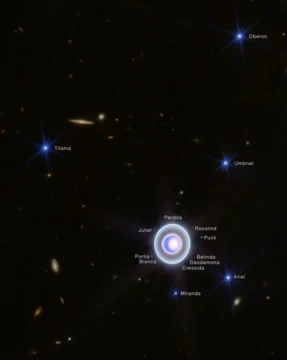
Setebos (moon)
One of Uranus's largest irregular satellites, with a fast rotation.

Setebos (Uranus XIX) is among the largest irregular moons orbiting Uranus. It was discovered on July 18, 1999, by John J. Kavelaars and his team, and was initially designated S/1999 U 1. The moon takes its name from the god Setebos, who is worshipped by Caliban and Sycorax in William Shakespeare's play *The Tempest*. (A crater on the Uranian moon Umbriel shares this name, though spelled Setibos.)
The moon travels around Uranus at an average distance of 16,256,000 km, completing one orbit in 1,978 days. Its orbit is retrograde, inclined about 152° to the ecliptic, and highly eccentric (0.445). These orbital parameters shift continuously due to gravitational influences from the Sun and other planets.
Setebos is estimated to be 47 kilometers in diameter, assuming an albedo of 4%. In visible light, it appears neutral grey, with color indices of B−V=0.77 and R−V=0.35—similar to the moon Prospero. Light curve measurements from the Kepler space telescope show that Setebos rotates once every 4 hours and 15.3 minutes, making it one of the fastest-spinning moons in the Solar System.
The moon likely did not form near Uranus but was captured later. Its orbital characteristics suggest it may belong to the same dynamic cluster as Sycorax and Prospero, hinting at a shared origin. However, Sycorax is much redder than the other two, which are grey.
No space probe has imaged Setebos up close. The proposed Uranus Orbiter and Probe (UOP) plans to observe all Uranian irregular moons, including Setebos, from a distance, measuring their rotation periods and shapes by monitoring brightness changes over time. A close flyby of Setebos may not be possible because its orbit lies far from the ecliptic plane.
- Discovery date
- 18 July 1999
- Discoverer
- John J. Kavelaars et al.
- Provisional designation
- S/1999 U 1
- Average orbit distance
- 16,256,000 km
- Orbital period
- 1978 days
- Orbital inclination
- about 152° to the ecliptic
- Eccentricity
- 0.445
- Estimated diameter
- 47 kilometers
- Rotation period
- about 4 hours and 15.3 min
Lore & Background
Setebos was discovered on 18 July 1999 by John J. Kavelaars et al. and provisionally designated S/1999 U 1. It was later confirmed as Uranus XIX and named after the god Setebos worshipped by Caliban and Sycorax in William Shakespeare's play The Tempest. A crater on Umbriel is also named after Setebos, but with the spelling Setibos.
Setebos orbits Uranus at an average distance of 16,256,000 km, completing one orbit in 1978 days. Its orbit is retrograde, with an inclination of about 152° to the ecliptic and a high eccentricity of 0.445. The orbital elements are continuously changing due to solar and planetary perturbations. The satellite appears neutral (grey) in visible light, with color indices B−V=0.77 and R−V=0.35, similar to Prospero. Measurements of its light curve by the Kepler space telescope indicate a rotation period of about 4 hours and 15.3 minutes, making it one of the fastest-rotating moons in the Solar System.
Setebos probably did not form near Uranus but was captured later. Its orbital parameters suggest it may belong to the same dynamic cluster as Sycorax and Prospero, implying a common origin. However, Sycorax has a much redder color than the other moons, which tend to be grey. Setebos has not been imaged up close by a space probe. All Uranian irregular moons including Setebos are planned to be distant observation targets for the proposed Uranus Orbiter and Probe (UOP), which will measure their rotation periods and shapes by watching brightness changes over time. The UOP may not be able to do a close flyby of Setebos because the moon does not orbit near the ecliptic plane.
Reader's Guide
Setebos is significant as one of the largest irregular satellites of Uranus, providing insight into the capture history of the Uranian system. Its retrograde, highly eccentric orbit and membership in a possible dynamic cluster with Sycorax and Prospero suggest a common origin from a captured body that later fragmented. The moon's very fast rotation period—about 4 hours and 15.3 minutes—makes it one of the fastest-rotating moons in the Solar System, a notable characteristic for a small irregular satellite. Its neutral grey color contrasts with the redder Sycorax, indicating possible compositional differences within the cluster. Setebos has not been visited by any space probe, but it is a planned distant observation target for the proposed Uranus Orbiter and Probe (UOP), which would study its rotation and shape via brightness variations. The moon's orbit far from the ecliptic plane may prevent a close flyby, limiting direct exploration. Its legacy lies in helping scientists understand the dynamics and origins of Uranus's irregular moon population.
Did You Know?
- Its rotation period is about 4 hours and 15.3 minutes, one of the fastest in the Solar System.
- A crater on Umbriel is named Setibos, after the same figure.
More in Moons of Uranus and Neptune 1-24
Spotted an error? Know more?
Reader corrections go straight into our review queue. Suggest an edit · How this site is sourced