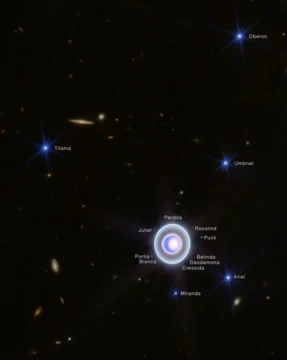
S/2023 U 1
First Uranian moon discovered in over 20 years

S/2023 U 1 is a small and distant irregular moon of Uranus, with a diameter of around 8-12 km. It was discovered on 4 November 2023 by Scott S. Sheppard using the 6.5-meter Magellan–Baade Telescope at Las Campanas Observatory, Chile, and later announced on 23 February 2024. It orbits Uranus in the retrograde direction at an average distance of about 8 e6km and takes almost two Earth years to complete one orbit. It is the first new Uranian moon found in over two decades, since Margaret was discovered in 2003, raising the planet's known moon count from 27 to 28.
- Average orbital distance
- 7.98 e6km
- Average orbital period
- 681 d
Lore & Background
S/2023 U 1 was discovered on 4 November 2023 by Scott S. Sheppard during his search for Uranian irregular moons with the 6.5-m Magellan–Baade Telescope at Las Campanas Observatory, Chile. Sheppard detected this faint moon through the shift-and-add technique, taking many long-exposure telescope images, aligning and shifting them to follow Uranus's motion, and adding them together to create a single deep image. To plan follow-up observations, Sheppard collaborated with Marina Brozović and Robert Jacobson to calculate predictions for the moon's orbit and positions on other dates. Sheppard observed S/2023 U 1 with the Magellan Telescope on 6 and 13 December 2023, and traced the moon back to his earlier observations on 8 September and 2 December 2021. The moon was confirmed and announced by the Minor Planet Center on 23 February 2024, bringing Uranus's number of known moons from 27 to 28. S/2023 U 1 is an irregular moon of Uranus, with a distant, highly elliptical and inclined orbit. Over an 800-year time span from 1600 to 2400, its average semi-major axis is 7.98 e6km, average orbital period 681 d, average eccentricity 0.25, and average inclination 144° with respect to the ecliptic. Since its inclination is greater than 90°, the moon has a retrograde orbit. Due to perturbations, its orbital elements fluctuate: semi-major axis ranges from 7.97 to 7.98 e6km, eccentricity from 0.14 to 0.29, and inclination from 141° to 144°. Its orbit exhibits nodal precession with an average period of about 5,000 Earth years and apsidal precession with an average period of about 5,100 Earth years. S/2023 U 1 is part of the Caliban group, a cluster of retrograde irregular moons of Uranus that includes Stephano and Caliban. The moons of this group have orbital elements clustered with semi-major axes between 7–8 million km, eccentricities between 0.16 and 0.23, and inclinations between 141° and 144°. Like all other irregular moon groups, the Caliban group is thought to have formed from the destruction of a larger captured moon of Uranus due to asteroid and comet impacts. Physically, S/2023 U 1 is extremely faint with an average apparent magnitude of 26.7. Its absolute magnitude is 13.7, and assuming a geometric albedo range of 0.04–0.10 typical for irregular moons, its diameter is between 8–12 km. Sheppard estimates the diameter to be 8 km.
Reader's Guide
S/2023 U 1 is significant as the first Uranian moon discovered in over 20 years, since Margaret in 2003, and it increased Uranus's known moon count from 27 to 28. Its discovery was made possible by the shift-and-add technique applied to the large-aperture Magellan Telescope, allowing deeper probing than previous surveys. The moon's orbit places it in the Caliban group, a cluster of retrograde irregular moons thought to originate from the destruction of a larger captured moon by impacts. This supports the broader understanding that irregular moons are fragments from collisions. The moon's small size, with a diameter of 8–12 km, ties it as the smallest known Uranian moon as of 2025. Its orbital elements fluctuate due to perturbations from the Sun and other planets, illustrating the dynamic nature of irregular moons. The collaboration between Sheppard, Brozović, and Jacobson to calculate orbital predictions highlights the teamwork required to confirm such faint objects. The moon's retrograde orbit and membership in the Caliban group provide context for the formation and evolution of Uranus's outer moon system.
Frequently Asked Questions
What is S/2023 U 1?
It is a tiny, far-flung irregular satellite of Uranus, estimated to be somewhere between 8 and 12 kilometers in diameter. Like Uranus's other outer moons, it travels in a retrograde orbit well beyond the planet's main equatorial satellite group.
Who discovered S/2023 U 1 and when?
Scott S. Sheppard first detected it on 4 November 2023 with the 6.5-meter Magellan–Baade Telescope at Las Campanas Observatory in Chile. The finding was formally announced to the community on 23 February 2024.
Why is S/2023 U 1 such a big deal for Uranus fans?
It broke a roughly twenty-year silence on new Uranian moons, since Margaret was the last one identified back in 2003. Its confirmation also nudged Uranus's known satellite tally from 27 up to 28.
How does S/2023 U 1 orbit Uranus?
It circles the planet in a retrograde direction at a mean distance of about 7.98 million kilometers. A single orbital lap takes roughly 681 days, or just under two Earth years.
Is S/2023 U 1 a regular or irregular moon?
It is firmly classified as an irregular moon, given its distant, retrograde path that differs sharply from the tight, prograde orbits of Uranus's inner equatorial satellites. Its size and orbital geometry place it squarely in the outer satellite family.
More in Moons of Uranus and Neptune 1-24
Spotted an error? Know more?
Reader corrections go straight into our review queue. Suggest an edit · How this site is sourced