Siarnaq
Largest Inuit-group moon of Saturn, discovered in 2000.

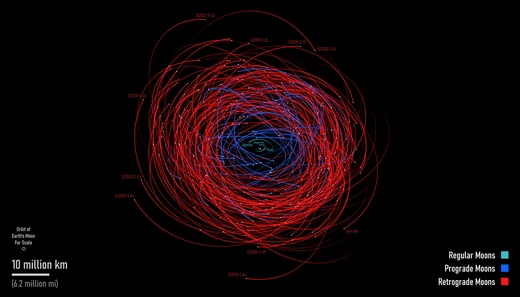
Siarnaq, the second-largest irregular moon of Saturn, holds the distinction of being the biggest member of the planet's Inuit group—a set of prograde irregular moons that orbit far from Saturn in the same direction as its rotation. It was spotted on 23 September 2000 by a team led by Brett J. Gladman, who coordinated a campaign using ground-based telescopes with sensitive CCD cameras to scan Saturn's Hill sphere for distant irregular satellites. The moon's name comes from the Inuit sea goddess Siarnaq, often called Sedna.
The discovery was part of a wider survey in September 2000 using the 3.6-meter Canada-France-Hawaii Telescope at Mauna Kea. Gladman and his collaborators reobserved two earlier finds—Ymir and Paaliaq—and identified two new candidates: Siarnaq and Tarvos. Siarnaq, the brighter of the two, had an apparent magnitude of 20. Follow-up observations from 25 to 29 September 2000 at various observatories ruled out foreground asteroids, confirming the objects as Saturnian satellites. The International Astronomical Union formally reported the discoveries of Ymir, Paaliaq, Siarnaq, and Tarvos on 25 October 2000, and Gladman's team announced them the next day at a meeting of the American Astronomical Society's Division for Planetary Sciences. This brought Saturn's known moon count to 22, surpassing Uranus's 21 at the time.
Siarnaq's orbit was initially poorly known due to few observations. It was reobserved at Kitt Peak National Observatory in December 2000, and later at Palomar and La Palma in early 2001. By then, Gladman's team had found eight more irregular Saturnian moons, raising the planet's total to 30 and briefly overtaking Jupiter as the planet with the most known moons until 2003.
The moon is named after Siarnaq, the Inuit sea giantess or goddess who rules the underworld Adlivun. In other legends, she is known as Nuliajuk or Sedna, said to live at the ocean floor and create all sea life, which she withholds from hunters when angered. One tale describes her as a beautiful maiden tricked into marrying a bird-man; her father rescued her, but during a storm, he sacrificed her to the sea to save himself. The IAU approved the name in July 2003, and it was formally published on 8 August 2003, with the Roman numeral designation Saturn XXIX.
Quick Facts
- Mpc Name
- Saturn XXIX
- Named After
- Siarnaq (Inuit mythology)
- Pronounced
- ˈ · s · iː · ɑr · n · ɑː · k
- Discovery Site
- Mauna Kea Obs.
- Discovered
- 23 September 2000
- Epoch
- 17 December 2020 (JD 2459200.5)
- Semimajor
- 0.1187382 AU
- Eccentricity
- 0.5293834
- Period
- +2.42 yr (+883.87 d)
- Mean Anomaly
- 35.08520°
- Inclination
- 43.80073° (to ecliptic)
- Asc Node
- 40.96116°
Facts from the source article.
Lore & Background
Siarnaq was discovered on 23 September 2000 using the 3.6-meter Canada-France-Hawaii Telescope at Mauna Kea Observatory. It was detected at an apparent magnitude of 20. Follow-up observations between 25–29 September 2000 confirmed it was orbiting Saturn, and the discovery was formally reported by the International Astronomical Union on 25 October 2000. The moon was reobserved by Kitt Peak National Observatory in December 2000 and by Palomar and La Palma observatories in early 2001.
Siarnaq is light red in color and its infrared spectrum is very similar to other Inuit-group satellites Paaliaq and Kiviuq, supporting a common origin from the collisional breakup of a larger progenitor moon. The James Webb Space Telescope found a 3.0 micron absorption feature from hydrated minerals, but no substantial water ice. Carbon dioxide formed by irradiation of organic compounds was detected on its surface. Siarnaq's brightness shows a strong opposition surge, suggesting a highly porous surface with substantial regolith. Its rotation period of 10.19 hours is the shortest among prograde irregular moons of Saturn, and its light curve indicates a roughly triangular shape. The moon's north rotational pole points toward −23° ecliptic latitude and 98° ecliptic longitude, giving it a sideways axial tilt similar to Uranus.
Siarnaq orbits Saturn at an average distance of 17.9 million km in 896 days. Its orbit varies over time, with semi-major axis fluctuating between 17.5–18.3 million km, eccentricity between 0.089–0.554, and inclination between 41.4°–54.3°. It is in a temporary secular resonance with Saturn and is close to the threshold for Lidov–Kozai resonance.
Reader's Guide
Siarnaq is notable as the largest member of Saturn's Inuit group of prograde irregular moons, which are believed to have originated as fragments from the collisional breakup of a larger progenitor moon captured into orbit billions of years ago. Its discovery, along with Ymir, Paaliaq, and Tarvos, raised Saturn's known moons to 22, surpassing Uranus's count of 21 at the time. The moon's naming broke from Greco-Roman tradition; John J. Kavelaars consulted Inuit culture and, after reading the tale Hide and Sneak to his children, contacted author Michael Kusugak, who suggested the name Sedna, later changed to Siarnaq to end in 'q' to distinguish the group. The name Siarnaq was formally approved by the IAU on 8 August 2003, and the moon was assigned the Roman numeral designation Saturn XXIX. Siarnaq's composition, nearly identical to Albiorix, and its phase curve behavior indicating a porous, regolith-covered surface, provide insights into the history of irregular satellite formation and collisional evolution in the Saturn system.
Did You Know?
- Siarnaq is the second-largest irregular moon of Saturn and the largest member of the Inuit group.
- Its rotation period of 10.19 hours is the shortest of all prograde irregular moons of Saturn.
- The moon's name was changed from Sedna to Siarnaq to end in the letter 'q' to distinguish the Inuit group.
- Siarnaq's discovery raised Saturn's known moon count to 22, surpassing Uranus at the time.
More in Moons of Saturn 1-24
Spotted an error? Know more?
Reader corrections go straight into our review queue. Suggest an edit · How this site is sourced