Epimetheus (moon)
Co-orbital moon of Saturn that swaps orbits with Janus.

https://en.wikipedia.org/wiki/User:Jrkenti · CC BY-SA 3.0
Epimetheus is an inner satellite of Saturn, named after the Titan Epimetheus, brother of Prometheus and son of Iapetus. It is notable for sharing essentially the same orbit as the moon Janus, a rare co-orbital configuration that results in a horseshoe orbit, the only known such arrangement for moons in the Solar System.
Quick Facts
- Pronounced
- ɛ · p · ə · ˈ · m · iː · θ · iː · ə · s
- Adjectives
- Epimethean ɛ · p · ə · ˈ · m · iː · θ · iː · ə · n
- Named After
- Ἐπιμηθεύς Epimētheus
- Mpc Name
- Saturn XI
- Discoverer
- Richard Walker
- Discovered
- 18 December 1966
- Orbit Ref
- Ciarnello et al. · 2024Epimetheus switched to the inner orbit in 2002 and 2010, and to the outer orbit in 2006 and 2014.
- Eccentricity
- 0.0097
- Satellite Of
- Saturn
Facts from the source article.
Lore & Background
Epimetheus was first observed on 18 December 1966 by Richard Walker, though at the time it was believed to be the same moon as Janus, which had been observed three days earlier by Audouin Dollfus. For twelve years, astronomers assumed only one moon existed in that orbit. In October 1978, Stephen M. Larson and John W. Fountain realized the 1966 observations were best explained by two distinct objects sharing very similar orbits. This was confirmed in 1980 by Voyager 1, and Larson and Fountain officially share the discovery with Walker. A moon that was probably Epimetheus appeared in two Pioneer 11 images and was designated S/1979 S 1, though uncertainty remains because the two images were not enough to calculate a reliable orbit. The name Epimetheus was approved by the IAU in 1983.
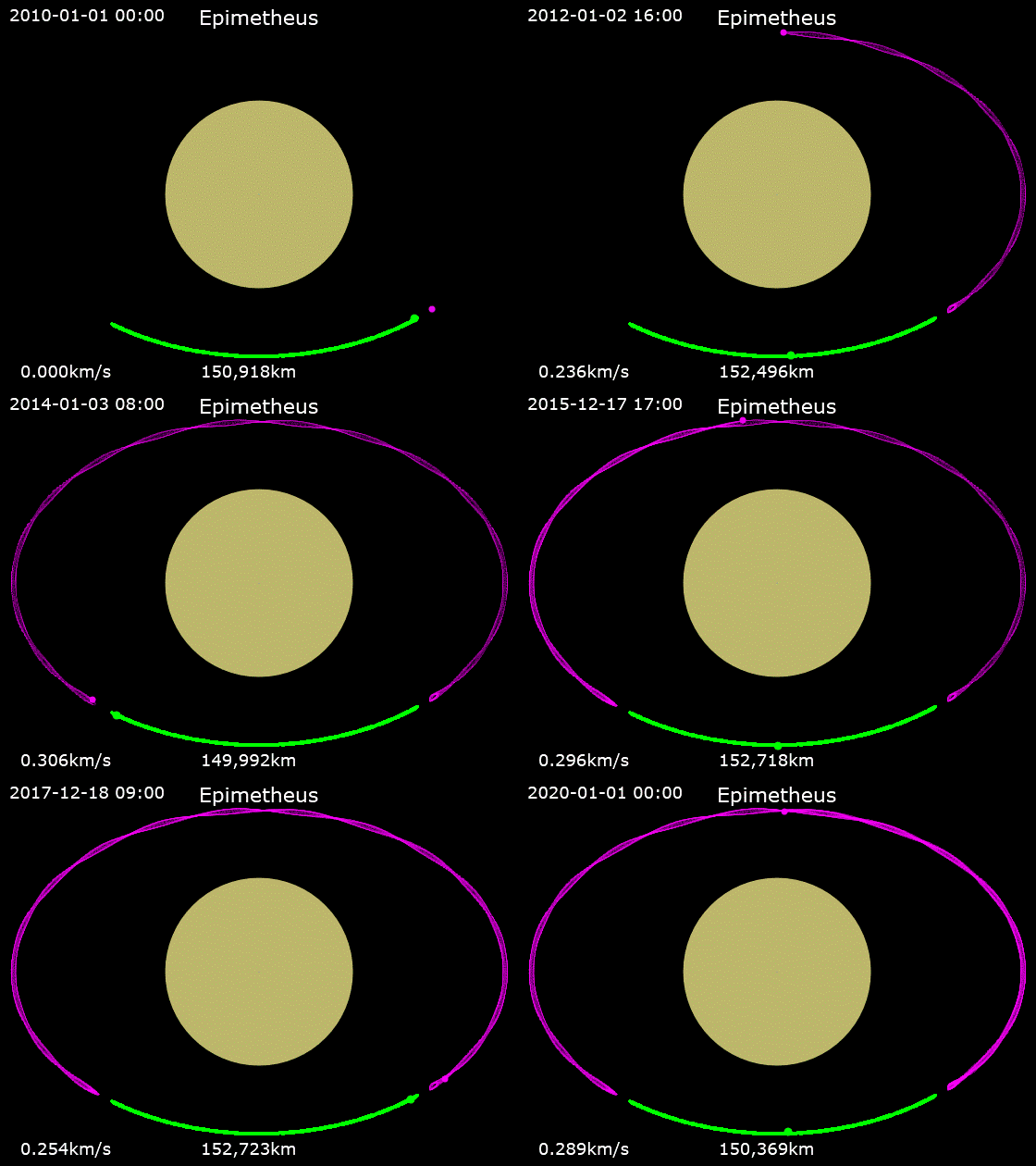
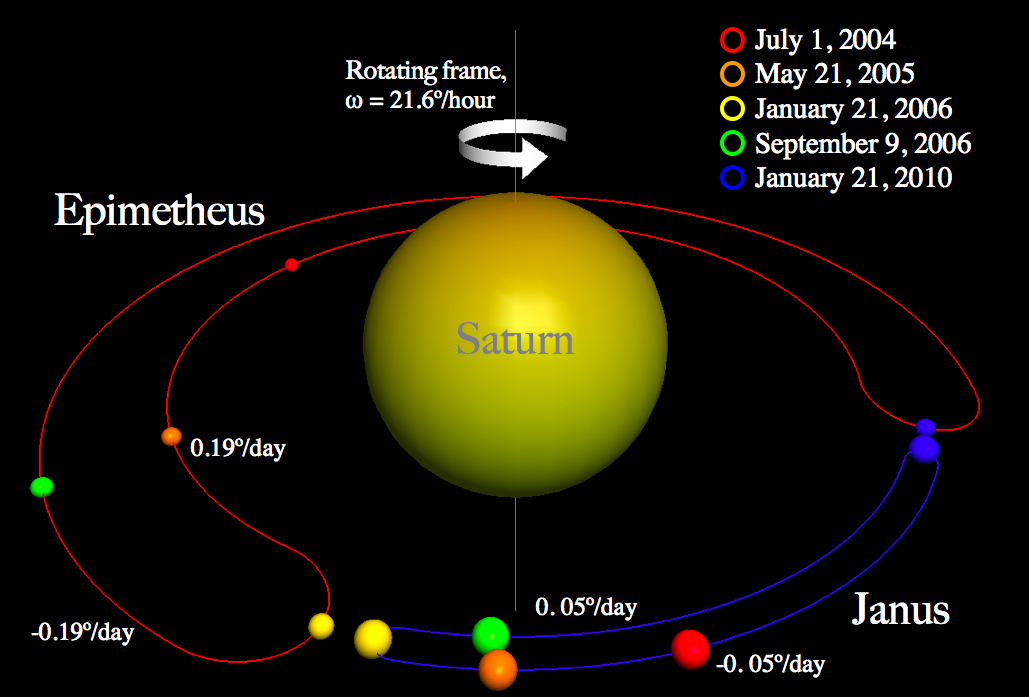
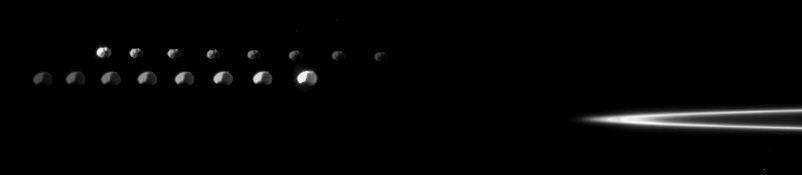
Epimetheus's orbit is co-orbital with Janus. Janus's mean orbital radius from Saturn is only 50 km less than that of Epimetheus, a distance smaller than either moon's mean radius. The inner moon completes its orbit about 30 seconds more quickly, and each day progresses 0.25° more around Saturn. As the inner moon catches up, their mutual gravitational attraction causes them to swap orbits, never approaching closer than about 10,000 km. At each encounter, Janus's orbital radius changes by ~20 km and Epimetheus's by ~80 km. This exchange occurs approximately every four years. The two moons librate about their mutual L4 and L5 Lagrange points, forming a horseshoe orbit.
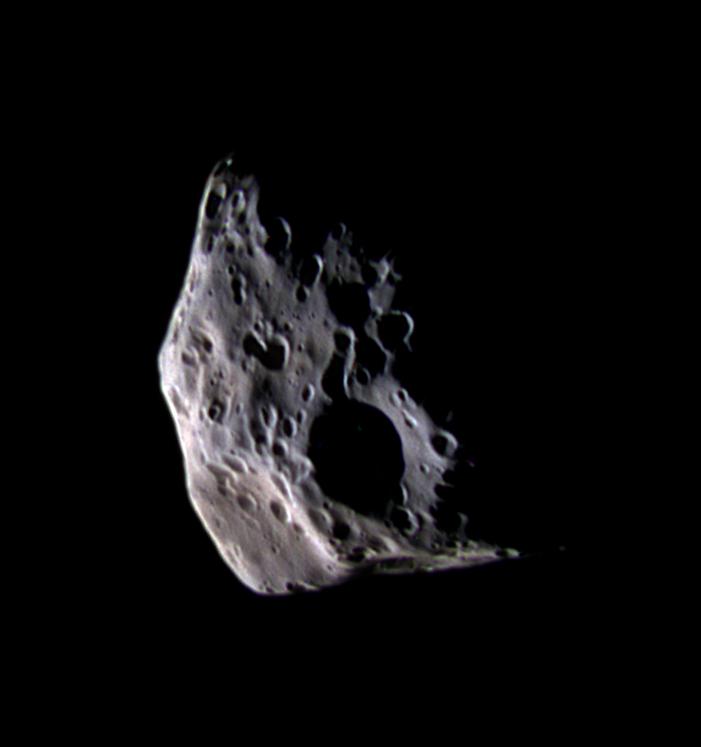
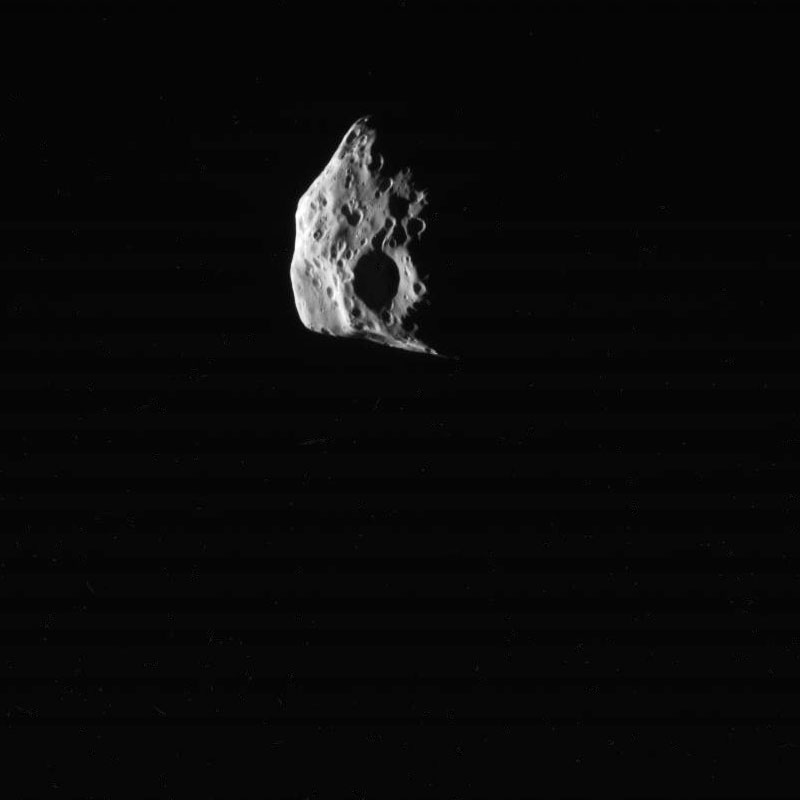
Physically, Epimetheus has several craters larger than 30 km in diameter, along with ridges and grooves. The extensive cratering indicates it is quite old. Its south pole is dominated by a large, flat basin with a central peak, possibly the remains of a large impact. Two terrain types exist: darker, smoother areas and brighter, slightly more yellowish, fractured terrain. The darker material likely has lower ice content and moves down slopes, while the brighter material appears more like bedrock. Both terrains are probably rich in water ice. Epimetheus likely formed from a disruption of a single parent body early in the satellite system's history.
Reader's Guide
Epimetheus's significance lies in its unique co-orbital relationship with Janus, the only known such configuration for moons in the Solar System. This orbital dance, where the two moons swap orbits approximately every four years, provides a natural laboratory for studying gravitational interactions and the circular restricted three-body problem. The moons' mutual gravitational exchange alters their orbital radii by tens of kilometers each encounter, demonstrating a delicate balance that prevents collision. Epimetheus also participates in mean-motion resonances with Prometheus (15:17) and Pandora (19:21), though only when it is the outer moon. Along with Janus, it acts as a shepherd moon, maintaining the sharp outer edge of Saturn's A Ring through a 7:6 orbital resonance, an effect more obvious when the more massive Janus is on the resonant inner orbit. A faint dust ring, about 5000 km in radial extent, surrounds the region of their orbits, sourced from particles blasted off their surfaces by meteoroid impacts. In the far future, gravitational interactions with the A Ring are expected to cause the co-orbital configuration to collapse, with Epimetheus becoming a trojan of Janus.
Did You Know?
- Epimetheus and Janus share essentially the same orbit, with a mean orbital radius difference of only 50 km.
- Epimetheus was probably imaged by Pioneer 11 and designated S/1979 S 1, but the two images were insufficient for a reliable orbit calculation.
- Craters on Epimetheus are named after characters in the legend of Castor and Pollux.
The Long Road to Recognition
For over a decade, the small body orbiting Saturn that we now call Epimetheus was invisible to astronomers' understanding. In December 1966, Audouin Dollfus spotted a moon on the 15th, and three days later Richard Walker made a similar detection. Both observations were photographic, taken at widely separated times, making it extraordinarily hard to pin down a single consistent orbit. The scientific community simply refused to accept that two moons could share nearly the same path around Saturn without colliding, so the object was informally filed under the name Janus. It was not until October 1978 that Stephen Larson and John Fountain demonstrated that the 1966 data were best explained by two distinct bodies in closely matched orbits. Voyager 1 flew by in 1980 and confirmed the dual-moon picture, officially sharing discovery credit with Walker. A probable Epimethean appearance in two Pioneer 11 frames had been catalogued as S/1979 S 1, but the pair of images was insufficient for a reliable orbit. The IAU approved the name Epimetheus in 1983, alongside the formal adoption of Janus.
The Four-Year Orbital Swap
Epimetheus and Janus trace nearly identical paths around Saturn, with their mean orbital radii differing by only about fifty kilometres as of 2006 — a gap smaller than either moon's own radius. Because the inner moon travels slightly faster, it slowly closes the distance on its companion, gaining roughly a quarter-degree per day. As the two draw near, their mutual gravity transfers momentum: the inner body speeds up and its orbit expands, while the outer body slows and contracts. The result is a graceful exchange of positions, with the pair never dipping closer than roughly ten thousand kilometres. Janus, being four times more massive, sees its orbital radius shift by about twenty kilometres per encounter, compared with Epimetheus's roughly eighty. This swap recurs approximately every four years; documented close approaches occurred in 2006, 2010, 2014, 2018, and 2022. Viewed from the other moon, each traces a horseshoe-shaped path, librating around their shared L4 and L5 Lagrange points. While a few asteroids share this orbital geometry, Janus and Epimetheus remain the only known moons in the entire Solar System locked in such a co-orbital dance, a configuration that fits neatly within the circular restricted three-body problem.
A Porous, Ancient Icy World
Epimetheus's surface tells a story of great age. Numerous craters exceeding thirty kilometres in diameter, along with both large and small ridges and grooves, paint a picture of a body that has endured countless impacts over a long geological history. The south pole is dominated by an enormous flat basin crowned with a central peak, stretching across much of the southern hemisphere — likely the scar of a single colossal impact. Two distinct terrain types are visible: darker, smoother regions and brighter, slightly yellowish, fractured ground. One working interpretation holds that the darker material flows downslope and contains less ice, while the brighter terrain resembles exposed bedrock; both, however, are probably rich in water ice. The moon's very low density combined with a relatively high albedo strongly suggests a highly porous icy structure, though considerable uncertainty remains in these measurements. Some researchers have speculated that Janus and Epimetheus may both be fragments of a single parent body that was shattered early in the satellite system's history, producing a pair of co-orbital satellites. Craters on Epimetheus, following the same convention as Janus, bear names drawn from the mythological legend of Castor and Pollux.
Shepherd, Resonance Partner, and Future Trojan
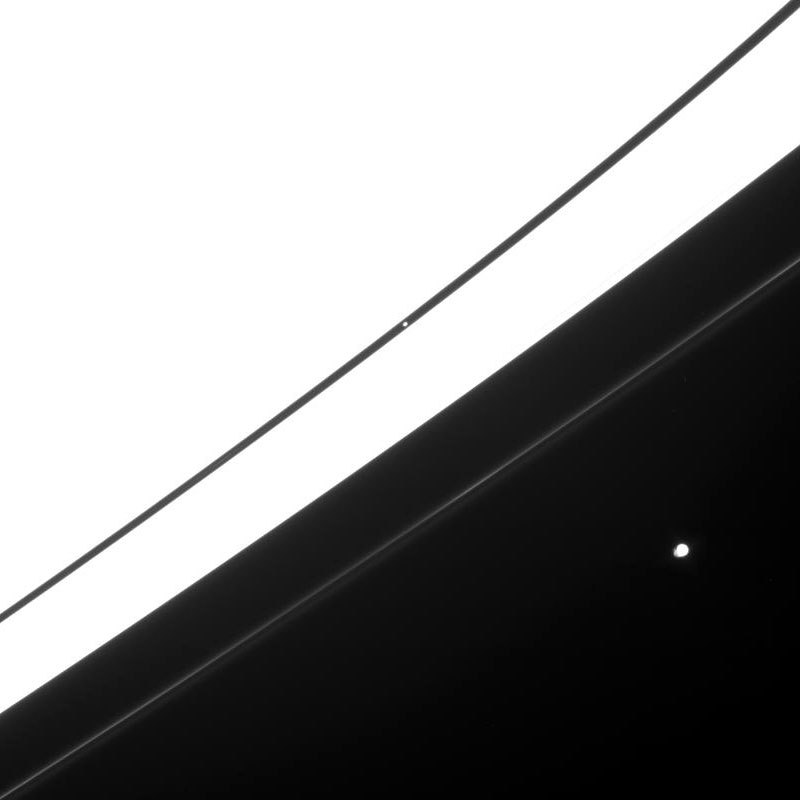
Epimetheus plays a quiet but important role in sculpting Saturn's ring system. Together with Janus, it acts as a shepherd moon, using a 7:6 orbital resonance to maintain the sharp outer edge of the A Ring; the effect is most pronounced when the more massive Janus occupies the inner, resonant orbit. In 2006, Cassini's forward-scattered-light images revealed a faint dust ring spanning roughly five thousand kilometres in radial extent around the moons' shared orbital region, fed by particles knocked loose from their surfaces by meteoroid strikes. Beyond the rings, Epimetheus participates in two mean-motion resonances while on its outer orbit: a 15:17 resonance with Prometheus and a 19:21 resonance with Pandora. No such resonant state exists when Epimetheus is on the inner orbit, nor for Janus in general. Looking far into the future, gravitational interactions with the A Ring will gradually push both moons' orbits outward. This migration is expected to eventually destabilise the co-orbital swap, leaving Epimetheus locked as a Trojan satellite librating around Janus's L4 or L5 point.
Gallery
Frequently Asked Questions
What is Epimetheus (moon)?
Epimetheus is a small inner satellite of Saturn, named after the Greek Titan who was brother to Prometheus. It is best known for its unusual shared orbit with its companion moon Janus.
What makes Epimetheus's orbit so unusual?
Epimetheus and Janus share essentially the same orbital path around Saturn, producing a rare co-orbital configuration in which Epimetheus traces a horseshoe-shaped trajectory as it periodically trades positions with Janus. This is the only known example of such an arrangement among the moons in our Solar System.
How often does Epimetheus swap orbits with Janus?
The two moons exchange their orbital positions roughly every four years. Their most recent close approaches took place in January 2006, 2010, 2014, 2018, and 2022.
Who discovered Epimetheus and when?
Richard Walker first spotted Epimetheus on 18 December 1966, with Stephen M. Larson and John W. Fountain also officially credited for the discovery. The moon's existence was later confirmed by the Voyager 1 spacecraft in 1980.
How does Epimetheus compare in size to Janus?
Janus is roughly four times more massive than Epimetheus, making it the clearly larger member of the pair. Their mean orbital radii differ by only about 50 kilometers (as of 2006), which is what permits them to occupy the same orbital zone.
More in Moons of Saturn 1-24
Spotted an error? Know more?
Reader corrections go straight into our review queue. Suggest an edit · How this site is sourced