Bestla (moon)
Retrograde irregular moon of Saturn, likely a contact binary.

Jorchr · CC BY-SA 3.0
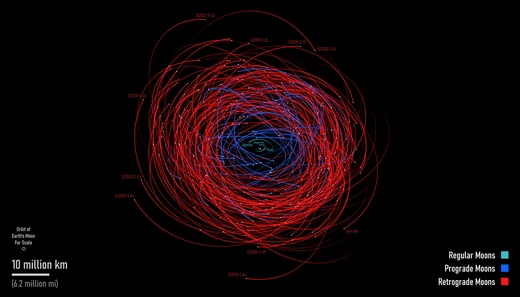
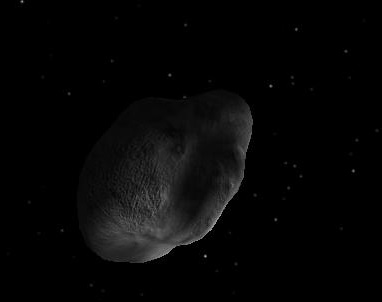
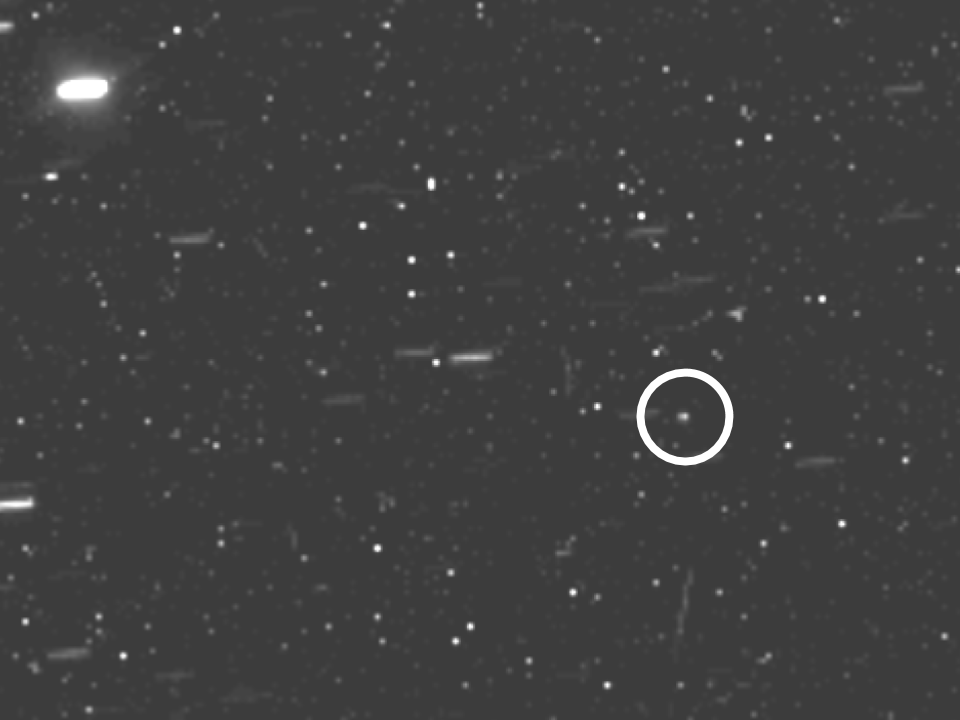
Bestla, also known as Saturn XXXIX, is a retrograde irregular moon of Saturn. It was discovered by Scott S. Sheppard, David C. Jewitt, Jan Kleyna, and Brian G. Marsden, with the announcement made on 4 May 2005 based on observations from 13 December 2004 to 5 March 2005. The moon has a diameter of about 7 kilometres and orbits Saturn at an average distance of 20,337,900 km, completing one orbit in 1087 days. Its orbit is retrograde, with an inclination of 136° to the ecliptic and an eccentricity of 0.461. Early 2005 observations initially suggested a much higher eccentricity of 0.77. Like many outer irregular moons of giant planets, Bestla's eccentricity may change over time due to the Kozai mechanism. It rotates retrograde, with a full rotation taking 14.6238±0.0001 hours. Its light curve shows strong brightness variations and a plateau-like maximum, unlike other irregular moons, suggesting it is likely a contact binary or binary object, similar to Kiviuq. The moon was named in April 2007 after Bestla, a frost giantess from Norse mythology and mother of Odin.
Quick Facts
- Pronounced
- ˈ · b · ɛ · s · t · l · ə
- Named After
- Bestla
- Mpc Name
- Saturn XXXIX
- Discovered
- 2004
- Discoverer
- Scott S. Sheppard / David C. Jewitt / Jan T. Kleyna / Brian G. Marsden
- Inclination
- 136.3°
- Eccentricity
- 0.461
- Period
- −1087.46 days
- Satellite Of
- Saturn
- Group
- Norse group
- Dimensions
- 15.56 × 7 × 5.98 kmModeled using the diameter calculated from the assumed albedo.
- Rotation
- -14.6238 · 0.0001 h
Facts from the source article.
Lore & Background
Bestla orbits Saturn at an average distance of 20,337,900 km in 1087 days, with an inclination of 136° to the ecliptic, in a retrograde direction and with an eccentricity of 0.461. Early observations from 2005 suggested a very high eccentricity of 0.77, but later data refined this value. Like many outer irregular moons of the giant planets, Bestla's eccentricity may vary as a result of the Kozai mechanism. The moon rotates in a retrograde direction and completes a full rotation every 14.6238±0.0001 hours. Its light curve shows strong variation in brightness and a plateau-like maximum not seen in other irregulars, leading to the interpretation that Bestla is likely a contact binary or binary object, similar to Kiviuq. The moon was named in April 2007 after Bestla, a frost giantess from Norse mythology who is a mother of Odin.
Reader's Guide
Bestla's significance lies in its classification as a retrograde irregular moon of Saturn, one of many discovered in the early 2000s by a team including Scott S. Sheppard. Its discovery, announced on 4 May 2005, expanded the known satellite system of Saturn. The moon's light curve, with strong brightness variation and a plateau-like maximum, suggests it may be a contact binary or binary object, a characteristic shared with Kiviuq. This feature distinguishes Bestla from other irregular moons and provides insight into the possible formation and evolution of such bodies. The Kozai mechanism may influence its eccentricity over time, a common dynamic process among outer irregular moons. Named in April 2007 after a figure from Norse mythology, Bestla contributes to the cultural naming tradition for Saturn's moons. Its physical properties, such as a diameter of about 7 kilometres and a retrograde rotation period of 14.6238 hours, are derived from observations. The moon's legacy is tied to ongoing studies of irregular satellites and their diverse orbital and physical characteristics.
Did You Know?
- Bestla is about 7 kilometres in diameter.
- Its discovery was announced on 4 May 2005.
- It was named after a frost giantess from Norse mythology.
Discovery and the Race to a Name
In September 1848, Hyperion entered the astronomical record through the independent efforts of two observing teams separated by an ocean. In the United States, father-and-son astronomers William Cranch Bond and George Phillips Bond spotted the faint satellite, while in the United Kingdom, William Lassell made his own detection just two days later. The naming that followed was as competitive as the discovery itself. Lassell had already embraced the Greek-mythology scheme that John Herschel had proposed in his 1847 Cape of Good Hope publication for Saturn's seven known satellites, and he quickly settled on Hyperion—the Titan god of watchfulness and observation, elder brother of Cronus, the Greek counterpart to Roman Saturn. Because Lassell beat Bond to publication, his proposed name stuck. The moon was formally designated Saturn VII, and the adjectival form Hyperionian entered the scientific vocabulary. What made the discovery particularly noteworthy was that Hyperion was the first non-rounded moon ever identified, breaking the pattern of spherical satellites that had defined planetary moon discoveries up to that point.
A Tumbling Orbit and Unpredictable Spin
Hyperion circles Saturn at roughly 1.48 million kilometers, threading a path between the much larger Titan and Iapetus. Its orbit is moderately eccentric, a condition that Titan's gravitational pull actively sustains, preventing the path from ever settling into a circle. The two moons share a 3:4 orbital resonance: for every four laps Titan completes, Hyperion manages three, and their closest approaches consistently occur near Hyperion's apocenter. Perhaps most striking is the moon's rotation. Rather than spinning in a steady, predictable manner, Hyperion tumbles chaotically—its axis of rotation wanders so erratically that its orientation in space cannot be forecast beyond a Lyapunov time of approximately thirty days. Over short intervals the motion is calculable, but stretch the timescale and predictability dissolves entirely. Together with Pluto's small satellites Nix and Hydra, Hyperion belongs to a tiny club of Solar System moons with confirmed chaotic rotation. It is also the only regular planetary satellite known to escape tidal locking, a fact that likely explains why its surface shows no stark contrast between leading and trailing hemispheres, unlike many of Saturn's other moons.
A Porous Relic of a Shattered Past
Hyperion stands out as one of the largest bodies in the Solar System that has never achieved a rounded, hydrostatically balanced shape. Only Neptune's Proteus and Nereid are larger among irregularly shaped planetary moons. Despite ranking eighth in size among Saturn's satellites, Hyperion is merely ninth in mass, with Phoebe actually outweighing it despite a smaller radius. Its low density reveals a composition dominated by water ice with just a trace of rock, and Cassini flyby data from 2005 and 2006 revealed that roughly forty percent of the moon's volume is simply empty space. This extreme porosity, measured at about 0.42, suggests a loosely held rubble-pile structure rather than a solid body. One compelling hypothesis holds that Hyperion is the surviving fragment of a much larger proto-moon, perhaps 350 to 1,000 kilometers across, shattered by a catastrophic ancient impact. Over the following millennium, debris from that breakup would have rained onto Titan at low velocities, gradually enriching its atmosphere with volatile compounds.
The Sponge and Its Scars
Looking at Hyperion through a telescope or spacecraft camera, the most immediate impression is of a giant sponge. Its surface is pocked with deep, sharply edged craters whose floors are filled with dark material, and many of the smaller craters display polygon-shaped rims rather than smooth circular ones. This sponge-like texture is a direct consequence of the moon's extraordinarily low density and weak surface gravity: incoming impactors tend to compress the porous surface rather than dig out clean bowls, and debris ejected during a strike rarely has enough energy to fall back. The reddish material lining the crater basins contains long chains of carbon and hydrogen and closely resembles the dark coating found on Iapetus, possibly originating from Phoebe. Despite the low gravity, the steep crater walls still experience mass wasting, driven by day-night temperature swings and the shock of nearby impacts. Notably, the high porosity may allow craters to persist nearly unchanged across geological eons. The IAU has officially named only four craters and one ridge on the moon, all in 1982, largely because the absence of an approved coordinate system makes it difficult to pin down the absolute location of other features.
Gallery
Frequently Asked Questions
What is Bestla (moon)?
Bestla is a small retrograde irregular satellite of Saturn, carrying the designation Saturn XXXIX. It belongs to the family of distant, irregular moons that circle the ringed planet in the opposite direction of its spin.
Who discovered Bestla (moon) and when?
Scott S. Sheppard, David C. Jewitt, Jan Kleyna, and Brian G. Marsden identified the moon, with the formal announcement coming on 4 May 2005. Their observations spanned from 13 December 2004 through 5 March 2005.
How big is Bestla (moon) and how far does it orbit from Saturn?
Bestla measures roughly 7 kilometres across, making it a very modest body. It travels along an orbit averaging about 20.3 million kilometres from Saturn's centre, completing a single revolution in approximately 1,087 days.
What is unusual about Bestla (moon)'s orbit?
The moon follows a retrograde path with a steep 136° inclination to the ecliptic and a moderate eccentricity of 0.461. Early 2005 data had suggested a much higher eccentricity near 0.77 before subsequent observations corrected the figure.
What shape is Bestla (moon) likely to have?
Bestla is thought to be a contact binary, meaning two lobes have merged into a single lumpy body. This dumbbell-like structure is typical of small irregular satellites that were captured from the outer solar system.
More in Moons of Saturn 1-24
Spotted an error? Know more?
Reader corrections go straight into our review queue. Suggest an edit · How this site is sourced