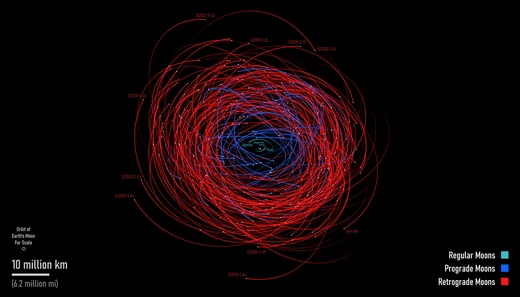
Chrysalis (hypothetical moon)
Hypothetical moon whose destruction may have formed Saturn's rings.

H. Zell · CC BY-SA 3.0
Chrysalis is the name given to a hypothetical former moon of Saturn, proposed in 2022 by researchers at the Massachusetts Institute of Technology based on data from the Cassini–Huygens mission. According to the hypothesis, the moon was destroyed by Saturn’s tidal forces between 200 and 100 million years ago. As much as 99% of Chrysalis’s mass would have been pulled into Saturn itself, while the remaining 1% is thought to have formed the planet’s rings. The idea that Saturn’s rings originated from the destruction of a satellite had been suggested by other scientists before.
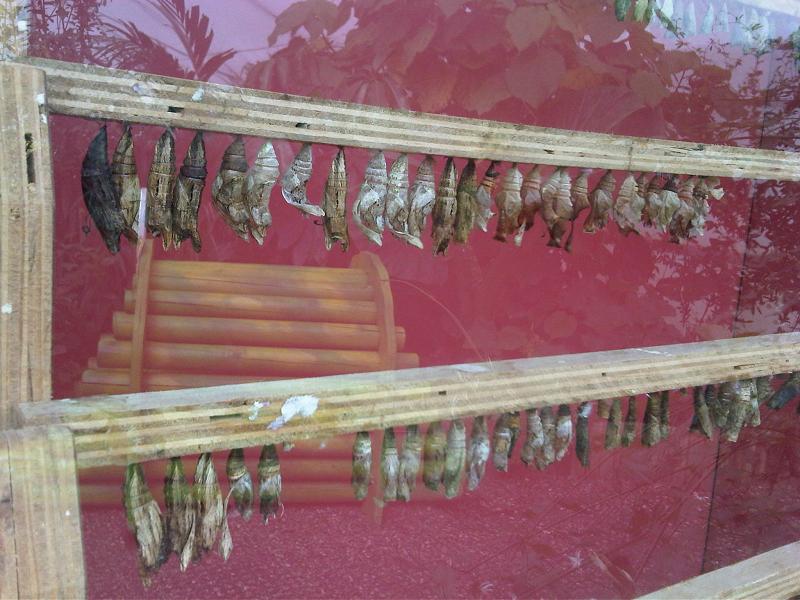
**Nomenclature** The moon was named after the pupal stage of a butterfly, with Saturn’s rings symbolizing the butterfly emerging from the chrysalis.
**Size and orbit** Chrysalis is thought to have been similar in size and mass to Iapetus, with a comparable water-ice composition. It likely orbited Saturn in a region between Iapetus and Titan. Its orbit may have become unstable due to Titan’s orbit expanding as a result of interactions between the Saturnian system and a resonance with Neptune. This process would have increased Chrysalis’s orbital eccentricity until, during a close approach to Saturn, the planet’s gravity tore it apart.
- Named by
- scientists of the Massachusetts Institute of Technology
- Year named
- 2022
- Data source
- Cassini–Huygens mission
- Hypothesized destruction period
- between 200 and 100 million years ago
- Mass swallowed by saturn
- up to 99%
- Mass forming rings
- remaining 1%
Lore & Background
The hypothetical moon was named after the pupa stage of a butterfly, with the rings of Saturn representing its emergence from the chrysalis. Chrysalis was hypothesized to be similar in size and mass to Iapetus, with a similar water-ice composition, and to have orbited somewhere between Iapetus and Titan. Its orbit around Saturn may have been degraded as a result of Titan's orbit expanding due to interactions of the Saturnian system with a resonance with Neptune, resulting in the increasing eccentricity of Chrysalis's orbit until being torn apart during a close encounter with Saturn by its parent planet's gravitational force. The origin of Saturn's rings from the destruction of a satellite has been previously proposed by other authors.
Reader's Guide
Chrysalis is significant as a proposed explanation for the origin of Saturn's rings, a long-standing puzzle in planetary science. The hypothesis, based on Cassini–Huygens data, suggests that a moon similar in size and composition to Iapetus was torn apart by tidal forces between 200 and 100 million years ago. Up to 99% of its mass fell into Saturn, while the remaining 1% formed the rings. This scenario ties the rings' formation to the orbital dynamics of the Saturnian system, specifically the expanding orbit of Titan and a resonance with Neptune. The name 'Chrysalis' metaphorically links the moon's destruction to the emergence of the rings, like a butterfly from a pupa. While the idea of ring formation from a destroyed satellite had been proposed before, Chrysalis provides a specific, data-driven model. Its legacy lies in offering a coherent narrative that connects the moon's hypothetical existence, its orbital instability, and the relatively young age of the rings, as inferred from Cassini observations.
Did You Know?
- Chrysalis was named in 2022 by scientists of the Massachusetts Institute of Technology.
- The moon is hypothesized to have been torn apart by Saturn's tidal forces between 200 and 100 million years ago.
- Up to 99% of Chrysalis's mass would have been swallowed by Saturn, with the remaining 1% forming the rings.
Discovery & Nomenclature
Chrysalis entered scientific discourse in 2022 when researchers at the Massachusetts Institute of Technology proposed its existence, drawing on observational data gathered during the Cassini–Huygens mission. The name itself carries a poetic resonance: it references the pupal stage of a butterfly, evoking the image of Saturn's rings as the creature emerging from its cocoon. This naming choice transforms a cold orbital-mechanics hypothesis into something almost mythological—a celestial metamorphosis. The proposal did not emerge in isolation; earlier authors had independently suggested that Saturn's rings could be the debris of a shattered satellite, but the MIT team's work gave the idea a specific identity, a size, and a place in time. By anchoring the hypothesis to Cassini data, the researchers provided a concrete observational foundation for what had previously remained a speculative scenario about ring formation.
Physical Profile & Orbital Position
Based on the MIT team's modeling, Chrysalis would have been a body comparable in both size and mass to Iapetus, one of Saturn's larger moons. Its composition was hypothesized to be predominantly water ice, consistent with the icy nature of many Saturnian satellites. In terms of orbital placement, Chrysalis is thought to have circled Saturn in a region between the orbits of Iapetus and Titan, occupying a middle ground in Saturn's complex satellite architecture. This positioning is significant because it placed the moon in a zone where gravitational interactions with both neighboring bodies would have been dynamically relevant. The water-ice composition also aligns with the broader understanding of how icy material in the Saturnian system contributes to ring formation, making the proposed origin of the rings from Chrysalis's destruction physically coherent with what we observe in the ring system today.
Orbital Degradation & Tidal Disruption
The mechanism by which Chrysalis met its end involved a slow, multi-million-year process of orbital decay. The hypothesis centers on Titan's orbit gradually expanding over geological time, a consequence of gravitational interactions within the Saturnian system tied to a resonance with Neptune. As Titan's orbit shifted outward, the gravitational environment in the region between Iapetus and Titan changed, progressively increasing the eccentricity of Chrysalis's own orbit. Over millions of years, this growing eccentricity would have brought the moon repeatedly closer to Saturn during each pericenter passage. Eventually, during a sufficiently close encounter, Saturn's tidal forces exceeded the gravitational self-binding of the icy body, tearing it apart. The timeline for this catastrophic event is estimated to fall somewhere between 200 and 100 million years ago, placing it deep in the geological past of the Saturnian system.
Legacy & the Ring Connection
The most striking consequence of Chrysalis's destruction was the partitioning of its mass. According to the MIT hypothesis, up to 99 percent of the moon's material was ultimately swallowed by Saturn itself, absorbed into the gas giant's vast atmosphere. The remaining one percent, however, escaped capture and settled into orbit around Saturn, forming the planet's iconic ring system. This dramatic redistribution of a single body's mass—nearly all lost to the planet, a sliver preserved as rings—gives the hypothesis a compelling narrative arc. The idea that Saturn's rings are not primordial but rather the scattered remains of a once-whole moon has been explored by other researchers before the 2022 proposal, but the Chrysalis framework adds specificity: a named body, a defined size, a particular orbital zone, and a mechanistic pathway linking Neptune's distant gravitational whisper to a local catastrophe. It reframes the rings not as a static feature but as a fossil record of violence.
Gallery

Frequently Asked Questions
What is Chrysalis?
Chrysalis is a proposed former moon of Saturn that, according to a 2022 MIT hypothesis, was torn apart by tidal forces roughly 100 to 200 million years ago. It is not a confirmed body but rather a theoretical explanation for how Saturn's ring system came to exist.
Who named Chrysalis and when?
The name was coined by researchers at the Massachusetts Institute of Technology in 2022. They built the hypothesis on orbital and compositional data gathered during the Cassini–Huygens mission.
How did Chrysalis meet its end?
Saturn's tidal gravity progressively stretched and shredded the moon, ultimately destroying it somewhere between 200 and 100 million years ago. The overwhelming majority of its material was pulled into the planet rather than staying in orbit.
What is the link between Chrysalis and Saturn's rings?
The hypothesis holds that the roughly 1% of Chrysalis's mass that escaped being absorbed into Saturn went on to make up the planet's current ring system. In this scenario, the rings are essentially the scattered debris of a once-whole satellite.
Is Chrysalis a confirmed moon?
No—Chrysalis exists only as a scientific hypothesis and has never been directly observed. The broader idea that Saturn's rings originated from a shattered satellite had been floated by other researchers before the 2022 MIT proposal, but no direct evidence of the original body has been identified.
More in Moons of Saturn 1-24
Spotted an error? Know more?
Reader corrections go straight into our review queue. Suggest an edit · How this site is sourced