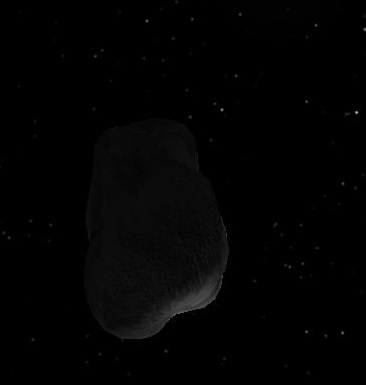
Bergelmir (moon)
A small retrograde moon of Saturn named after a Norse giant.

NASA/Cassini · CC BY-SA 4.0
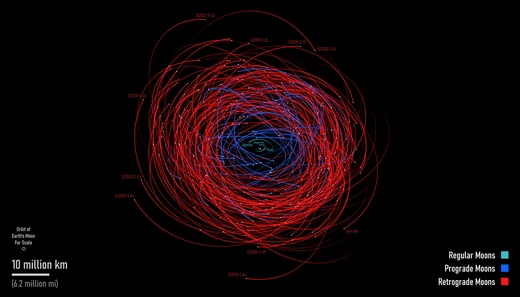
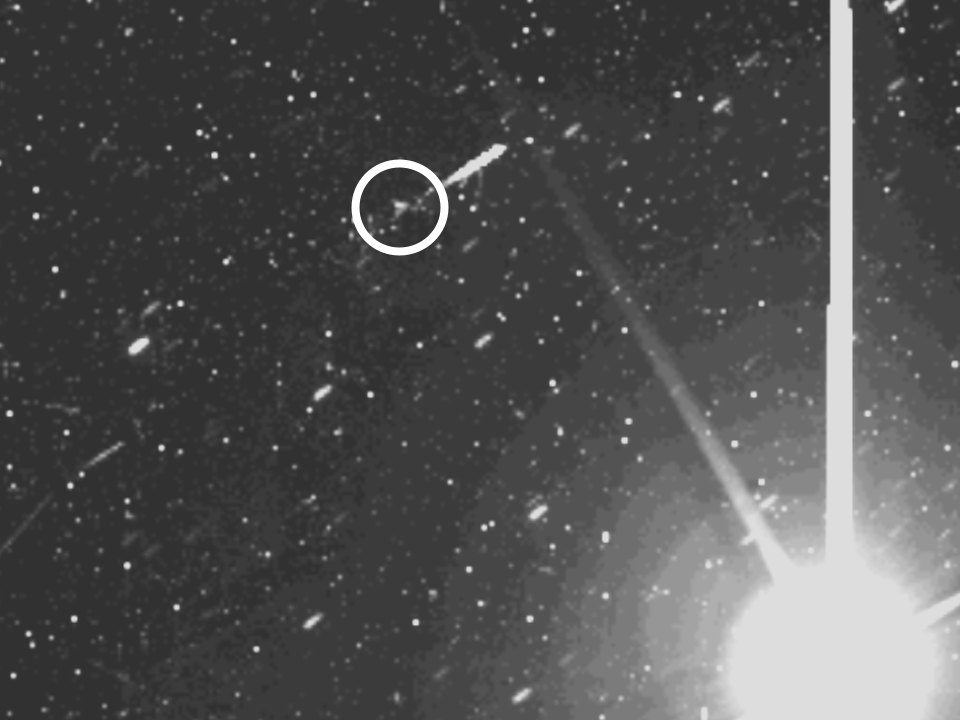
Bergelmir, also known as Saturn XXXVIII (provisional designation S/2004 S 15), is a moon of Saturn. Its discovery was announced on May 4, 2005, by Scott S. Sheppard, David C. Jewitt, Jan Kleyna, and Brian G. Marsden, based on observations made from December 12, 2004, to March 9, 2005. The moon is roughly 6 kilometers (4 miles) across. It orbits Saturn at an average distance of 19,338,000 km, completing one orbit in 1006.659 days. Its orbit is retrograde, inclined 157° to the ecliptic (134° to Saturn's equator), with an eccentricity of 0.152. Bergelmir rotates once every 8.13±0.09 hours. Named in April 2007, it takes its name from Norse mythology: Bergelmir, a giant and grandson of the primordial giant Ymir. According to myth, Bergelmir and his wife were the only giants to survive the flood of blood from Ymir’s wounds after Odin and his brothers killed him at the dawn of time, and Bergelmir became the ancestor of a new race of giants.
Quick Facts
- Discoverer
- S. Sheppard, D. Jewitt, / J. Kleyna, and B. Marsden
- Discovered
- May 4, 2005
- Mpc Name
- Saturn XXXVIII
- Adjective
- BergelmianThe oblique stem of the name is Bergelmi, as in Modern Norwegian Bergelme. The -r is the nominative case ending.
- Named After
- Bergelmir
- Eccentricity
- 0.142
- Inclination
- 158.5°
- Satellite Of
- Saturn
- Group
- Norse group
- Albedo
- 0.06 (assumed)
Facts from the source article.
Lore & Background
Bergelmir was discovered by Scott S. Sheppard, David C. Jewitt, Jan Kleyna, and Brian G. Marsden, with the announcement made on May 4, 2005, based on observations taken between December 12, 2004, and March 9, 2005. It is about 6 kilometers (4 miles) in diameter and orbits Saturn at an average distance of 19,338,000 km in 1006.659 days. Its orbit is retrograde, with an inclination of 157° to the ecliptic (134° to Saturn's equator) and an eccentricity of 0.152. Its rotation period is 8.13±0.09 hours.
The moon was named in April 2007 after Bergelmir, a giant from Norse mythology and the grandson of Ymir, the primordial giant. According to myth, Bergelmir and his wife were the only survivors of the enormous deluge of blood from Ymir's wounds when he was killed by Odin and his brothers at the dawn of time, and Bergelmir became the progenitor of a new race of giants.
Reader's Guide
Bergelmir is one of Saturn's many irregular moons, distinguished by its retrograde orbit and small size. Its discovery in 2005, as part of a systematic survey by Sheppard, Jewitt, Kleyna, and Marsden, contributed to the growing catalog of Saturn's outer satellites. The moon's naming in April 2007, following Norse mythological tradition, aligns with the convention for Saturn's moons to draw from Norse, Gallic, and Inuit mythologies. The mythological Bergelmir's survival of a cosmic flood and role as progenitor of a new giant race adds a layer of cultural significance to this small celestial body. The moon's orbital characteristics—retrograde, inclined, and moderately eccentric—place it among the Norse group of Saturn's irregular satellites, though the article does not explicitly assign it to a group. Its rotation period of 8.13±0.09 hours, measured with uncertainty, provides a rare glimpse into the spin state of a tiny moon. Bergelmir remains a minor but meaningful component of Saturn's diverse satellite system, its legacy tied to both astronomical discovery and mythological storytelling.
Did You Know?
- It orbits Saturn in a retrograde direction with an inclination of 157° to the ecliptic.
- It was named in April 2007 after a giant from Norse mythology.
Discovery and the Long Road to a Name
Giovanni Domenico Cassini spotted Dione in 1684 using a large aerial telescope positioned on the grounds of the Paris Observatory. At the time, he grouped it with three other Saturnian moons he had found—Tethys, Rhea, and Iapetus—under the collective Latin title Sidera Lodoicea, meaning "the stars of Louis," a tribute to King Louis XIV. For nearly two centuries, these satellites went by their discovery numbers rather than proper names. It was not until 1847 that John Herschel, son of the famous William Herschel, published his Results of Astronomical Observations made at the Cape of Good Hope, in which he proposed drawing names from the Titans, the siblings of Cronus in Greek mythology. Dione thus received its name from the Titaness Dione. In modern astronomical practice, planetary moons other than Earth's have never been assigned formal symbols, though software engineer Denis Moskowitz once suggested combining a Greek delta with the crook of Saturn's symbol—a proposal that never gained wide adoption.
Interior Architecture and the Possibility of a Hidden Ocean
Dione's mean diameter of approximately 1,123 km and density of about 1.48 g/cm³ place it as Saturn's fourth-largest moon and the fifteenth-largest in the entire Solar System. Its mass exceeds that of all known smaller moons combined. Based on these bulk properties, the moon's interior is thought to consist of silicate rock and water ice in nearly equal proportions by mass. Cassini's shape and gravity measurements point to a rocky core with a radius of roughly 400 km, wrapped in an ice envelope about 160 km thick. Some models even suggest the deepest part of that ice layer could be a liquid salt-water ocean, a possibility supported by the downward bending of the surface near the 1.5-kilometer-high ridge Janiculum Dorsa. Dione's ice shell is believed to vary in thickness by less than five percent, with the thinnest regions at the poles where tidal heating of the crust is strongest. Neither Dione nor its resonance partner Enceladus has achieved hydrostatic equilibrium; their shape deviations are sustained by isostatic forces.
The Wispy Terrain Mystery and the Reveal of Tectonic Chasmata
When Voyager 1 flew past Dione in 1980, its cameras revealed a puzzling pattern of bright, wispy streaks across the moon's trailing hemisphere. The material was highly reflective yet thin enough not to hide the terrain beneath, and its origin remained a mystery. One popular hypothesis proposed that early in Dione's history, cryovolcanic activity had erupted along surface cracks, depositing streaks of snow or ash that later persisted while cratering on the leading hemisphere erased any similar marks there. That explanation was decisively overturned on 13 December 2004, when Cassini's flyby produced close-up images showing the "wisps" were actually the bright walls of enormous tectonic fractures—chasmata—riving the trailing hemisphere apart. A subsequent closer pass at 500 km on 11 October 2005 captured oblique views confirming that some of these ice cliffs rise several hundred metres high. The discovery reclassified Dione from a world of mysterious deposits to one shaped by dramatic internal tectonics.
Orbital Resonance, Tidal Heating, and a Small Trojan Family
Dione circles Saturn at a semimajor axis roughly two percent shorter than Earth's Moon, yet because Saturn is ninety-five times more massive, Dione completes an orbit in only about one-tenth the time of our Moon. More dynamically significant is Dione's current 1:2 mean-motion resonance with Enceladus: for every single orbit Dione completes, Enceladus laps around twice. This gravitational coupling sustains Enceladus's orbital eccentricity at 0.0047, a small but crucial value that drives the tidal heating behind its spectacular cryovolcanic geyser jets. Dione itself retains a smaller eccentricity of 0.0022, which also produces mild tidal heating within its interior. Dione is not alone in its orbit either; it hosts two trojan moons, Helene and Polydeuces, which occupy the L4 and L5 Lagrangian points sixty degrees ahead of and behind it respectively. In 1982, Stephen P. Synnott reported a leading co-orbital body twelve degrees ahead of Helene, adding another layer to this small orbital family.
Gallery


Frequently Asked Questions
What is Bergelmir (moon)?
Bergelmir is a tiny irregular satellite of Saturn, carrying the provisional label S/2004 S 15 and the systematic name Saturn XXXVIII. It belongs to the family of small, distant moons that circle the planet in highly tilted paths.
Who discovered Bergelmir and when was it announced?
The discovery was announced on May 4, 2005, by a team led by Scott S. Sheppard and David C. Jewitt, with contributions from Jan Kleyna and Brian G. Marsden. Their observations spanned from mid-December 2004 through early March 2005.
How large is Bergelmir and how does it orbit Saturn?
The moon measures roughly 6 kilometers (about 4 miles) in diameter, making it one of Saturn's smaller known satellites. It travels at a mean distance of about 19.3 million kilometers and takes approximately 1,007 days to complete a single revolution.
Why is the moon called Bergelmir?
The name comes from Norse mythology, where Bergelmir is a giant who survived the flood that destroyed his kin. Saturn's small, distant moons are traditionally given names drawn from various mythological traditions, and this one was assigned a Norse figure.
What is unusual about Bergelmir's orbital path?
Bergelmir moves in a retrograde direction and is tilted about 157° relative to the ecliptic plane, meaning it circles Saturn in a dramatically different orientation than the planet's equatorial moons. Its orbit also carries a moderate eccentricity of 0.152, so its distance from Saturn varies noticeably over each lap.
More in Moons of Saturn 1-24
Spotted an error? Know more?
Reader corrections go straight into our review queue. Suggest an edit · How this site is sourced