Aegir (moon)
A small retrograde moon of Saturn named after a Norse giant.

kees torn · CC BY-SA 2.0
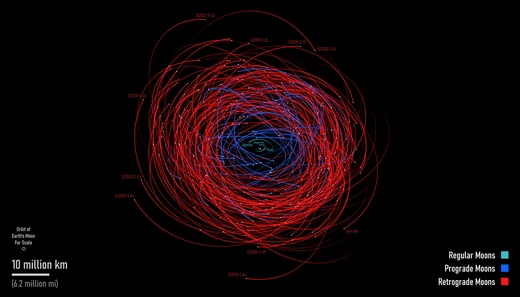
Aegir, also known as Saturn XXXVI (provisional designation S/2004 S 10), is a moon of Saturn. It was discovered by Scott S. Sheppard, David C. Jewitt, Jan Kleyna, and Brian G. Marsden, with the announcement made on May 4, 2005, based on observations from December 12, 2004, to March 11, 2005. The moon is roughly 4 kilometers across. It travels around Saturn at an average distance of 19,618 Mm, completing one orbit in 1025.908 days. Its orbit is retrograde, tilted 167° to the ecliptic (or 140° to Saturn's equator), and has an eccentricity of 0.237.
The moon received its name in April 2007, taken from Ægir, a giant in Norse mythology who personifies calm seas and soothes storms. Ægir is a son of Fornjót and brother of Logi (fire) and Kári (wind). In 2015, the exoplanet Epsilon Eridani b was also named Ægir. To tell the moon apart from the exoplanet, the moon is typically spelled with the letters "a" and "e" separate, while the exoplanet uses the combined character "Æ". If "Æ" cannot be typed, the exoplanet should be written as "AEgir". The name has several possible pronunciations, including one with a soft 'g' (like a y-sound) that matches modern Norwegian and Icelandic, a hard 'g' that approximates Old Norse, and Latinized or spelling-based versions such as , , and .
Quick Facts
- Discoverer
- S. Sheppard, D. Jewitt, J. Kleyna, and B. Marsden
- Discovered
- May 4, 2005
- Mpc Name
- Saturn XXXVI
- Pronounced
- ˈ · aɪ · j · ɪər · ,_ · ˈ · æ · g · ɪər etc.
- Named After
- Ægir
- Eccentricity
- 0.252
- Inclination
- 166.7°
- Satellite Of
- Saturn
- Group
- Norse group
- Mean Diameter
- 4 km
- Albedo
- 0.06 (assumed)
Facts from the source article.
Lore & Background
The moon was named in April 2007 after Ægir, a giant from Norse mythology, the personification of tranquil seas, the one who soothes storms away. He is a son of Fornjót, and brother of Logi (fire, flame) and Kári (wind). The exoplanet Epsilon Eridani b (Ægir) was also named after this figure in 2015. The generally accepted way to differentiate the moon from the exoplanet is to spell the moon with the letters 'a' and 'e' as two separate letters, but put them together for the exoplanet ('Æ'). If 'Æ' cannot be used, it is recommended to spell the exoplanet 'AEgir'.
The name may be pronounced various ways. One pronunciation (with the 'g' pronounced as a y-sound) approximates modern Norwegian and Icelandic. Another (with a hard 'g') approximates what the Old Norse may have sounded like, while the Latinized/spelling pronunciations are also found.
Reader's Guide
Aegir is one of Saturn's many irregular moons, discovered in 2005 by a team including Scott S. Sheppard, David C. Jewitt, Jan Kleyna, and Brian G. Marsden. Its small size, about 4 kilometres in diameter, and its highly inclined, retrograde orbit distinguish it from the planet's larger, regular satellites. The moon's naming in April 2007 connects it to Norse mythology, specifically the giant Ægir, who personifies tranquil seas. This mythological link is shared with the exoplanet Epsilon Eridani b, also named Ægir in 2015, leading to a spelling convention to differentiate the two: the moon uses separate 'a' and 'e' letters, while the exoplanet uses the ligature 'Æ'. The article notes multiple possible pronunciations of the name, reflecting its Old Norse origins and modern adaptations. Aegir's discovery and naming contribute to the catalog of Saturn's known moons and illustrate the ongoing process of identifying and designating celestial bodies in the outer solar system.
Did You Know?
- Aegir is about 4 kilometres in diameter.
- It orbits Saturn in a retrograde direction with an eccentricity of 0.237.
- The moon was named in April 2007 after the Norse giant Ægir.
Gallery




Frequently Asked Questions
What is Aegir (moon)?
Aegir is a tiny irregular retrograde satellite of Saturn, originally catalogued under the provisional label S/2004 S 10. It is only about 4 kilometers in diameter and belongs to the family of distant moons that circle far from the planet.
Who discovered Aegir and when was it announced?
Scott S. Sheppard, David C. Jewitt, Jan Kleyna, and Brian G. Marsden identified the moon from observations taken between December 2004 and March 2005. The discovery was made public on May 4, 2005.
What are Aegir's orbital characteristics?
Aegir orbits Saturn in a retrograde direction at a mean distance of roughly 19,618 million kilometers, completing a full revolution in about 1,026 days. Its path is strongly tilted at 167° to the ecliptic and carries an eccentricity of 0.237, giving it a noticeably stretched orbit.
Where does the name Aegir come from?
The name was officially assigned in April 2007 and is drawn from Norse mythology, where Aegir is a giant associated with the sea. This fits the long-standing convention of naming Saturn's irregular satellites after figures from various mythologies.
How does Aegir compare to other moons of Saturn?
At roughly 4 kilometers across, Aegir is one of the smallest known satellites in Saturn's system. Its highly inclined, eccentric retrograde orbit sets it apart from the larger, more orderly regular moons that hug the equatorial region.
More in Moons of Saturn 1-24
Spotted an error? Know more?
Reader corrections go straight into our review queue. Suggest an edit · How this site is sourced