Daphnis (moon)
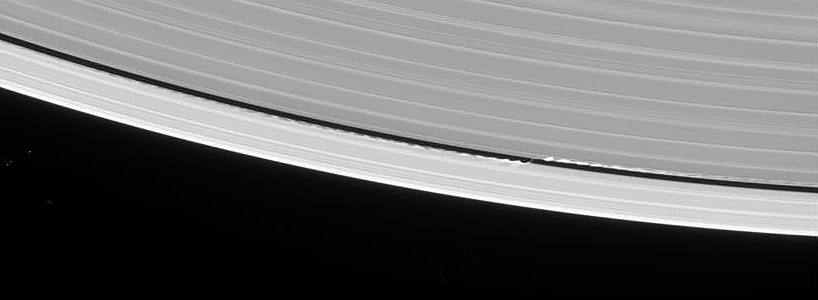
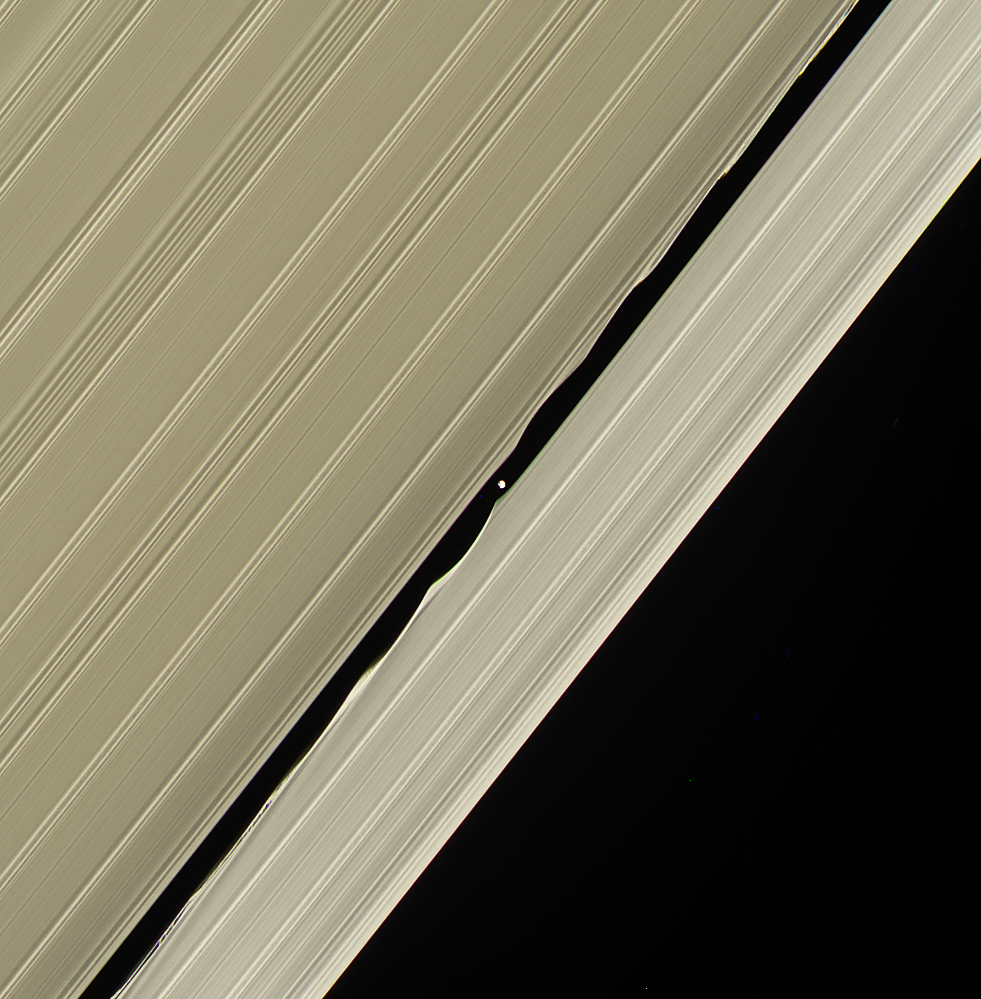
Shepherd moon orbiting within Saturn's Keeler Gap.

Kevin Gill from Los Angeles, CA, United States · CC BY 2.0
Daphnis is an inner satellite of Saturn, also known as Saturn XXXV, with the provisional designation S/2005 S 1. It is about 7.8 kilometers (4.8 mi) in diameter and orbits the planet in the Keeler Gap within the A ring. Daphnis is notable as one of only two known shepherd moons orbiting within Saturn's main rings, the other being Pan.
Quick Facts
- Pronounced
- ˈ · d · æ · f · n · ə · s
- Named After
- Δάφνις Daphnis
- Adjectives
- Daphnidian d · æ · f · ˈ · n · ɪ · d · i · ə · n
- Mpc Name
- Saturn XXXV
- Discoverer
- [https: · web.archive.org/web/20051212120914/http: · ciclops.org/team/iss_team.php Cassini Imaging Science Team]
- Discovered
- May 1, 2005
- Epoch
- 2005 May 1 09:56:20 / (JD 2453491.91412)
- Eccentricity
- 0.0000331 · 0.0000062
- Satellite Of
- Saturn
Facts from the source article.
Lore & Background
Before it was photographed, the existence of a moon in Daphnis's position had been inferred from gravitational ripples observed on the edges of the Keeler gap. The discovery of Daphnis was announced by the Cassini Imaging Science Team on May 10, 2005. Discovery images were taken by the Cassini probe over 16 minutes on May 1, 2005, from a time-lapse sequence of 0.180 second narrow-angle-camera exposures of the outer edge of the A ring. The moon was subsequently found in 32 low-phase images taken of the F ring on April 13, 2005 (spanning 18 minutes) and again in two high-resolution (3.54 km/pixel) low-phase images taken on May 2, 2005, when its 7 km disk was resolved.
The moon was named in 2006 after Daphnis, a shepherd, pipes player, and pastoral poet in Greek mythology; he was a descendant of the Titans, after whom the largest moons of Saturn are named. Both Daphnis and Pan, the only other known shepherd moon to orbit within Saturn's main rings, are named for mythological figures associated with shepherds.
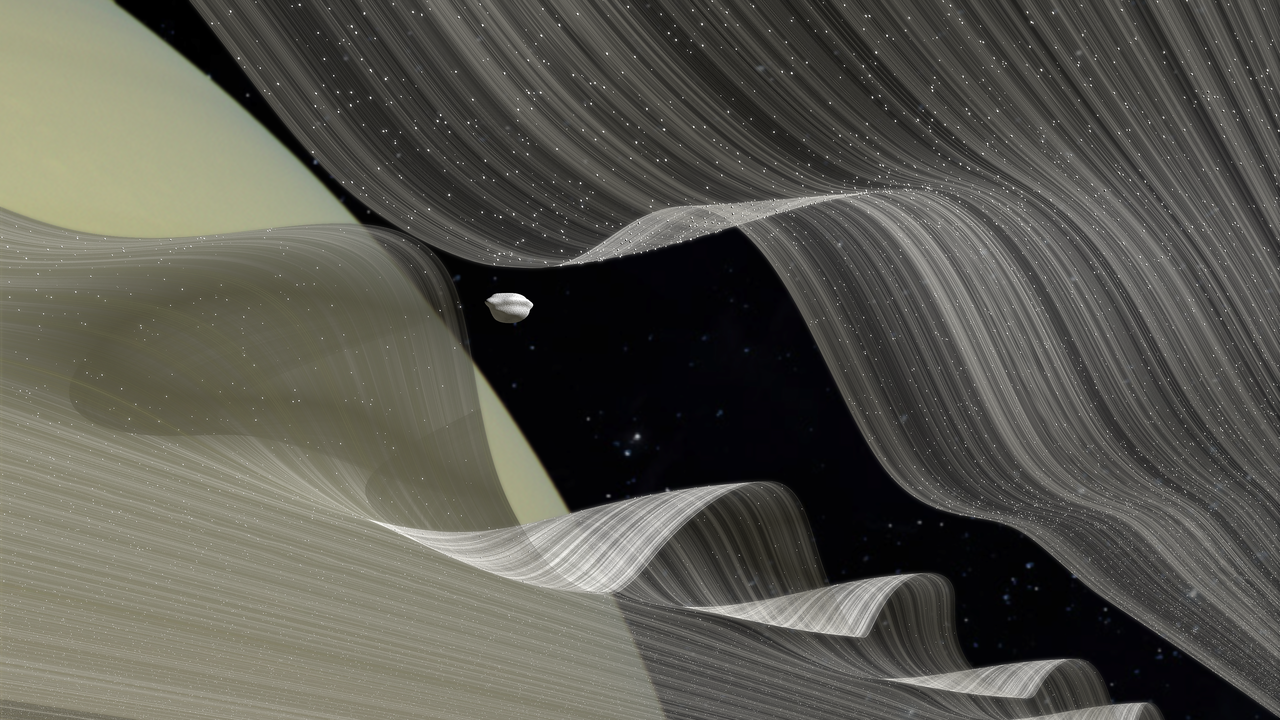
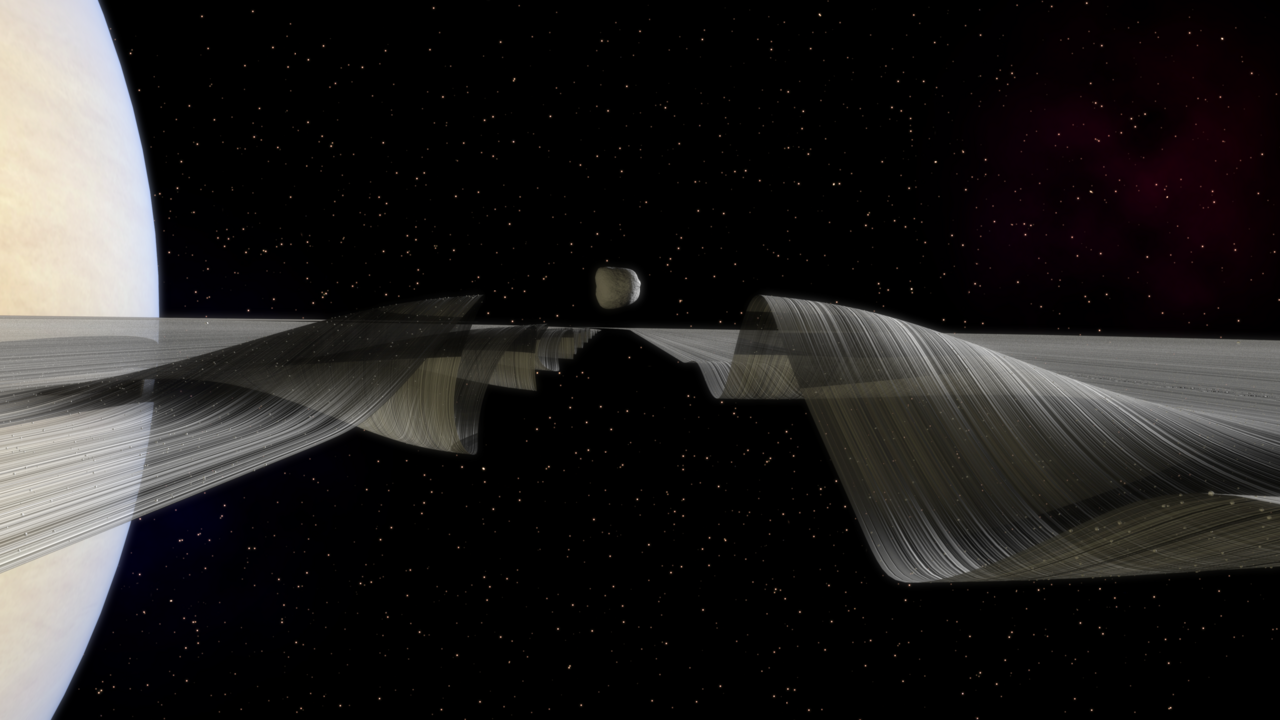
The inclination and eccentricity of Daphnis's orbit are very small but distinguishable from zero. Both, particularly the inclination, are significantly greater than those of Pan. Its eccentricity causes its distance from Saturn to vary by about 9 km, and its inclination causes it to move up and down by about 17 km. The Keeler Gap is about 42 km wide. As it orbits, Daphnis creates gravitational ripples on the edges of the gap as ring particles are attracted toward the moon and then fall back down. The waves on the inner edge precede it in orbit, while those on the outer edge lag behind. In a photograph taken on January 18, 2017, a tendril of ring particles was seen extending toward the moon, possibly from a moment when Daphnis drew a packet of material out of the ring.
Reader's Guide
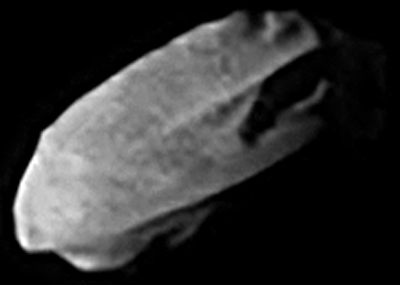
Daphnis's significance lies in its role as a shepherd moon within Saturn's A ring, actively shaping the Keeler Gap through gravitational interactions. Its discovery confirmed earlier inferences from ripple patterns, demonstrating how ring features can reveal unseen moons. The moon's small size and low density (expected porosity over 60%) suggest it is a rubble pile, likely covered in ring particles. Its equatorial ridge, only 1% of the moon's total volume, is thought to reflect density variations within the ring rather than its thickness. The 2017 close-up images revealed an irregular shape with a mostly smooth surface, a few craters, and an equatorial ridge, along with another ridge in the northern hemisphere extending roughly 90° in longitude. As one of only two known shepherd moons in Saturn's main rings, Daphnis provides a unique laboratory for studying moon-ring interactions and the dynamics of gap formation.
Did You Know?
- Daphnis is about 7.8 kilometers in diameter and orbits within the Keeler Gap of Saturn's A ring.
- Its existence was inferred from gravitational ripples on the edges of the Keeler gap before it was photographed.
- Daphnis was discovered by the Cassini Imaging Science Team on May 10, 2005, using images from the Cassini probe.
- The moon is named after Daphnis, a shepherd and pastoral poet in Greek mythology, and is one of only two shepherd moons in Saturn's main rings.
Discovery and Visual Confirmation
In November 2004, scientists working with the Cassini spacecraft announced that the structure of Saturn's rings indicated the presence of several additional moons orbiting within them. Daphnis distinguished itself from these inferred bodies by being the only one that had been visually confirmed at the time of the announcement. This made it a particularly significant find in the early months of the Cassini mission, which had arrived at Saturn in July 2004. The discovery underscored how ring architecture itself could serve as evidence for hidden moons, with gravitational perturbations leaving detectable signatures in the surrounding material. Daphnis's confirmation also set a methodological precedent for later announcements, including the 2007 identification of Anthe, the 2009 detection of Aegaeon within the G Ring, and the observation of S/2009 S 1 in the B Ring. Each of these subsequent finds built upon the groundwork laid by Daphnis's identification, reinforcing the understanding that Saturn's rings harbor a population of small orbiting bodies that had eluded earlier detection methods.
Orbital Position and Shepherd Role
Daphnis belongs to the group of twenty-five regular satellites that orbit Saturn in prograde paths closely aligned with the planet's equatorial plane. Unlike the larger rounded satellites such as Titan or Rhea, Daphnis is a small moonlet whose orbit places it within the broader ring system rather than in the open space between major moons. The regular satellites occupying such positions orbit near the edges of, or within gaps in, Saturn's main rings, and some of them serve as shepherd moons for the dense A Ring and the narrow F Ring. Daphnis is among these ring-embedded bodies, and its gravitational influence helps shape and maintain the structure of the ring material surrounding it. This shepherd role is one of the most dynamically interesting aspects of a small moon's existence: a body only hundreds of meters across can exert enough gravitational pull to carve gaps and create density waves in a ring spanning thousands of kilometers. Over 150 such moonlets have been detected in Saturn's rings by the disturbances they create in surrounding material, though scientists believe this represents only a small fraction of the true population.
Naming and Mythological Heritage
The naming of Saturn's regular satellites follows a tradition rooted in Greek mythology. These moons are traditionally given names drawn from the Titans, Titanesses, or other figures associated with the mythological Saturn. Daphnis fits squarely within this convention, taking its name from a figure in the Greek mythological pantheon. This practice distinguishes the regular satellites from the irregular ones, which are classified into the prograde Inuit and Gallic groups and the retrograde Norse group, with names chosen from the corresponding mythologies. The Gallic group, in particular, draws from Celtic tradition. Even within this system, exceptions exist: Phoebe, the largest irregular moon, belongs to the Norse group yet bears the name of a Greek Titaness. Daphnis, as a regular satellite, follows the more straightforward Titan-associated naming pattern. The fact that two regular moons, S/2009 S 1 and S/2009 S 2, remain unnamed also underscores that the mythological naming tradition, while long-standing, does not yet cover every confirmed body in Saturn's satellite system.
Place in Saturn's Vast Moon Population
As of June 2026, Saturn boasts 293 confirmed moons, the most of any planet in the Solar System. Daphnis occupies a modest but meaningful place within this extraordinary population. The moons range enormously in size, from tiny moonlets to Titan, which surpasses Mercury in diameter and ranks as the second-largest moon in the entire Solar System. Daphnis belongs to the small end of this spectrum, a moonlet among over 150 similar bodies detected within the rings. Yet the total count of Saturnian moons remains uncertain. The 293 confirmed figures do not include the countless ring moonlets or hundreds of possible kilometer-sized distant moons observed only on single occasions. There is no agreed-upon boundary between the small unnamed objects that constitute the ring system and the larger bodies designated as moons. Daphnis, therefore, exists in a category that is well-defined in its orbital mechanics yet somewhat fluid in its classification, reminding observers that Saturn's satellite family is still being catalogued and understood.
Gallery

Frequently Asked Questions
What is Daphnis (moon)?
Daphnis is a small inner satellite of Saturn, roughly 7.8 kilometers across, that circles the planet inside the A ring. It carries the official designation Saturn XXXV and was originally catalogued as S/2005 S 1 before receiving its mythological name.
Where does Daphnis orbit within Saturn's rings?
Daphnis travels through the Keeler Gap, a narrow clearing carved into Saturn's A ring. This places it as one of only two confirmed shepherd moons residing inside Saturn's main ring system, the other being Pan.
What makes Daphnis notable among Saturn's moons?
Daphnis earns its reputation as a shepherd moon, using its gravity to sculpt and maintain the Keeler Gap it inhabits. Its status as a ring-embedded shepherd makes it a rare and heavily studied object in the Saturnian system.
When and by whom was Daphnis discovered?
The Cassini Imaging Science Team identified Daphnis on May 10, 2005, during the Cassini-Huygens mission at Saturn. It was initially logged under the provisional label S/2005 S 1 before being formally named.
How big is Daphnis compared to other Saturn moons?
At approximately 7.8 kilometers (about 4.8 miles) in diameter, Daphnis is a compact, irregularly shaped inner satellite. It is comparable in scale to other small ring-region moons like Pan but remains one of the smaller objects in Saturn's retinue.
More in Moons of Saturn 1-24
Spotted an error? Know more?
Reader corrections go straight into our review queue. Suggest an edit · How this site is sourced