Enceladus
A small, icy moon with active geysers and a subsurface ocean.

Justin Cowart · Public domain
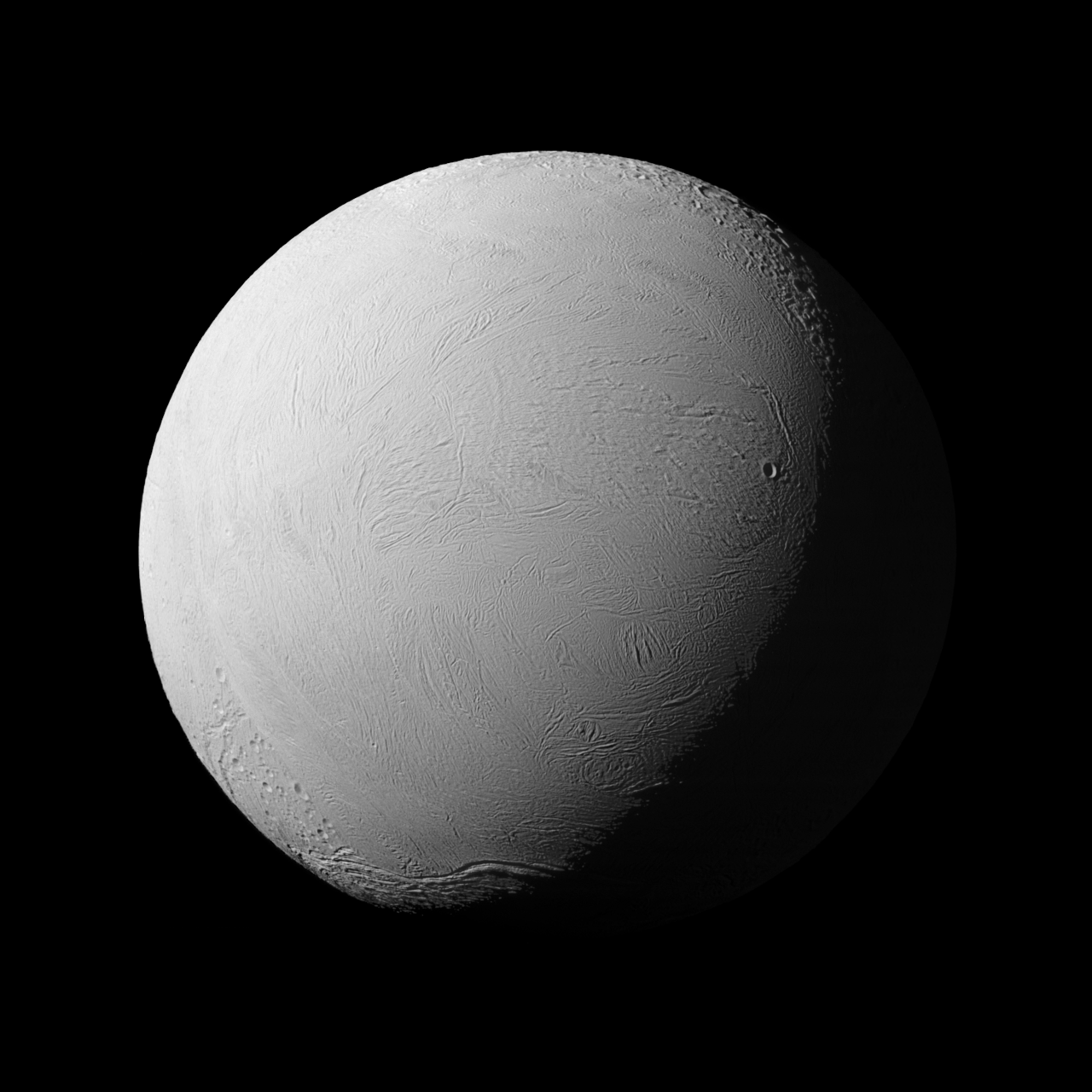
Enceladus is Saturn's sixth-largest moon and the 18th largest in the Solar System, with a diameter of about 500 kilometers—roughly one-tenth that of Titan, Saturn's biggest moon. Its surface is covered by hundreds of meters of clean, freshly deposited snow, making it one of the most reflective bodies in the Solar System. Because it reflects so much sunlight, its noontime surface temperature is only −198 °C, far colder than a darker object would be. Despite its small size, the moon displays a mix of ancient, heavily cratered terrain and younger, tectonically deformed regions.
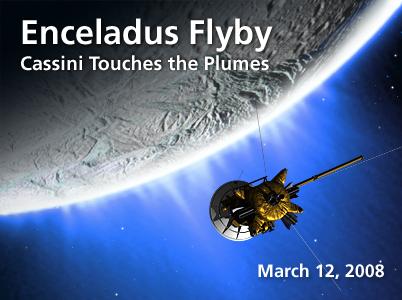
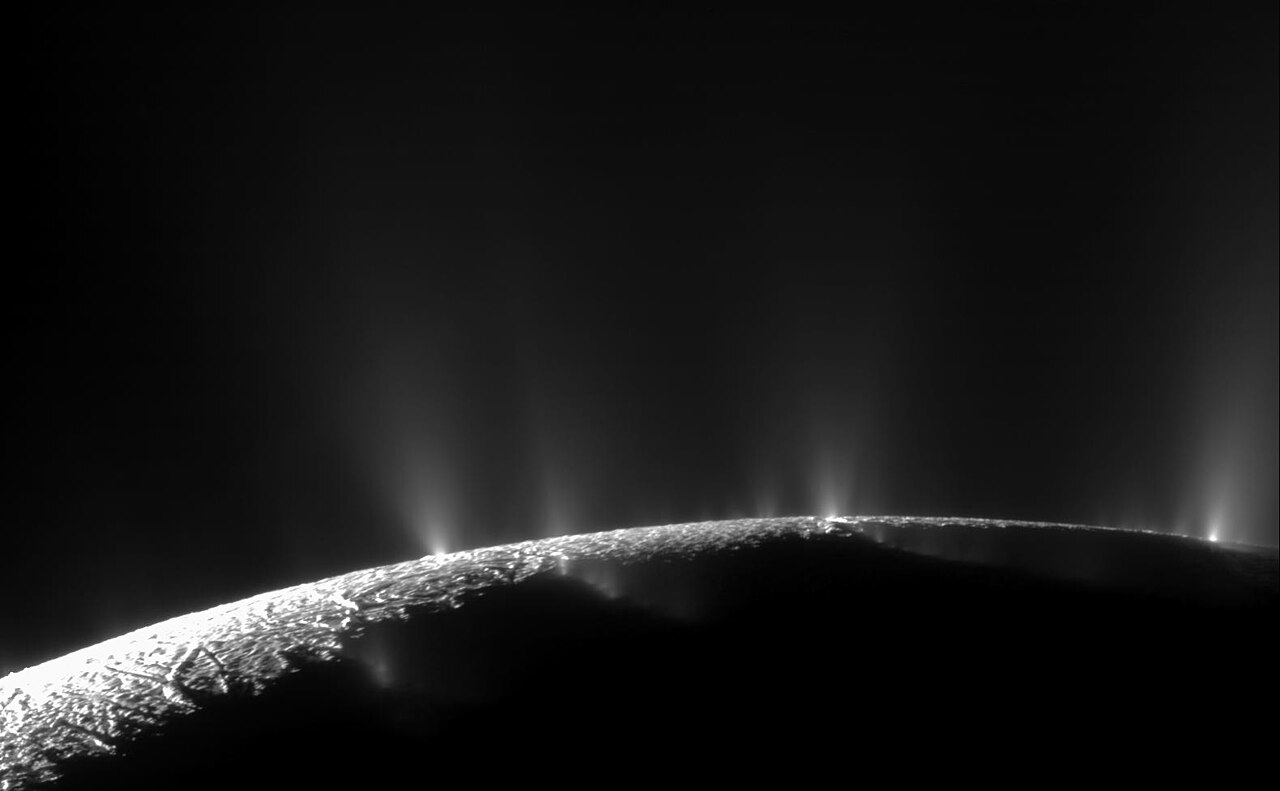
Discovered by William Herschel on August 28, 1789, using his new 1.2-meter telescope—then the largest in the world—Enceladus remained little more than a faint dot until the Voyager 1 and 2 flybys in 1980 and 1981. In 2005, the Cassini spacecraft began a series of close flybys, revealing the moon's surface and environment in unprecedented detail. Cassini detected water-rich plumes erupting from the south polar region. These cryovolcanoes shoot geyser-like jets of water vapor, molecular hydrogen, other volatiles, and solid material—including sodium chloride crystals and ice particles—into space at a rate of about 200 kilograms per second. Over 100 individual geysers have been identified. Some of the water vapor falls back as snow, building the thick reflective layer; the rest escapes and supplies most of the material for Saturn's E ring. NASA scientists have noted that the plumes' composition resembles that of comets. In 2014, Cassini found evidence for a large subsurface ocean of liquid water beneath the south pole, roughly 10 kilometers thick. This ocean's existence has since been confirmed through mathematical modeling.
The active cryoeruptions, along with escaping internal heat and a near-total lack of impact craters in the south polar region, indicate that Enceladus is currently geologically active. Like many moons of the giant planets, it is locked in an orbital resonance—in this case, a 2:1 resonance with Dione. This resonance forces Enceladus's orbit to be slightly eccentric (0.0047), and the resulting tidal deformation generates heat that drives its geological activity. Cassini's chemical analysis of the plumes found evidence of hydrothermal activity, which could support complex chemistry.
Quick Facts
- Pronounced
- ɛ · n · ˈ · s · ɛ · l · ə · d · ə · s
- Mpc Name
- Saturn II
- Named After
- Ἐγκέλαδος Enkélados
- Adjectives
- Enceladean ɛ · n · s · ə · ˈ · l · eɪ · d · i · ə · n
- Note
- yes
- Discoverer
- William Herschel
- Discovered
- August 28, 1789
- Periapsis
- 236 · 895 km
- Apoapsis
- 239 · 180 km
- Eccentricity
- 0.0047
- Inclination
- 0.009° (to Saturn's equator)
- Satellite Of
- Saturn
Facts from the source article.
Lore & Background
Enceladus was discovered by William Herschel on August 28, 1789, using his new 1.2 m (47 in) 40-foot telescope in Slough, England. Its faint apparent magnitude (HV = +11.7) and proximity to bright Saturn and its rings made it difficult to observe from Earth. Prior to the Voyager missions, only its orbital characteristics were known, with estimations of its mass, density, and albedo. The name Enceladus, from Greek mythology, was suggested by John Herschel in 1847.
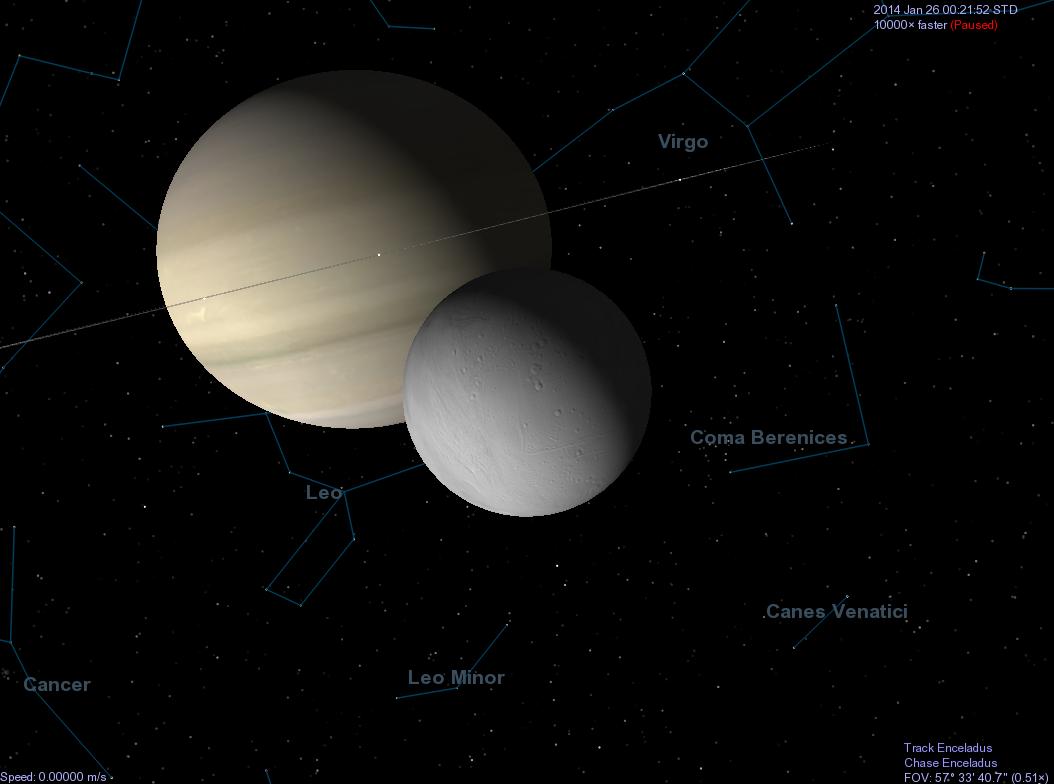
The moon is covered by clean, freshly deposited snow hundreds of meters thick, making it highly reflective. Its surface temperature at noon reaches only −198 °C. Despite its small size, Enceladus has a wide variety of surface features, from old, heavily cratered regions to young, tectonically deformed terrain. It orbits Saturn every 32.9 hours at a distance of 238,000 km from Saturn's center, within the densest part of Saturn's E ring, and is in a 2:1 orbital resonance with Dione, which excites its orbital eccentricity and drives tidal heating.
In 2005, the Cassini spacecraft discovered water-rich plumes venting from the south polar region. Cryovolcanoes near the south pole shoot geyser-like jets of water vapor, molecular hydrogen, other volatiles, and solid material, including sodium chloride crystals and ice particles, into space at a rate of about 200 kg per second. More than 100 geysers have been identified. Some of the water vapor falls back as snow; the rest supplies most of the material for Saturn's E ring. In 2014, NASA reported evidence for a large south polar subsurface ocean of liquid water about 10 km thick, which has since been mathematically modeled and replicated.
Reader's Guide
Enceladus is significant primarily for its active geology and potential habitability. The Cassini spacecraft's observations of active cryoeruptions, escaping internal heat, and few impact craters in the south polar region demonstrate that Enceladus is currently geologically active. Its orbital resonance with Dione excites its eccentricity, which is damped by tidal forces, heating its interior and driving this activity. Chemical analysis of the plumes found evidence for hydrothermal activity, possibly driving complex chemistry. Ongoing research suggests that Enceladus's hydrothermal environment could be habitable to some of Earth's hydrothermal vent microorganisms, and that methane found in the plumes could be produced by such organisms. The plumes also supply the material for Saturn's E ring, which is unstable and must be constantly replenished. Enceladus's subsurface ocean and active plumes make it a prime target for future astrobiological exploration, as it offers a potential environment for life beyond Earth.
Did You Know?
- Enceladus is about 500 km in diameter, roughly one-tenth the size of Saturn's largest moon, Titan.
- Its surface temperature at noon is only −198 °C, far colder than a light-absorbing body would be.
- More than 100 geysers have been identified near its south pole, shooting water vapor and ice particles into space.
- The plumes from Enceladus supply most of the material for Saturn's E ring.
Architecture Born from a Tiny World
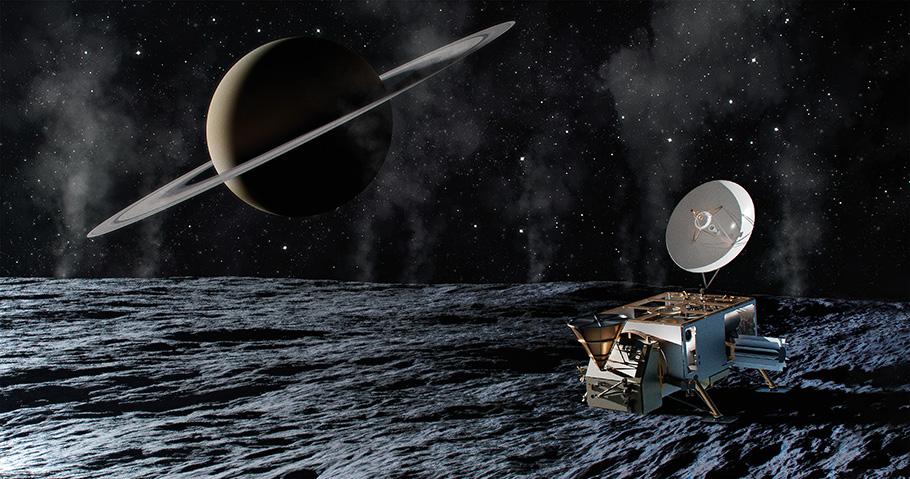
The Enceladus Orbilander represents a bold architectural choice that flows directly from the moon's physical characteristics. Because Enceladus is so small—just 500 kilometres across—its gravity is so weak that the propellant needed to touch down is essentially the same as what would be spent merely entering orbit. Shannon MacKenzie's team, working within the larger budget envelope of a Flagship-class mission, explored whether an orbiter, a lander, or some hybrid would best serve the science. The answer was a single spacecraft that does both: it orbits, it samples plumes, and then it lands. This elegant simplification eliminates the need for separate vehicles and their associated complexity. Priced at roughly $4.9 billion and ranked as the second-priority Flagship in the 2023–2032 Planetary Science Decadal Survey—just behind the Uranus Orbiter and Probe—the Orbilander was selected specifically because its exobiology and habitability focus addresses questions no previous mission has been able to answer directly.
What Cassini Revealed and Why It Matters
Enceladus sits at the 19th position among the largest bodies in our Solar System and is the sixth-largest moon orbiting Saturn. Before the 2010s, our knowledge of this ice world was limited to flybys by the twin Voyager spacecraft. The real transformation came with Cassini, whose 23 dedicated close encounters painted a startlingly different picture. The moon turned out to be geologically young, with terrain that had recently solidified, and its south polar region was erupting warm water plumes that stretched far beyond the surface into space. Beneath the ice, evidence pointed to a global subsurface ocean, and hydrothermal activity appeared to be the engine driving both the geysers and the moon's restless geology. Together, these findings elevated Enceladus to one of the most compelling targets in the entire Solar System for the search for life. Earlier follow-up concepts—Journey to Enceladus and Titan in the Discovery program, and the 2017 New Frontiers entries ELSAH and LIFE—each fell short of selection, leaving the Orbilander as the next serious attempt to return.
A Decade-Long Voyage to the Rings
The Orbilander's journey to Saturn is a masterclass in gravitational economics. A launch in October 2038 aboard a Space Launch System Block II with a Castor 30B upper stage—or, alternatively, a Falcon Heavy on a slower trajectory that includes Venus flybys—sets the spacecraft on its path. In October 2040, a Jupiter gravity assist conserves propellant that will be needed later. Saturn orbital insertion follows in August 2045, but the spacecraft does not head straight for Enceladus. Instead, it embarks on a 4.5-year tour of the Saturnian system, using gravity assists from Titan, Rhea, Dione, and Tethys to gradually lower its orbital inclination. Only after a series of targeted flybys of Enceladus itself does the spacecraft finally settle into orbit around the small moon. The entire transit, from launch to landing in the early 2050s, spans more than a decade—a reminder that reaching the outer Solar System remains one of the most demanding engineering challenges in spaceflight.
Touching Down on a World of Ice
Once in a 12-hour elliptical orbit, the Orbilander spends a year and a half sweeping over Enceladus's south polar tiger stripes, where the closest approach lets it harvest plume particles and gather remote-sensing data. Three distinct sampling systems cover each operational phase: a one-square-metre funnel that passively catches airborne particles, a mechanical scoop for active collection once on the ground, and a gas inlet designed to capture volatile emissions. When mission controllers are satisfied with the orbital data, they use high-resolution imagery to define a safe landing ellipse. The spacecraft then lowers its orbit and begins a powered descent, relying on terrain-relative navigation—the same approach that guided OSIRIS-REx—to dodge hazards. At ten metres above the surface, the main engine cuts off to prevent contamination, and the vehicle pitches onto its side for a soft touchdown. What follows is a two-year surface campaign to examine materials and search for evidence of life, a goal that has eluded every previous mission to this moon.
Gallery
Frequently Asked Questions
What is Enceladus?
Enceladus is Saturn's sixth-largest moon and the 18th-largest object in the Solar System, measuring roughly 500 kilometers across. It is a small icy body best known for its active south-pole geysers and a hidden liquid-water ocean beneath its frozen crust.
Who discovered Enceladus and when?
William Herschel first observed Enceladus on August 28, 1789, while surveying Saturn's satellite system. The moon circles Saturn at a mean distance of about 238,000 kilometers from the planet's center, completing one orbit every 32.9 hours.
Why is Enceladus so bright and reflective?
Its surface is buried under hundreds of meters of pristine, recently deposited ice, giving the moon one of the highest albedos in the entire Solar System. Because so little sunlight is absorbed, the noontime surface temperature stays near −198 °C, far colder than a darker body of the same size would be.
Does Enceladus have a subsurface ocean?
Yes, a global layer of liquid water exists beneath the ice shell, and it is widely believed to feed the plumes erupting from the south-polar region. Those geysers fling water vapor, ice grains, and organic molecules into space, continuously refreshing the surface snow.
How does Enceladus compare in size to Titan?
At roughly 500 kilometers in diameter, Enceladus is about one-tenth the size of Titan, Saturn's largest moon. Despite its modest scale, the moon shows a striking mix of ancient, heavily cratered terrain alongside younger regions reshaped by tectonic activity.
More in Moons of Saturn 1-24
Spotted an error? Know more?
Reader corrections go straight into our review queue. Suggest an edit · How this site is sourced