Atlas (moon)
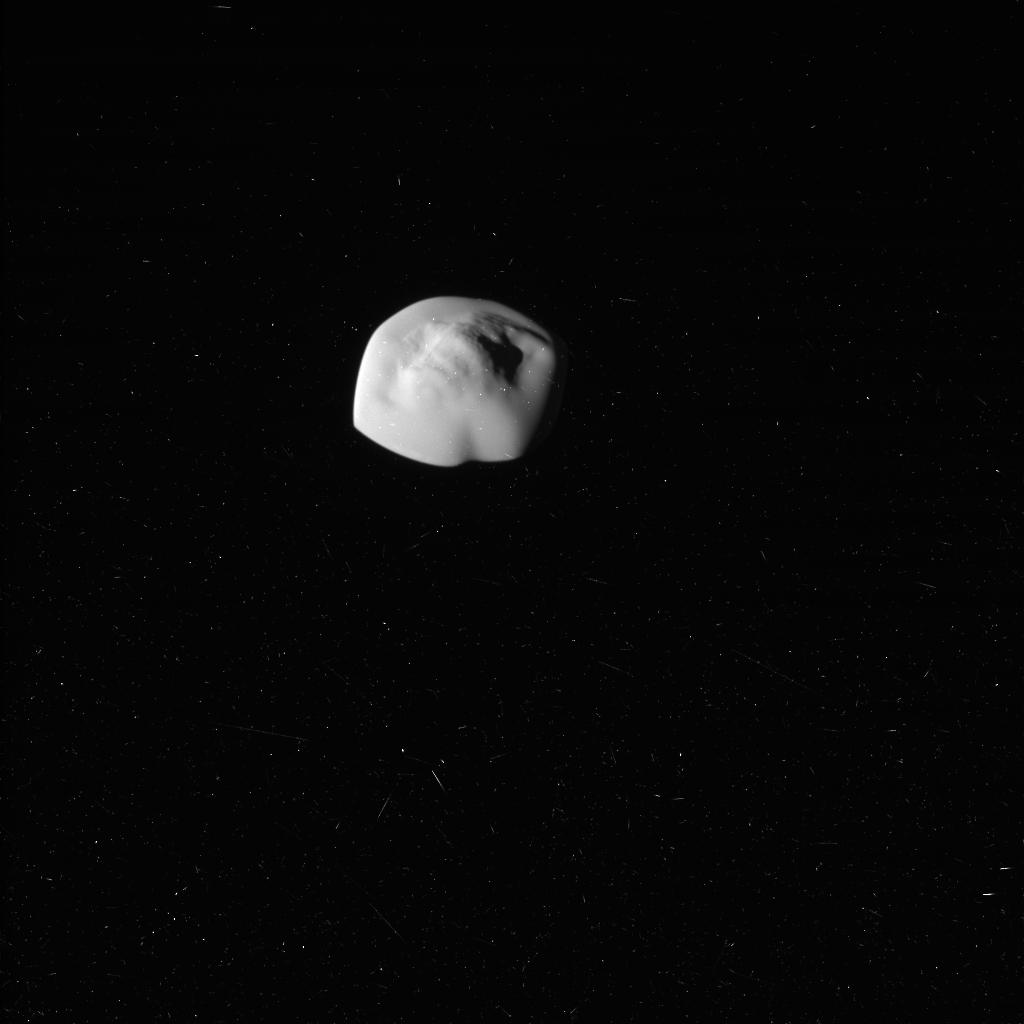
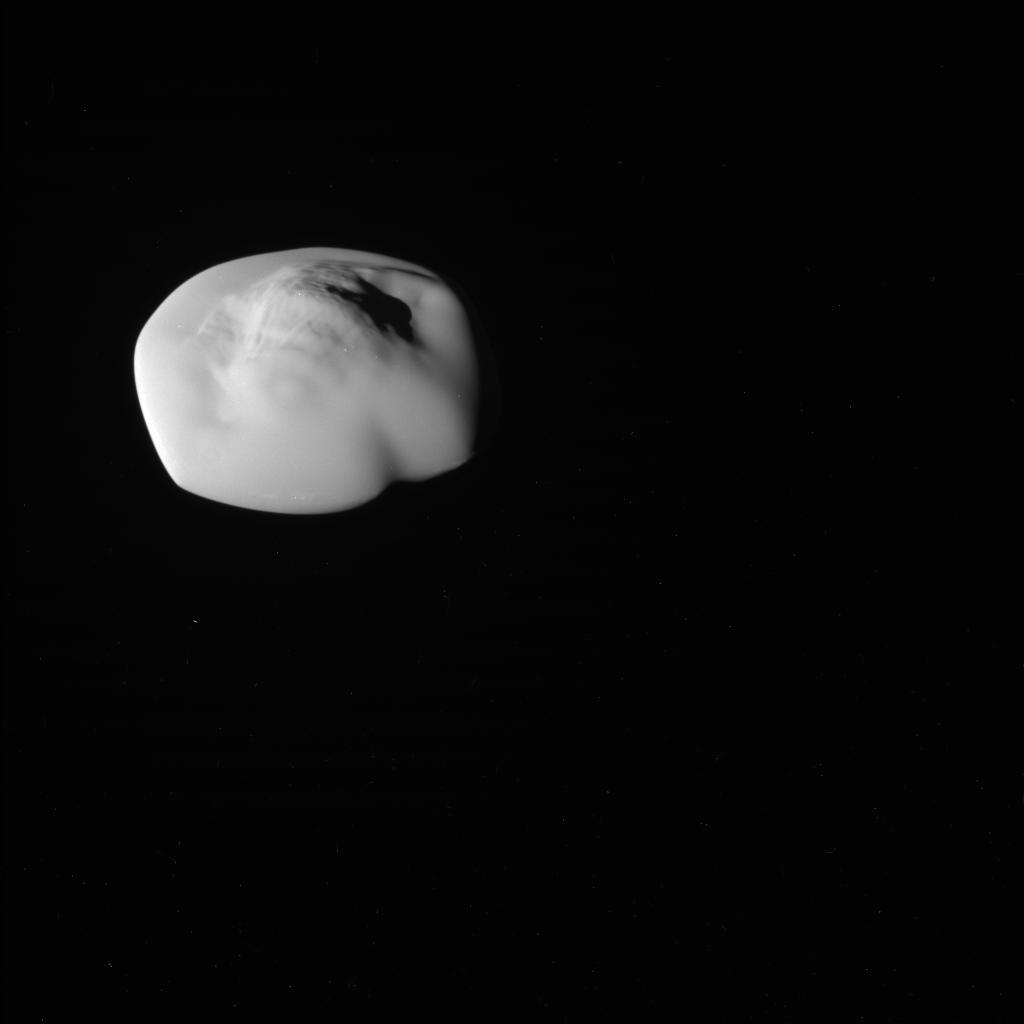
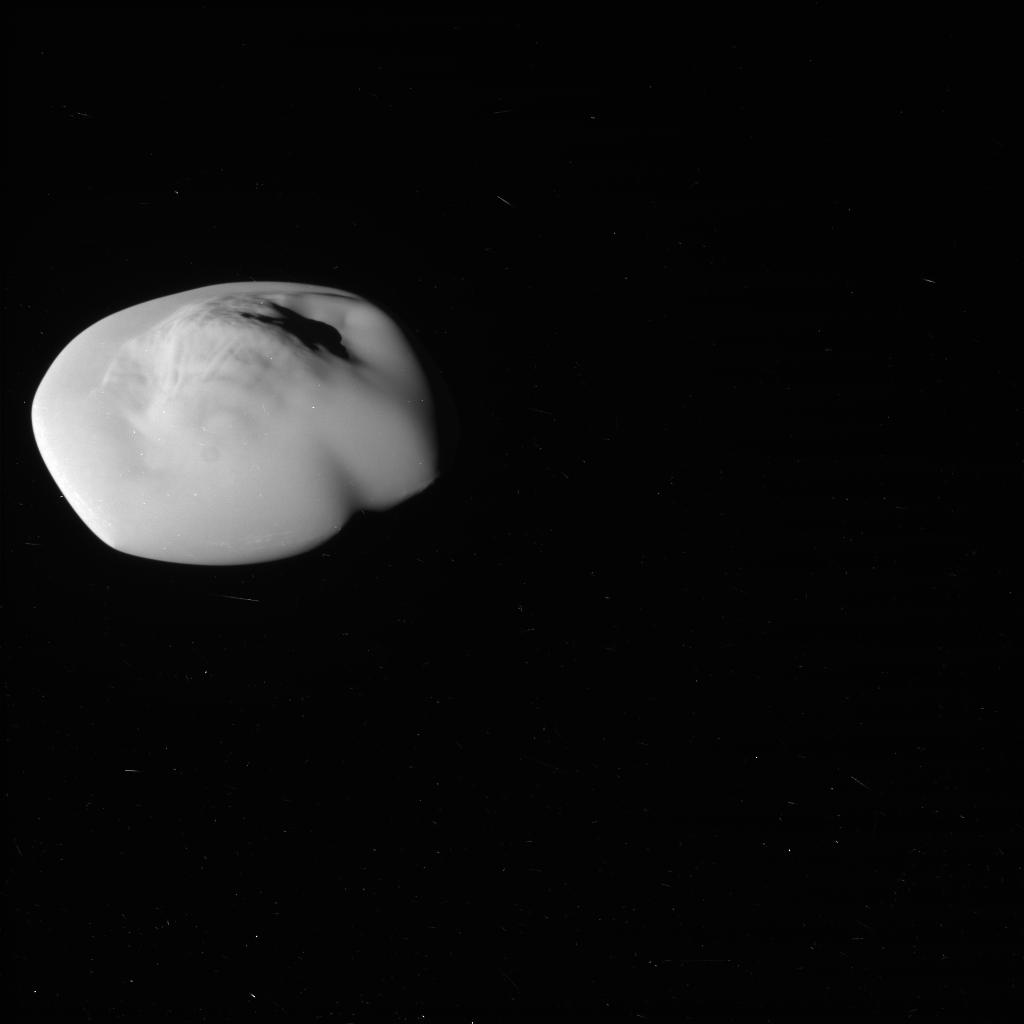
Inner Saturnian moon with a prominent equatorial ridge.

NASA/GSFC/Arizona State University · Public domain
Atlas orbits Saturn as an inner moon, first spotted by Richard Terrile in 1980 using images from the Voyager spacecraft. Initially cataloged as S/1980 S 28, it later received the permanent designation Saturn XV. Its name, officially assigned in 1983, comes from the Titan of Greek mythology who held up the sky, chosen because this moon appears to "hold the rings on its shoulders."
This satellite travels closer to the sharp outer boundary of Saturn’s A ring than any other known moon. For a long time, astronomers thought Atlas acted as a shepherd, keeping that ring edge in place—likely the reason behind its mythological name. However, it is now understood that a 7:6 orbital resonance with the larger, more distant moons Janus and Epimetheus actually maintains that edge. In 2004, a faint, thin ring—temporarily called R/2004 S 1—was found sharing Atlas’s orbit.
Atlas experiences significant gravitational disturbances from Prometheus and, to a lesser extent, from Pandora. These perturbations cause its longitude to shift by up to 600 kilometers (about 0.25°) away from what a precessing Keplerian orbit would predict, with a rough cycle of roughly three years. The moon’s orbit is chaotic, with a Lyapunov time of about ten years.
Physically, Atlas is unusual. High-resolution images from the Cassini spacecraft in June 2005 revealed a roughly spherical core surrounded by a large, smooth equatorial ridge. The leading explanation is that ring material swept up by the moon accumulates preferentially at the equator because the ring is so thin. The ridge’s size is comparable to the moon’s Roche lobe; any additional particles hitting the equator would experience centrifugal force nearly strong enough to overcome Atlas’s weak gravity, and they would likely be lost.
This equatorial ridge is prominent and roughly polygonal, extending 20–50° from the equator and making up about 25% of Atlas’s total volume. It appears completely smooth at the best available image resolution, with a seamless transition between the ridge and the moon’s core section.
Quick Facts
- Mpc Name
- Saturn XV
- Adjectives
- Atlantean æ · t · l · æ · n · ˈ · t · iː · ə · n
- Pronounced
- ˈ · æ · t · l · ə · s
- Named After
- Ἄτλας Ātlās
- Discoverer
- Terrile, Voyager 1
- Discovered
- October, 1980
- Eccentricity
- 0.00116
- Satellite Of
- Saturn
Facts from the source article.
Lore & Background
Atlas was discovered by Richard Terrile in 1980 from Voyager photos and was designated S/1980 S 28. In 1983, it was officially named after Atlas of Greek mythology because it 'holds the rings on its shoulders' like the Titan Atlas held the sky. It is also designated Saturn XV. Atlas is the closest satellite to the sharp outer edge of the A ring and was long thought to be a shepherd satellite for this ring, which was probably the reason for its name. However, it is now known that the outer edge of the ring is instead maintained by a 7:6 orbital resonance with the larger but more distant moons Janus and Epimetheus. In 2004, a faint, thin ring, temporarily designated R/2004 S 1, was discovered in the Atlantean orbit.
Atlas is significantly perturbed by Prometheus and to a lesser degree by Pandora, leading to excursions in longitude of up to 600 km (~0.25°) away from the precessing Keplerian orbit with a rough period of about 3 years. The orbit of Atlas is chaotic, with a Lyapunov time of 10 years. High-resolution images taken in June 2005 by Cassini revealed Atlas to have a roughly spherical centre surrounded by a large, smooth equatorial ridge. The most likely explanation for this unusual and prominent structure is that ring material swept up by the moon accumulates on the moon, with a strong preference for the equator due to the ring's thinness. The size of the equatorial ridge is comparable with the expected Roche lobe of the moon, meaning that for any additional particles impacting the equator, the centrifugal force will nearly overcome Atlas's tiny gravity, and they will probably be lost.
Reader's Guide
Atlas holds significance as a small inner moon of Saturn whose orbit and physical characteristics are intimately tied to the planet's ring system. Its discovery in 1980 from Voyager photos added to the catalog of Saturn's numerous small satellites. The moon's naming after the Titan Atlas reflects its perceived role in 'holding' the A ring, though later observations revealed that the ring's outer edge is actually maintained by orbital resonance with Janus and Epimetheus. The discovery in 2004 of a faint ring in Atlas's orbit further connects it to the ring environment. Atlas's chaotic orbit, with a Lyapunov time of 10 years, and its significant perturbations by Prometheus and Pandora, demonstrate the complex gravitational interactions among Saturn's inner moons. The most striking legacy from Cassini imagery is Atlas's unusual shape: a roughly spherical core with a large, smooth equatorial ridge that comprises about 25% of its total volume. This ridge is thought to result from the accumulation of ring material preferentially at the equator, and its size being comparable to the Roche lobe suggests a dynamic equilibrium where additional material is likely lost. This makes Atlas a key object for understanding moon-ring interactions and the processes that shape small satellites in dense ring environments.
Discovery by the Voyager Missions
Atlas joined the catalog of Saturnian moons during a transformative era in planetary science. When the uncrewed Voyager spacecraft reached Saturn in 1980 and 1981, the mission yielded the identification of three previously unknown satellites: Atlas, Prometheus, and Pandora. This single flyby pushed the confirmed count to seventeen, a dramatic leap from the era of direct optical observation and early photographic plates. The Voyager era marked a fundamental shift in how scientists studied the outer planets, replacing ground-based telescopes with close-range imaging from spacecraft in orbit. Atlas's discovery was part of this broader revolution, adding to a roster that had grown slowly over three centuries—from Christiaan Huygens's 1655 sighting of Titan through the incremental additions of Cassini, Herschel, and the Bond brothers. The spacecraft's vantage point allowed observers to detect small bodies nestled among the rings that no telescope on Earth could have resolved with confidence.
Shepherd of the A Ring
Among Saturn's twenty-five regular satellites, Atlas occupies a dynamically significant niche. Rather than cruising in a wide, empty orbit, it travels near the edges of or within the gaps that separate Saturn's major ring structures. In this position, Atlas functions as a shepherd moon of the dense A Ring, its gravitational influence helping to confine and shape the countless particles that make up that ring. The A Ring itself is composed of objects spanning an enormous size range—from microscopic grains to moonlets hundreds of meters across—each tracing its own individual path around the planet. Atlas's proximity to this ring material means it interacts continuously with the surrounding debris, playing a quiet but essential role in maintaining the ring's structure. This shepherd behavior is shared by a handful of other regular satellites positioned at the boundaries of the main rings, collectively acting as gravitational custodians of Saturn's most prominent ring features.
A Regular Satellite in a Vast System
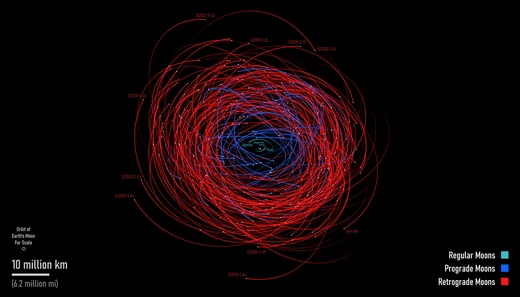
As of June 2026, Saturn claims 293 confirmed moons in stable orbits, the highest count of any planet in the Solar System. Atlas is one of just twenty-five classified as a regular satellite, distinguished by its prograde orbit that lies close to Saturn's equatorial plane without significant inclination. This places it in a fundamentally different dynamical category from the 268 irregular satellites—bodies with high inclinations, eccentric paths, and mixed prograde and retrograde motions that orbit much farther out. The regular group includes the seven rounded satellites and four small trojan companions of the larger moons, while Atlas belongs to the subset that orbits at the peripheries of the main ring system. The sheer diversity of Saturn's satellite population, from the tiny moonlets to Titan (which exceeds Mercury in size), makes Atlas's modest, orderly orbit a reminder that not every companion of the ringed planet is a world unto itself.
Mythological Heritage in Its Name
The naming of Saturn's regular satellites follows a tradition rooted in classical mythology. Atlas, like its fellow regular companions, takes its name from the Titans, Titanesses, or other figures from the mythological retinue associated with the Roman god Saturn. This convention creates a coherent thematic thread through the group: the rounded giants and the small ring-shepherds alike bear names drawn from the same ancient pantheon. The irregular satellites, by contrast, follow a different mythological logic—the prograde Inuit and Gallic groups draw from Norse and Celtic traditions respectively, while the large retrograde Norse group takes its names from Norse mythology. Phoebe stands as the sole exception to this system, a Norse-group member bearing a Greek Titaness name. Within this elaborate naming architecture, Atlas's designation connects a small ring-adjacent moon to the broader mythological family of Saturn's companions, reinforcing the classical association between the planet and its entourage of named bodies.
Gallery

Frequently Asked Questions
What is Atlas (moon)?
Atlas is one of Saturn's inner moons, officially designated Saturn XV. It was first identified in 1980 by Richard Terrile while reviewing images captured by the Voyager spacecraft.
What role does Atlas play in Saturn's ring system?
Atlas orbits right at the sharp outer edge of Saturn's A ring, closer than any other known moon. For years, astronomers believed it acted as a shepherd, helping to keep that ring boundary defined.
How was Atlas discovered?
Richard Terrile spotted the moon in 1980 using Voyager imagery, and it was initially logged under the temporary designation S/1980 S 28. It later received its permanent name and official Saturn XV designation.
Why is it called Atlas?
The name was officially assigned in 1983 after the Greek Titan who held up the sky. The choice reflects the moon's position, which makes it appear as though it is supporting the A ring on its shoulders.
What does Atlas look like?
Atlas is a small inner Saturnian moon characterized by a prominent equatorial ridge that runs along its surface.
More in Moons of Saturn 1-24
Spotted an error? Know more?
Reader corrections go straight into our review queue. Suggest an edit · How this site is sourced