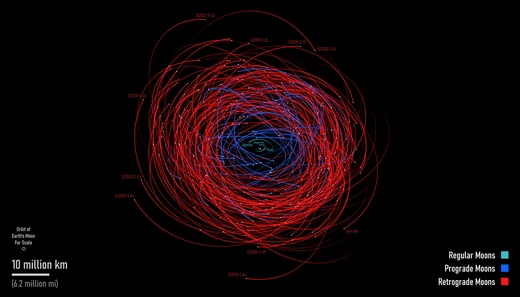
Anthe (moon)
A tiny Saturnian moon discovered by the Cassini Imaging Team.

Sir Morosus · CC BY-SA 3.0
Anthe is a tiny moon of Saturn, orbiting between the larger moons Mimas and Enceladus. Officially designated Saturn XLIX and originally called S/2007 S 4, it holds the title of Saturn's sixtieth confirmed satellite. Its name, drawn from one of the Alkyonides, means "flowery."
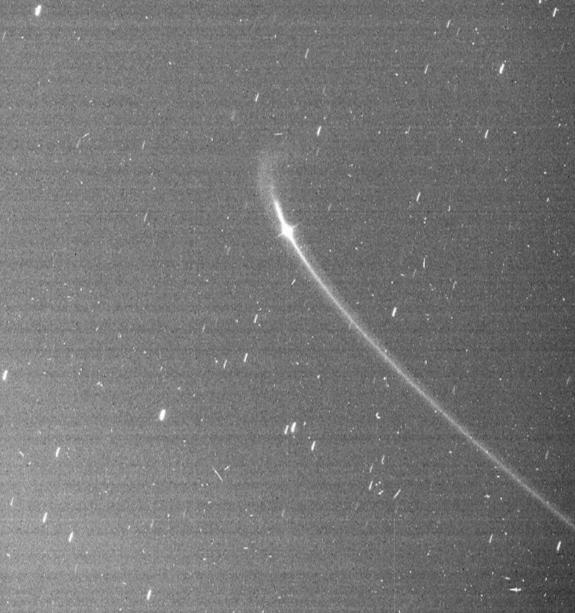
The Cassini Imaging Team spotted Anthe in pictures taken on May 30, 2007. After the discovery, scientists found it in older Cassini images dating back to June 2004. The find was first announced on July 18, 2007. The designation S/2007 S 4 was also accidentally and incorrectly used for a different Saturnian satellite discovered later. The published discovery was retracted a few hours later and republished the next day under the correct name of S/2007 S 5. Anthe is strongly influenced by a 10:11 mean-longitude resonance with the much larger Mimas. This interaction causes the moon's orbital elements to shift, with its semi-major axis varying by about 20 kilometers over roughly two Earth years. Because its orbit lies so close to those of Pallene and Methone, these three moons may form a dynamical family. The moon's shape is similar to Methone's: the ratio of its medium axis to its long axis is about 0.7, and the ratio of its short axis to its medium axis is about 0.95. Micrometeoroid impacts knock material off Anthe, and this debris is thought to create the Anthe Ring Arc—a faint, partial ring around Saturn that shares the moon's orbit. This ring arc was first detected in June 2007.
Quick Facts
- Discoverer
- Cassini Imaging Team Cassini Imaging Team
- Pronounced
- ˈ · æ · n · θ · iː
- Adjective
- Anthean æ · n · ˈ · θ · iː · ə · n
- Named After
- Άνθη Anthē
- Mpc Name
- Saturn XLIX
- Discovered
- May 30, 2007
- Orbit Ref
- Cooper et al. · 2008
- Epoch
- 2007 May 30 04:02:02.511 UTC / (JED 2454250.66883907)
- Eccentricity
- 0.0012 · 0.0008
- Satellite Of
- Saturn
- Avg Speed
- 13.824 km/sIAUC 8857
- Period
- 1.036517 dCiarniello et al. · 2024
Facts from the source article.
Lore & Background
Anthe was discovered by the Cassini Imaging Team in images taken on 30 May 2007. Once the discovery was made, a search of older Cassini images revealed it in observations from as far back as June 2004. It was first announced on 18 July 2007. The provisional designation S/2007 S 4 was also accidentally and incorrectly used for a different Saturnian satellite discovered later; the published discovery was retracted a few hours later and republished the next day under the correct name of S/2007 S 5. Anthe is visibly affected by a perturbing 10:11 mean-longitude resonance with the much larger Mimas. This causes its osculating orbital elements to vary with an amplitude of about 20 km in semi-major axis on a timescale of about 2 Earth years. The close proximity to the orbits of Pallene and Methone suggests that these moons may form a dynamical family. The ratio of Anthe's medium axis to its long axis is ≈0.7, and the ratio of its short axis to its medium axis is ≈0.95, implying that it has a similar shape to Methone. Material blasted off Anthe by micrometeoroid impacts is thought to be the source of the Anthe Ring Arc, a faint partial ring about Saturn co-orbital with the moon first detected in June 2007.
Reader's Guide
Anthe's significance lies in its role as a member of a possible dynamical family with Pallene and Methone, as suggested by their close orbital proximity. Its perturbing 10:11 mean-longitude resonance with Mimas provides insight into the gravitational interactions that shape the orbits of small moons. The discovery of the Anthe Ring Arc, a faint partial ring co-orbital with the moon, demonstrates how micrometeoroid impacts on tiny satellites can generate tenuous ring material. The accidental misassignment of its provisional designation to another moon highlights the challenges of identifying and cataloging small bodies in the Saturn system. As the sixtieth confirmed moon of Saturn, Anthe contributes to the understanding of the planet's satellite population and the dynamical processes affecting small moons.
Discovery and a Designation Mix-Up
Anthe was identified by the Cassini Imaging Team working with photographs captured on May 30, 2007. After the initial detection, researchers combed through earlier Cassini imagery and spotted the tiny body in observations stretching back to June 2004, confirming it was a persistent object rather than a transient feature. The discovery was formally announced on July 18, 2007, making Anthe the sixtieth confirmed satellite of Saturn. It received the provisional label S/2007 S 4, and its permanent name was drawn from one of the Alkyonides, a word that carries the meaning "flowery." In a curious administrative hiccup, the same provisional designation S/2007 S 4 was mistakenly assigned to a different, later-discovered Saturnian moon. The error was caught within hours, the original publication was retracted, and the correct announcement followed the next day under the proper label S/2007 S 5, preserving Anthe's identity in the official record.
Orbital Neighborhood and Resonance with Mimas
Anthe occupies a narrow band of space between the orbits of Mimas and Enceladus, placing it firmly among Saturn's inner small satellites. Its orbital path is not entirely free: it is visibly perturbed by a 10:11 mean-longitude resonance with the far more massive Mimas. This gravitational interplay causes Anthe's osculating orbital elements to oscillate, with its semi-major axis shifting by roughly 20 kilometers over a cycle of about two Earth years. Anthe also shares its orbital region with two other tiny moons, Pallene and Methone. Their close proximity in orbital space has led researchers to propose that these three bodies may constitute a dynamical family, perhaps sharing a common origin or having been shaped by similar gravitational forces over long timescales. The resonance with Mimas ensures that Anthe's orbit is never perfectly static, giving it a subtle, breathing quality that distinguishes it from a simple Keplerian path.
Shape and Physical Form
Anthe is an extremely small natural satellite, and its physical form has been characterized through shape analysis that reveals a distinctly non-spherical geometry. The ratio of its medium axis to its long axis is approximately 0.7, while the ratio of its short axis to its medium axis is approximately 0.95. These proportions indicate a body that is elongated along one axis but relatively rounded in cross-section, a profile that closely mirrors the shape of its neighbor Methone. The similarity in form between the two moons reinforces the broader hypothesis that Anthe, Methone, and Pallene may belong to the same dynamical family, having experienced comparable gravitational histories in their shared orbital neighborhood. As one of the smallest confirmed moons in the Saturnian system, Anthe's modest dimensions mean its surface retains the irregular, somewhat lumpy geometry described by its axis ratios rather than settling into a smooth, rounded form.
The Anthe Ring Arc
Perhaps the most visually striking association with Anthe is the faint partial ring structure that shares its orbit around Saturn. First detected in June 2007, the Anthe Ring Arc is a tenuous, incomplete ring co-orbital with the moon. The prevailing explanation for its existence is that micrometeoroid impacts strike Anthe's surface, blasting small particles of material into orbit. These fragments then populate a narrow band of space along the moon's path, forming the visible arc rather than a complete, continuous ring. The partial nature of the arc, covering only a segment of the orbital path, distinguishes it from Saturn's main rings and ties its structure directly to the moon's own surface activity. The detection of this ring arc was part of a broader effort that identified similar tenuous arcs around other tiny inner moons of Saturn, demonstrating that even the smallest satellites can leave a visible, measurable signature in their planetary environment through the simple physics of impact and ejection.
Gallery




Frequently Asked Questions
What is Anthe (moon)?
Anthe is a very small natural satellite of Saturn, recognized as the planet's sixtieth confirmed moon. It circles the gas giant in the region between the larger moons Mimas and Enceladus.
How was Anthe discovered?
Members of the Cassini Imaging Team first identified Anthe in spacecraft imagery captured on May 30, 2007. The find was made public on July 18, 2007, and researchers subsequently located the moon in earlier Cassini photos stretching back to June 2004.
Where does Anthe orbit relative to other Saturn moons?
Anthe completes its orbit in the gap between Mimas and Enceladus, two of Saturn's more prominent inner satellites.
What does the name Anthe mean?
The name is borrowed from one of the Alkyonides figures in Greek mythology and carries the meaning 'flowery.'
What is Anthe's official designation?
It holds the formal label Saturn XLIX, and it was initially catalogued under the provisional name S/2007 S 4 at the time of its discovery.
More in Moons of Saturn 1-24
Spotted an error? Know more?
Reader corrections go straight into our review queue. Suggest an edit · How this site is sourced