Calypso (moon)
A small, highly reflective trojan moon of Saturn.

Frits De Jong · CC0
Calypso is a natural satellite of Saturn, discovered in 1980 from ground-based observations by Dan Pascu, P. Kenneth Seidelmann, William A. Baum, and Douglas G. Currie. It is notable for being co-orbital with the moon Tethys, residing in Tethys's trailing Lagrangian point (L5), 60 degrees behind Tethys, and is one of four known trojan moons.
Quick Facts
- Pronounced
- k · ə · ˈ · l · ɪ · p · s · oʊ
- Adjectives
- Calypsoan k · æ · l · ᵻ · p · ˈ · s · oʊ · . · ə · n, Calypsonian k · æ · l · ᵻ · p · ˈ · s · oʊ · n · i · ə · n
- Named After
- Καλυψώ Kalypsō
- Mpc Name
- Saturn XIV
- Discoverer
- Dan Pascu / P. Kenneth Seidelmann / William A. Baum / Douglas G. Currie
- Discovered
- March 13, 1980
- Eccentricity
- 0.001
- Inclination
- 1.56° (to Saturn's equator)
- Satellite Of
- Saturn
Facts from the source article.
Lore & Background
Calypso was discovered in 1980 from ground-based observations by Dan Pascu, P. Kenneth Seidelmann, William A. Baum, and Douglas G. Currie, and was provisionally designated S/1980 S 25. Several other apparitions were recorded in the following months: S/1980 S 29, S/1980 S 30, S/1980 S 32, and S/1981 S 2. In 1983 it was officially named after Calypso of Greek mythology. It is also designated Saturn XIV or Tethys C.
Calypso is co-orbital with the moon Tethys, residing in Tethys's trailing Lagrangian point (L5), 60 degrees behind Tethys. This relationship was first identified by Seidelmann et al. in 1981. The moon Telesto resides in the other (leading) Lagrangian point of Tethys. Calypso and Telesto have been termed 'Tethys trojans', by analogy to the trojan asteroids, and are half of the four presently known trojan moons.
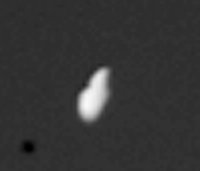
Like many other small Saturnian moons and small asteroids, Calypso is irregularly shaped, has overlapping large craters, and appears to also have loose surface material capable of smoothing the craters' appearance. Its surface is one of the most reflective (at visual wavelengths) in the Solar System, with a visual geometric albedo of 1.34. This very high albedo is the result of the sandblasting of particles from Saturn's E-ring, a faint ring composed of small, water-ice particles generated by Enceladus's south polar geysers.
Reader's Guide
Calypso's significance lies in its role as a trojan moon, co-orbital with Tethys at the trailing Lagrangian point L5, a relationship first identified by Seidelmann et al. in 1981. Along with Telesto, it is one of four known trojan moons in the Solar System, providing a natural laboratory for studying orbital dynamics and the stability of Lagrangian points. Its extremely high visual geometric albedo of 1.34 makes it one of the most reflective surfaces at visual wavelengths, attributed to sandblasting by particles from Saturn's E-ring, which originates from Enceladus's south polar geysers. This process highlights the interconnectedness of Saturn's moon system, where material from one moon influences the surface properties of another. Calypso's irregular shape, overlapping craters, and loose surface material offer insights into the collisional history and surface evolution of small icy bodies. Its discovery in 1980 by a team of astronomers using ground-based observations marked an early step in cataloging Saturn's numerous small moons, and its multiple provisional designations reflect the careful tracking of its apparitions.
Did You Know?
- Its surface has a visual geometric albedo of 1.34, one of the highest in the Solar System.
- The high albedo is caused by sandblasting from particles of Saturn's E-ring, generated by Enceladus's south polar geysers.
Discovery and Mythological Naming
Calypso first entered the astronomical record in 1980, when a team of ground-based observers—Dan Pascu, P. Kenneth Seidelmann, William A. Baum, and Douglas G. Currie—detected a faint object orbiting Saturn. It was catalogued as the twenty-fifth satellite of Saturn found that year, receiving the provisional label S/1980 S 25. Over the following months, the same body was independently spotted and assigned additional temporary designations: S/1980 S 29, S/1980 S 30, S/1980 S 32, and S/1981 S 2, reflecting the difficulty of tracking such a small, distant object from Earth. Three years later, in 1983, the International Astronomical Union bestowed upon it a permanent name drawn from Greek mythology: Calypso, the nymph who sheltered Odysseus on her island. The moon also carries the numerical designation Saturn XIV and the relational label Tethys C, the latter acknowledging its gravitational partnership with the larger moon Tethys.
The Trojan Dance with Tethys
Calypso does not orbit Saturn in isolation; it shares Tethys's orbital path in a stable gravitational configuration known as a co-orbital resonance. Specifically, it occupies Tethys's trailing Lagrangian point, L5, sitting sixty degrees behind its larger companion along the same orbit. This remarkable arrangement was first recognized in 1981 by Seidelmann and colleagues, who identified the geometric relationship from observational data. On the opposite side of Tethys, the moon Telesto holds the leading Lagrangian point, L4, sixty degrees ahead. Together, Calypso and Telesto are often called the Tethys trojans, a term borrowed from the familiar concept of Jupiter's trojan asteroids. They represent two of only four trojan moons currently known in the entire Solar System, making their existence a rare and dynamically elegant example of how small bodies can lock into stable positions at the gravitational sweet spots of a larger orbiting partner.
A Blindingly Bright, Cratered World
Despite its small size, Calypso presents a strikingly bright face to observers. Its visual geometric albedo measures 1.34, placing it among the most reflective surfaces of any body in the Solar System at visible wavelengths. This extraordinary brightness is not intrinsic to the moon's composition but is instead the product of an external process: fine water-ice particles from Saturn's E-ring are continuously sandblasted onto Calypso's surface. The E-ring itself is a faint, diffuse structure composed of tiny ice grains ejected from the south polar geysers of Enceladus, meaning that a geologically active moon hundreds of thousands of kilometers away is responsible for painting Calypso in brilliant white. The surface itself is far from smooth—it is irregularly shaped and pocked with large, overlapping craters, though loose regolith material appears to partially fill and soften their rims, giving the terrain a somewhat muted, rounded appearance despite the harsh impact history.
A Small Moon in a Crowded Neighborhood
Calypso belongs to the family of small inner satellites that populate the region between Saturn's main rings and the larger, more prominent moons. Its designation as Tethys C underscores that it is best understood not as an independent world but as a gravitational companion to Tethys, locked into a shared orbit by the geometry of Lagrangian points. Along with Telesto and two other bodies, Calypso forms one of the four recognized trojan moon pairs in the Solar System—a distinction that highlights how rare such stable co-orbital configurations are among natural satellites. The moon also serves as a tangible link between Saturn's inner system and its more distant, active satellites: the very particles that give Calypso its dazzling albedo originate from Enceladus's cryovolcanic plumes, traveling outward through the E-ring before settling onto this small, cratered body. In this way, a quiet, irregular moon trailing Tethys by sixty degrees becomes a passive recipient of material from one of the most geologically dynamic worlds in the outer Solar System.
Gallery





Frequently Asked Questions
What is Calypso?
Calypso is a small natural satellite of Saturn that shares Tethys's orbital path, sitting at the trailing Lagrangian point (L5) 60 degrees behind its larger companion. It is one of only four confirmed trojan moons known in the Solar System.
Who discovered Calypso and when?
Calypso was identified in 1980 through ground-based observations by Dan Pascu, P. Kenneth Seidelmann, William A. Baum, and Douglas G. Currie. After cycling through several provisional designations, it received its official name in 1983.
What makes Calypso's orbit unique?
Calypso is a co-orbital (trojan) moon that rides steadily in Tethys's L5 point, trailing 60 degrees behind Tethys while both circle Saturn together. This stable Lagrangian configuration makes it a rare natural example of trojan dynamics in the outer Solar System.
What are Calypso's physical properties and alternate names?
Calypso is a small, highly reflective body with a visual geometric albedo of 1.34, making it one of the brightest moons in Saturn's retinue. It is also catalogued under the alternate designations Saturn XIV and Tethys C.
Why is Calypso important to Saturn moon studies?
As a trojan moon locked in a stable Lagrangian configuration with Tethys, Calypso provides a natural laboratory for studying co-orbital gravitational dynamics. Its 1980 detection from Earth-based telescopes also showed that tiny satellites could be found without dedicated space missions.
More in Moons of Saturn 1-24
Spotted an error? Know more?
Reader corrections go straight into our review queue. Suggest an edit · How this site is sourced