Albiorix (moon)
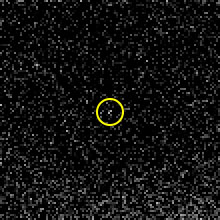
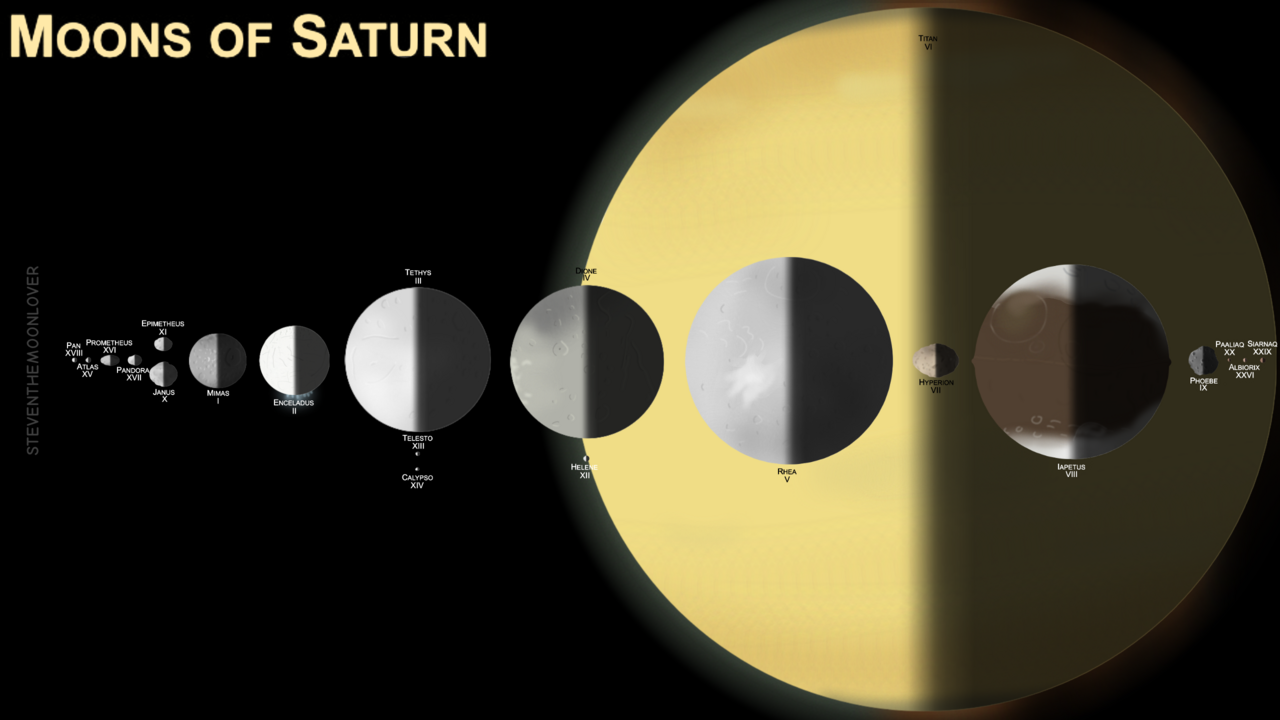
Largest member of the Gallic group of Saturn's irregular moons.

Steventhemoonlover · CC BY 4.0
Albiorix (Saturn XXVI) is the biggest moon in the Gallic group and Saturn’s third-largest irregular satellite. It was found in 2000 by Holman and his team, initially labeled S/2000 S 11. The moon got its name in August 2003 from a Gallic giant called Albiorix, described as “king of the world.” That name comes from an inscription near Sablet, France, linking the giant to the Roman god Mars. It’s not certain whether Albiorix was just a title (meaning “Mars, king of the world”) or a Celtic god interpreted as Mars.
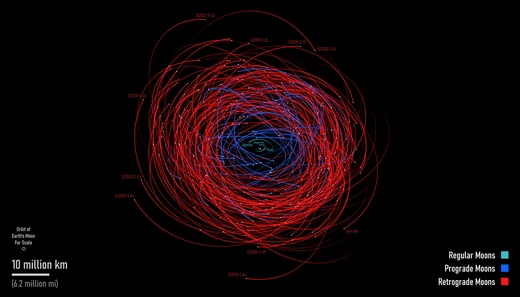
Albiorix circles Saturn at an average distance of 16 million kilometers, taking 783.5 days for one orbit. Its path is tilted about 39° to the ecliptic and goes prograde, with an eccentricity of 0.470. The orbit keeps shifting because of solar and planetary pulls. It belongs to the Gallic group, a set of prograde moons orbiting 16 to 23 million kilometers from Saturn, with tilts between 34° and 41° and eccentricities from 0.07 to 0.56.
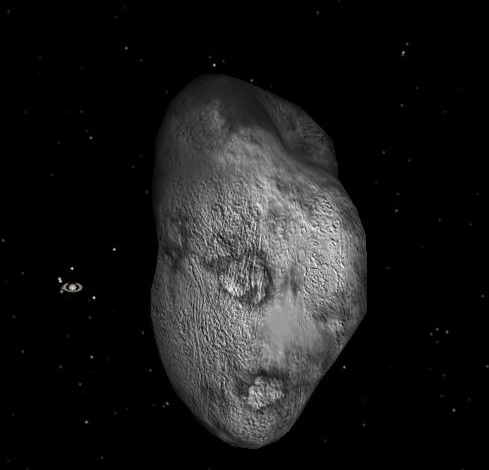
Measurements from NEOWISE put Albiorix’s albedo at 0.062 ± 0.028, giving it a diameter of about 28.6 ± 5.4 km. Its color is red (B−V=0.89, R−V=0.50), though some areas are less red. This color variation hints at a possible big crater, leading to the idea that moons Erriapus and Tarvos might be pieces of Albiorix from a near-breakup collision. The James Webb Space Telescope’s NIRSpec spotted a 3.0-micron absorption feature from hydrated minerals, but no substantial water ice. Carbon dioxide, made by radiation hitting organic compounds, was also found on its surface. Albiorix’s composition looks nearly identical to Siarnaq, another irregular Saturn moon observed by Webb. Cassini’s ISS camera measured its rotation period at 13 hours and 7.8 minutes. Light curves show big brightness changes, suggesting an elongated shape. One Cassini light curve had two minima with a slight wobble in one, while another angle showed one sharp minimum and two shallower ones.
Albiorix probably didn’t form near Saturn but was captured later. Like other Gallic group moons with similar orbits, it’s likely the leftover of a broken, captured asteroid from the Sun’s orbit.
Cassini observed Albiorix from 2005 to 2017, measuring its light curve and rotation period.
Quick Facts
- Pronounced
- ˌ · æ · l · b · i · ˈ · ɒr · ᵻ · k · s
- Adjective
- Albiorigian ˌ · æ · l · b · i · ə · ˈ · r · ɪ · dʒ · i · ə · n
- Named After
- Mars Albiorix
- Mpc Name
- Saturn XXVI
- Discoverer
- M. J. Holman et al.
- Discovered
- 19 December 2000
- Epoch
- 2000 January 1.5
- Eccentricity
- 0.470
- Inclination
- 38.9°
- Period
- 783.5 d / (2.15 yr)
- Satellite Of
- Saturn
- Group
- Gallic group
Facts from the source article.
Lore & Background
Albiorix orbits Saturn at an average distance of 16 million kilometers in 783.5 days, with an inclination of about 39° to the ecliptic in a prograde direction. Its eccentricity is 0.470, and its orbit is continuously changing due to solar and planetary perturbations. It belongs to the Gallic group, a prograde group of moons orbiting between 16 and 23 Gm from Saturn at inclinations between 34 and 41°, and eccentricities between 0.07 and 0.56.
Measurements from NEOWISE constrain the albedo at 0.062±0.028, giving a diameter of 28.6±5.4 km. Albiorix is red in color (B−V=0.89, R−V=0.50), but some parts of its surface are less red than others. Varying colors suggest a possibility of a large crater, leading to an alternative hypothesis that Erriapus and Tarvos could be fragments of Albiorix following a near-break-up collision. The James Webb Space Telescope detected a 3.0 micron absorption feature associated with hydrated minerals, though water ice was not found in substantial quantities. Carbon dioxide formed by irradiation of organic compounds was also detected. Albiorix appears nearly identical in composition to Siarnaq.
The rotation period was measured by Cassini's ISS camera at 13 hours and 7.8 minutes. Lightcurves show a large brightness variation, indicative of an elongated shape. One light curve measured by Cassini–Huygens found two minima with a moderate perturbation in one, while a different angle showed a sharp minimum and two shallower ones.
Reader's Guide
Albiorix is notable as the largest member of the Gallic group and Saturn's third-largest irregular moon, providing insight into the capture and fragmentation history of Saturn's outer satellite system. Its discovery by Holman and colleagues in 2000 expanded the known irregular moon population. The naming in August 2003 after a Gallic giant reflects cultural connections to Celtic mythology, though the exact nature of Albiorix as a deity or epithet remains uncertain. The moon's orbit, continuously perturbed by solar and planetary influences, exemplifies the dynamical complexity of irregular satellites. Its red color and compositional similarity to Siarnaq, as observed by the James Webb Space Telescope, suggest a common origin. The detection of hydrated minerals and carbon dioxide on its surface indicates past or present surface processing by irradiation. The hypothesis that Erriapus and Tarvos may be fragments of Albiorix points to a possible catastrophic collision in the past. Cassini observations between 2005 and 2017 provided the rotation period and lightcurve data, revealing an elongated shape. Albiorix likely originated as a captured heliocentric asteroid, later broken apart, making it a key object for understanding the evolution of Saturn's irregular moon system.
Did You Know?
- Its name comes from a Gallic giant considered to be the king of the world, known from an inscription near Sablet, France.
- The James Webb Space Telescope detected hydrated minerals and carbon dioxide on its surface.
- Erriapus and Tarvos may be fragments of Albiorix from a near-break-up collision.
Discovery and Mythological Heritage
Albiorix entered the astronomical record in 2000 when Holman and his team identified the small body orbiting Saturn, assigning it the provisional label S/2000 S 11. For nearly three years it remained an anonymous satellite until the International Astronomical Union formally bestowed its name in August 2003, drawing from Celtic mythology. The chosen eponym, Albiorix, was a Gallic giant regarded in ancient tradition as the sovereign ruler of the world. The name survives in a stone inscription discovered near the French village of Sablet, where the figure is linked to the Roman war god Mars. Scholars still debate the precise nature of this connection: Albiorix may have been nothing more than an honorific epithet meaning "Mars, king of the world," or it could represent a genuine Celtic deity later identified with Mars through the Roman practice of interpretatio. Regardless of the ambiguity, the naming cemented Albiorix's place as the largest satellite within the Gallic group and the third-largest irregular moon in Saturn's extensive retinue, tying a fragment of pre-Roman belief to a distant body circling the gas giant.
Orbital Architecture and the Gallic Family
Albiorix traces a long, tilted path around Saturn, completing one full revolution every 783.5 days at a mean distance of roughly 16 million kilometers. Its orbital plane is inclined by approximately 39 degrees relative to the ecliptic, and it travels in a prograde direction, the same sense as Saturn's own rotation. The orbit is notably elliptical, with an eccentricity of 0.470, meaning the moon's distance from the planet swings considerably over the course of each cycle. Because of its great distance from Saturn, the gravitational pull of the Sun and other planets constantly nudges Albiorix's trajectory, so its orbital elements are never truly static. These characteristics place it squarely within the Gallic group, a family of prograde irregular satellites that share a common orbital band between 16 and 23 gigameters from Saturn, with inclinations ranging from 34 to 41 degrees and eccentricities spanning 0.07 to 0.56. As the largest member of this cohort, Albiorix serves as a reference point for understanding the dynamical behavior of this entire population of captured bodies.
Surface Composition and Shape
The physical nature of Albiorix has been pieced together through a combination of infrared surveys and direct spectroscopy. Data from the NEOWISE mission constrain its surface albedo to roughly 0.062, implying a diameter of approximately 28.6 kilometers, making it a surprisingly substantial body for an irregular satellite. Spectroscopically, Albiorix presents a distinctly red coloration, with B−V and R−V indices of 0.89 and 0.50 respectively, yet the redness is not uniform; some regions of the surface appear noticeably less red than others. The James Webb Space Telescope's NIRSpec instrument detected a 3.0-micron absorption feature pointing to hydrated minerals, while also identifying carbon dioxide produced by the irradiation of organic compounds; however, water ice was not found in significant quantities. Its overall composition appears nearly identical to that of Siarnaq, another irregular moon also studied by JWST. Light-curve measurements taken by the Cassini spacecraft's imaging system revealed a rotation period of 13 hours and 7.8 minutes. The pronounced brightness swings between observations indicate a considerably elongated shape, with one viewing geometry producing two minima and another revealing a sharp minimum flanked by two shallower ones.
Captured Origins and the Collision Hypothesis
Albiorix almost certainly did not form in Saturn's immediate vicinity. Like its Gallic-group companions, it is believed to be the surviving remnant of a heliocentric asteroid that was gravitationally captured by Saturn at some point in the distant past. This captured-asteroid origin is consistent with its eccentric, highly inclined orbit and its membership in a family of bodies sharing similar dynamical parameters. Perhaps the most intriguing question surrounding Albiorix is whether it survived a catastrophic close encounter. The non-uniform redness observed across its surface hints at the possibility of a large impact crater exposing differently processed material beneath. Building on this observation, some researchers have proposed an even more dramatic scenario: that a near-breakup collision with another body may have fractured Albiorix itself, with the smaller satellites Erriapus and Tarvos potentially being fragments ejected from Albiorix during that violent event. If this hypothesis holds, Albiorix would be a living record of a collision that reshaped an entire cluster of Saturn's outer moons.
Gallery

Frequently Asked Questions
What is Albiorix (moon)?
Albiorix, designated Saturn XXVI, is the largest member of the Gallic group and ranks as Saturn's third-largest irregular satellite. It orbits roughly 16 million kilometers from the planet.
How was Albiorix discovered?
A team led by Holman identified the moon in 2000, and it was temporarily catalogued as S/2000 S 11 before receiving its official name in August 2003.
Why is the moon called Albiorix?
The name was drawn from a Gallic giant inscribed near Sablet, France, who was described as 'king of the world' and associated with the Roman god Mars. Scholars still debate whether Albiorix was a distinct Celtic deity or simply a title for Mars.
How long does Albiorix take to orbit Saturn?
One full circuit around Saturn takes approximately 783.5 days, reflecting its wide, distant path compared to the planet's inner regular moons.
What makes Albiorix significant among Saturn's moons?
It holds the distinction of being the biggest body in the Gallic group of irregular satellites, making it a key reference point for studying that particular family of captured or scattered objects around Saturn.
More in Moons of Saturn 1-24
Spotted an error? Know more?
Reader corrections go straight into our review queue. Suggest an edit · How this site is sourced