S/2020 S 4
A faint, disputed irregular moon of Saturn.

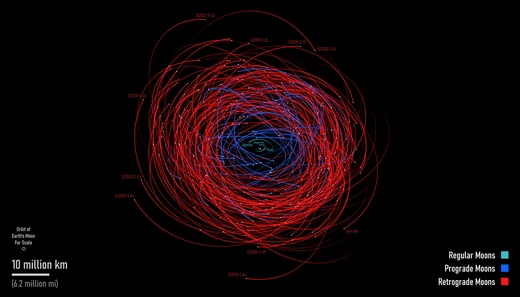
S/2020 S 4 is a small and very faint natural satellite of Saturn, discovered on June 24, 2020, by Edward Ashton, Brett J. Gladman, Jean-Marc Petit and Mike Alexandersen. It is notable for its highly eccentric orbit and disputed moon group classification, as well as being one of the faintest and potentially smallest known irregular moons of Saturn.
Quick Facts
- Discoverer
- Edward Ashton, Brett J. Gladman
- Discovered
- 2020
- Semimajor
- 18235500 km
- Eccentricity
- 0.495
- Period
- 2.538 yrs (926.96 d)
- Inclination
- 40.1° (to the ecliptic)
- Satellite Of
- Saturn
- Group
- Gallic group
- Abs Magnitude
- 17.0
Facts from the source article.
Lore & Background
S/2020 S 4 was discovered on June 24, 2020, by a team including Edward Ashton, Brett J. Gladman, Jean-Marc Petit and Mike Alexandersen. Its discovery was announced on May 6, 2023 by the IAU Minor Planet Center after observations taken between July 1, 2019 and July 9, 2021 confirmed its orbit. The moon orbits Saturn at an average distance of 18.2 million km with a high eccentricity of 0.495 and an orbital period of 2.5 years. Its inclination of 40.1° to the ecliptic suggests it belongs to the Gallic group, though its moon group is sometimes disputed and it may be included in the Inuit group. It has been suggested that S/2020 S 4 was a fragment piece of Siarnaq that broke off a long time ago over a few thousand years. The orbit of S/2020 S 4 is librating in accordance with the von Zeipel–Lidov–Kozai effect. Physically, it is estimated to be 3 km in diameter with an absolute magnitude of 17, making it one of the faintest moons of Saturn. Alternative estimates by Scott S. Sheppard and Tilmann Denk give diameters of 2 km and 2.25 km respectively, which would make it one of the smallest known irregular moons of Saturn.
Reader's Guide
S/2020 S 4 holds significance as a small, faint irregular moon whose discovery and orbital confirmation relied on a long observation period from July 1, 2019 to July 9, 2021. Its highly eccentric orbit (eccentricity 0.495) and inclination of 40.1° place it in a disputed moon group—either the Gallic or Inuit group—highlighting the ongoing uncertainty in classifying Saturn's irregular moons. The suggestion that it may be a fragment of Siarnaq that broke off over a few thousand years provides insight into the collisional history of Saturn's outer moon system. The moon's orbit is subject to the von Zeipel–Lidov–Kozai effect, a dynamical phenomenon that influences its librational behavior. Its small size (estimated 2–3 km in diameter) and faintness (absolute magnitude 17) make it one of the faintest and potentially smallest known irregular moons, underscoring the challenges of detecting and characterizing such distant, dim objects. The alternative diameter estimates by Scott S. Sheppard and Tilmann Denk further illustrate the uncertainty in its physical properties.
Did You Know?
- Its orbit has an eccentricity of 0.495 and an inclination of 40.1° to the ecliptic.
- Alternative estimates give its diameter as 2 km or 2.25 km, making it one of the smallest known irregular moons of Saturn.
More in Moons of Saturn 1-24
Spotted an error? Know more?
Reader corrections go straight into our review queue. Suggest an edit · How this site is sourced