S/2004 S 24
Outermost known prograde moon of Saturn, possibly of the Gallic group.

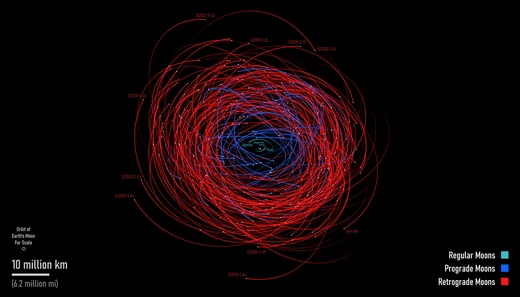
S/2004 S 24 is a moon of Saturn and the farthest known moon that orbits the planet in the same direction as Saturn's rotation. Its discovery was announced on October 7, 2019, by Scott S. Sheppard, David C. Jewitt, and Jan Kleyna, using observations made from December 12, 2004, to March 22, 2007. The moon is roughly 3 kilometers across. It travels around Saturn at an average distance of 22.901 million kilometers, completing one orbit in 1294.25 days. Its orbit is tilted 35.5° relative to the ecliptic, moves prograde, and has an eccentricity of 0.085.
Because its orbital tilt is similar to that of the Gallic group of Saturnian moons, S/2004 S 24 might belong to that group. However, its orbit is much farther out than the other Gallic moons, which casts doubt on that classification. It may instead be the only member of its own group. Another possibility is that S/2004 S 24 formed when Albiorix or another Gallic moon suffered a head-on collision at the farthest point of its orbit, flinging debris outward to this distance. The exact way S/2004 S 24 formed is unknown, and its low eccentricity makes a captured orbit unlikely. Furthermore, it orbits in the opposite direction of all other moons in its region, which makes it improbable that it has survived in that orbit for the entire history of the Solar System.
Quick Facts
- Discoverer
- Scott S. Sheppard / David C. Jewitt / Jan T. Kleyna
- Discovered
- 2019
- Earliest Precovery Date
- 12 December 2004
- Epoch
- 27 April 2019 (JD 2458600.5)
- Observation Arc
- 2.27 yr (830 d)
- Semimajor
- 0.1530807 AU
- Eccentricity
- 0.0846039
- Period
- 3.545 yr (1,293.85 d)
- Mean Anomaly
- 169.90382°
- Inclination
- 35.53797° (to the ecliptic)
- Asc Node
- 333.87854°
- Arg Peri
- 48.98081°
Facts from the source article.
Lore & Background
S/2004 S 24 orbits Saturn in a prograde direction at an average distance of 22.901 million km, completing one orbit in 1294.25 days. Its inclination of 35.5° to the ecliptic is similar to members of the Gallic group, suggesting it could belong to that group. However, its orbit is much more distant than other Gallic group members, which puts this classification into question, and it could very well be in a group of its own.
The exact formation mechanism of S/2004 S 24 is unknown. One hypothesis is that it formed when Albiorix or another Gallic group member was hit in a head-on collision while at the farthest point of their orbit, resulting in its large orbital distance. Due to its low eccentricity of 0.085, a captured orbit is considered unlikely. Notably, S/2004 S 24 orbits in the opposite direction of all other moons in its orbital region, making it unlikely to have survived in this orbit over the entire history of the Solar System.
Reader's Guide
S/2004 S 24 holds significance as the outermost known prograde satellite of Saturn, a distinction that sets it apart from the many retrograde moons at similar distances. Its discovery, announced in 2019 from observations spanning 2004 to 2007, adds to the inventory of small irregular moons around Saturn. The moon's uncertain classification—whether it belongs to the Gallic group, forms its own group, or originated from a collision involving Albiorix—highlights the ongoing challenges in understanding the origins and dynamical evolution of Saturn's outer satellite system. Its low eccentricity argues against a captured origin, while its opposite-direction orbit relative to neighboring moons suggests it may not have survived in its current orbit for the full age of the Solar System. These factors make S/2004 S 24 a valuable object for studying collisional histories and orbital dynamics in the Saturnian system, even as its exact formation remains unknown.
Did You Know?
- S/2004 S 24 is the outermost known prograde satellite of Saturn.
- The moon is about 3 kilometres in diameter and orbits Saturn at an average distance of 22.901 million km.
More in Moons of Saturn 1-24
Spotted an error? Know more?
Reader corrections go straight into our review queue. Suggest an edit · How this site is sourced