Phoebe (moon)
Saturn's most massive irregular satellite, discovered photographically in 1899.

Phoebe (pronounced FEE-bee) is Saturn’s largest irregular moon, with an average diameter of 213 kilometers. It holds the distinction of being the first moon ever discovered using photography: William Henry Pickering spotted it on March 18, 1899, on photographic plates that DeLisle Stewart had begun taking the previous August at the Boyden Station near Arequipa, Peru. When the Cassini spacecraft reached Saturn in 2004, Phoebe was its very first target, and the flyby gave scientists an unusually detailed look at an irregular moon of this size. Cassini’s trajectory and arrival time were deliberately chosen to make that encounter possible; after the flyby and orbital insertion, the spacecraft never ventured much farther out than Iapetus.
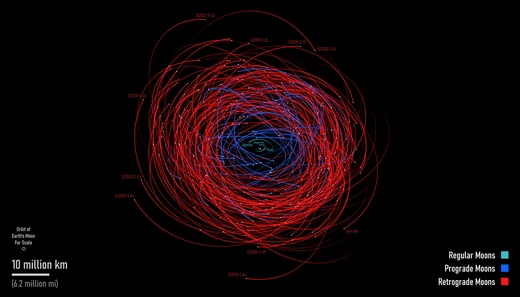
Phoebe follows a moderately elongated, retrograde orbit, which places it in Saturn’s Norse group of satellites. Among all retrograde moons in the Solar System, only Neptune’s Triton is larger. The moon is roughly spherical and has a differentiated interior—it was once hot and round, but repeated impacts have battered it out of perfect shape. Some evidence suggests Phoebe may be a captured centaur originally from the Kuiper belt.
**Discovery and naming** Pickering’s March 1899 discovery came from plates that Stewart had started exposing on August 16, 1898, at the Boyden Observatory near Arequipa, Peru. This was the first photographic discovery of a natural satellite. The moon was named after Phoebe, a Titaness in Greek mythology associated with the Moon and sister of Cronus (the Greek equivalent of Saturn). In scientific literature it is also designated Saturn IX. According to IAU naming rules, features on Phoebe are named after characters from the Greek myth of Jason and the Argonauts; in 2005 the IAU officially named 24 craters. Toby Owen of the University of Hawaiʻi at Mānoa, who chaired the IAU Outer Solar System Task Group, explained the choice: “We picked the legend of the Argonauts for Phoebe as it has some resonance with the exploration of the Saturn system by Cassini–Huygens.
Quick Facts
- Mpc Name
- Saturn IX
- Pronounced
- ˈ · f · iː · b · i FEE · bee
- Named After
- grc · Φοίβη Phoíbē
- Adjectives
- Phoebean f · iː · ˈ · b · iː · ə · n fee · BEE · ən
- Discoverer
- W. H. Pickering
- Discovered
- 18 March 1899 (from photos taken 16 August 1898)
- Semimajor
- 12 929 400 km
- Eccentricity
- 0.164
- Inclination
- 175.2° (to the Laplace plane) / 151.64° (to Saturn's equator)
- Avg Speed
- 1.71 km/s
- Satellite Of
- Saturn
- Group
- Norse group
Facts from the source article.
Lore & Background
Phoebe was discovered by William Henry Pickering on 18 March 1899 from photographic plates taken starting on 16 August 1898 at the Boyden Observatory near Arequipa, Peru, by DeLisle Stewart. It was the first satellite to be discovered photographically. It is named after Phoebe, a Titaness in Greek mythology associated with the Moon, and is also designated Saturn IX. Features on Phoebe are named after characters from the Greek myth of Jason and the Argonauts; in 2005, the IAU officially named 24 craters.
Phoebe has a moderately eccentric, retrograde orbit, making it part of Saturn's Norse group of satellites. It is the second-largest retrograde satellite in the Solar System after Triton. Phoebe is roughly spherical and has a differentiated interior; it was spherical and hot early in its history and was battered out of roundness by repeated impacts. Its surface is heavily scarred, with the largest crater, Jason, roughly 100 km in diameter. The surface shows considerable variation in brightness, indicating large quantities of ice below a thin blanket of dark surface deposits 300 to 500 metres thick. Carbon dioxide has been detected on the surface, and the overall spectrum resembles that of Kuiper belt objects, suggesting Phoebe may be a captured centaur from the Kuiper belt.
Reader's Guide
Phoebe's significance lies in its role as the first target of the Cassini spacecraft upon arrival at Saturn in 2004, chosen specifically to permit a flyby. This made it unusually well-studied for an irregular moon of its size. Its retrograde orbit and composition suggest it is a captured centaur from the Kuiper belt, making it the first such object imaged as anything other than a dot. The Phoebe ring, tilted 27 degrees from Saturn's equatorial plane and extending from at least 128 to 207 times Saturn's radius, is thought to originate from micrometeoroid impacts on Phoebe. Material from this ring may strike Iapetus's leading hemisphere, contributing to its two-tone coloration, and debris from impacts may be the origin of some other Norse group moons. Phoebe is expected to be involved in half of all collisions among irregular satellites due to its large cross-section, potentially clearing its orbital surroundings and reducing the original irregular population by about 30%.
Did You Know?
- Phoebe was the first natural satellite to be discovered photographically.
- Phoebe rotates every 9 hours and 16 minutes in the prograde direction, opposite to its retrograde orbit.
- The largest crater on Phoebe, Jason, is roughly 100 km in diameter.
More in Moons of Saturn 1-24
Spotted an error? Know more?
Reader corrections go straight into our review queue. Suggest an edit · How this site is sourced