Norse group
The largest group of Saturn's moons, composed of retrograde irregular satellites.

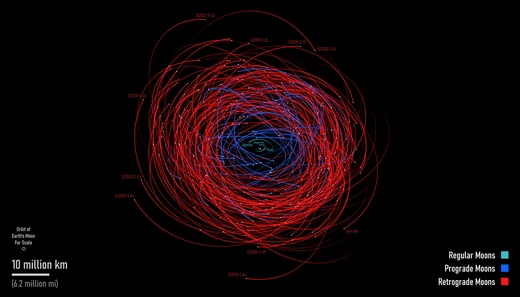
The retrograde irregular moons of Saturn are collectively known as the Norse group, sometimes called the Norse family, Norse cluster, or simply the retrograde moons. These satellites do not appear to share a single collisional origin; their orbital parameters vary widely, suggesting they instead form several smaller dynamical clusters with more consistent orbital and physical traits. As of April 2026, 210 confirmed moons belong to this group, making it the largest by far among Saturn's known satellites. Most Norse group moons are small, which may point to a recent major collision within the population. **Naming** The International Astronomical Union (IAU) assigns names from Norse mythology—mostly giants—to Saturn's retrograde moons, giving the group its name. However, the term "Norse group" is not always used, since many researchers see no dynamic link akin to a collisional family; they often just call these objects the retrograde satellites. One exception is Phoebe, which was discovered and named long before the others and takes its name from Greek mythology. Currently, only 31 of these moons have official names. In October 2019, the discovery of 17 new satellites in this group was announced. A team led by Scott S. Sheppard, using the Subaru Telescope on Mauna Kea, found 20 new moons, each about 5 kilometers (3 miles) in diameter; 17 of these belong to the Norse group, one of which was the most distantly orbiting satellite of Saturn known. A public naming contest was held, restricted to Norse mythology names, and ten of these satellites received official names in August 2022. **General characteristics** Overall, the Norse group's orbital elements are broadly scattered, with inclinations ranging from 136° to 178°. On average, these retrograde irregular moons orbit Saturn at greater distances than the prograde irregular moons, a common pattern in irregular satellite systems. The retrograde satellites generally rotate faster than the prograde ones: every measured prograde irregular has a rotation period longer than 10 hours, while most retrogrades have shorter periods. Correlations between rotation rates, inclinations, and semi-major axes have also been observed. The Saturnian irregular moon population has a steep size distribution, meaning it contains many more small moons than large ones.
- Number of known members
- 210
- Inclination range
- 136° to 178°
- Largest moon
- Phoebe
- Named moons
- 31
- Discovery announcement of 17 new satelli
- October 2019
- Naming contest announced
- public naming contest restricted to names from Norse mythology
- Ten satellites received official names
- August 2022
Lore & Background
The International Astronomical Union (IAU) reserves names taken from Norse mythology (mostly giants) for the retrograde satellites of Saturn, hence the name Norse group. The term Norse group is only sometimes used as authors do not consider them to be dynamically related like a collisional family, and they may refer to them simply as the retrograde satellites. The exception to the moon naming scheme is Phoebe, whose name is taken from Greek mythology, which was discovered and named long before the others. Only 31 of the moons have names at present. The discovery of 17 new satellites in this group was announced in October 2019. A team led by Scott S. Sheppard using the Subaru Telescope at Mauna Kea discovered 20 new moons, each about 5 km in diameter. 17 of these fit into the Norse group, one of which was the most distantly orbiting satellite of Saturn known. A public naming contest for the satellites was announced, restricted to names from Norse mythology. Ten of the satellites received official names in August 2022.
Reader's Guide
The Norse group is notable as the largest collection of Saturn's confirmed moons, with 210 known members as of April 2026. Its significance lies in its composition of retrograde irregular satellites, which orbit at larger distances from Saturn than prograde moons and exhibit a steep size distribution dominated by small moons. The group's naming convention, derived from Norse mythology, is a key aspect of its identity, though the term 'Norse group' is not universally used because authors often do not consider the moons dynamically related as a single collisional family. The discovery of 17 new satellites in October 2019, including the most distantly orbiting satellite of Saturn known, expanded the group substantially. A public naming contest restricted to Norse mythology names was announced, and ten satellites received official names in August 2022. The group's orbital inclinations range from 136° to 178°, and its rotation periods are generally faster than those of prograde irregular moons. The role of Phoebe, the largest irregular moon of Saturn, is significant in discussions of collisional origins, though no consensus exists on whether a single collisional family underlies the group. Various subcategorization attempts have been made, including divisions into the Phoebe group, Mundilfari group, Skathi group, and later subfamilies such as the Aegir and Ymir subfamilies, reflecting ongoing uncertainty about the group's dynamical history.
Did You Know?
- As of April 2026, the Norse group has 210 known members, making it by far the largest group of Saturn's confirmed moons.
- The group's moons are named after figures from Norse mythology, mostly giants, with the exception of Phoebe, which is named from Greek mythology.
- The retrograde satellites in the group generally have faster rotation periods than prograde irregular moons, with most retrogrades having periods shorter than 10 hours.
More in Moons of Saturn 1-24
Spotted an error? Know more?
Reader corrections go straight into our review queue. Suggest an edit · How this site is sourced