Narvi (moon)
A small retrograde moon of Saturn with a unique light curve.

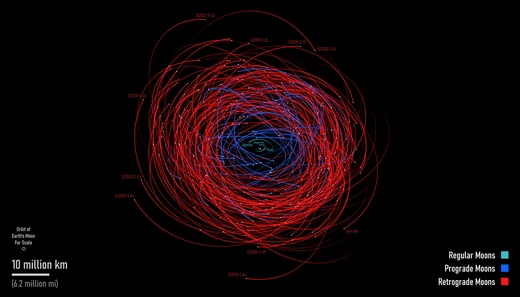
Narvi, also known as Saturn XXXI, is a moon of Saturn. It was discovered in 2003 by a team led by Scott S. Sheppard and initially designated S/2003 S 1. The moon has a diameter of about 7 kilometers and orbits Saturn at an average distance of 19,371,000 km, completing one orbit in 1006.541 days. Its orbit is retrograde, with an inclination of 136.8° to the ecliptic (109° to Saturn's equator) and an eccentricity of 0.2990, closely resembling the orbit of Bestla. This orbit can temporarily fall into secular resonance with Saturn. Narvi’s rotation period is 10.21 ± 0.02 hours, and its light curve shows three minima, similar to those of Siarnaq and Ymir. However, unlike those moons, one of Narvi’s minima is significantly brighter than the others, and the maximum occurring half a rotation period earlier is notably dimmer. The moon was named in January 2005 by the IAU Working Group on Planetary System Nomenclature after Narfi, a giant from Norse mythology.
Quick Facts
- Pronounced
- ˈ · n · ɑr · v · i
- Named After
- Narfi
- Discovered
- 11 April 2003
- Discoverer
- Scott S. Sheppard et al.
- Inclination
- 136.803°
- Eccentricity
- 0.2990
- Period
- −995.33 days
- Satellite Of
- Saturn
- Group
- Norse group
- Albedo
- 0.06 (assumed)
- Magnitude
- 23.8
Facts from the source article.
Lore & Background
Narvi was discovered in 2003 by a team of astronomers led by Scott S. Sheppard, and given the temporary designation S/2003 S 1. It is about 7 kilometres in diameter and orbits Saturn at an average distance of 19,371,000 km in 1006.541 days, with an inclination of 136.8° to the ecliptic (109° to Saturn's equator), in a retrograde direction and with an eccentricity of 0.2990, very similar to Bestla's orbit. Its orbit can temporarily fall into secular resonance with Saturn.
Narvi's rotation period is 10.21±0.02 hours, and its light curve has three minima like Siarnaq and Ymir. Unlike the other triangular moons, however, one minimum is much higher than the others, and the maximum that is a half-period ahead is much lower. It was named in January 2005 after Narfi, a giant in Norse mythology, with the name approved by the IAU Working Group on Planetary System Nomenclature on 21 January 2005.
Reader's Guide
Narvi's significance lies in its distinctive orbital and rotational characteristics as described in the source article. Its retrograde orbit, high inclination, and eccentricity similar to Bestla's orbit place it among the irregular moons of Saturn. The article notes that its orbit can temporarily fall into secular resonance with Saturn, a dynamic feature. Its light curve is particularly notable: while it shares three minima with Siarnaq and Ymir, it differs in that one minimum is much higher and the maximum a half-period ahead is much lower, indicating an unusual shape or surface properties. The naming after Narfi, a giant in Norse mythology, follows the convention for Saturn's moons. The discovery by Scott S. Sheppard's team in 2003 and the IAU approval in 2005 are key historical milestones. The article provides no further context on its legacy beyond these facts.
Did You Know?
- It orbits Saturn in a retrograde direction with an eccentricity of 0.2990.
- It was named after Narfi, a giant in Norse mythology, in January 2005.
More in Moons of Saturn 1-24
Spotted an error? Know more?
Reader corrections go straight into our review queue. Suggest an edit · How this site is sourced