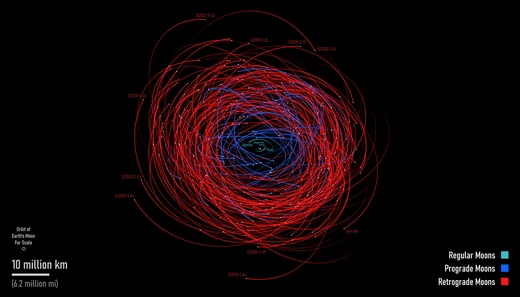
Kiviuq (moon)
A light-red, elongated irregular moon of Saturn in the Inuit group.

Kiviuq is a prograde irregular satellite of Saturn, discovered by JJ Kavelaars et al. in 2000. It is notable as a member of the Inuit group of irregular satellites and is named after a hero of Inuit mythology.
Quick Facts
- Pronounced
- ˈ · k · ɪ · v · i · . · ʌ · k
- Named After
- Kiviuq
- Discoverer
- JJ Kavelaars et al.
- Discovered
- 18 November 2000
- Mpc Name
- Saturn XXIV
- Epoch
- 2000 January 1.5
- Semimajor
- 11.3074 million km
- Eccentricity
- 0.275
- Inclination
- 48.0° (to the ecliptic)
- Period
- 448.91 d / (1.23 yr)
- Satellite Of
- Saturn
- Group
- Inuit group (Kiviuq)
Facts from the source article.
Lore & Background
Kiviuq was discovered in 2000 by JJ Kavelaars et al. and given the temporary designation S/2000 S 5. It was named after Kiviuq, a hero of Inuit mythology. The moon is about 17 km in diameter and orbits Saturn at an average distance of 11.3 million kilometers in 449 days. It is a member of the Inuit group of irregular satellites and is light red in color. Its infrared spectrum is very similar to the Inuit-group satellites Siarnaq and Paaliaq, supporting the thesis of a possible common origin of the Inuit group in the break-up of a larger body. Kiviuq is believed to be in Kozai resonance, cyclically reducing its orbital inclination while increasing the eccentricity and vice versa. Its current orbital elements overlap strongly with Phoebe's orbit, and the moons will likely eventually collide with each other. The light curve amplitude of Kiviuq is large, varying in brightness by over 2 magnitudes, suggesting it has an elongated shape and may be a possible contact binary.
Reader's Guide
Kiviuq's significance lies in its role as a member of the Inuit group of irregular satellites, with spectral similarities to Siarnaq and Paaliaq that support the hypothesis of a common origin from the breakup of a larger body. Its large light curve amplitude, varying by over 2 magnitudes, suggests an elongated shape and the possibility of being a contact binary. The moon is believed to be in Kozai resonance, which cyclically alters its orbital inclination and eccentricity, and its orbit overlaps strongly with Phoebe's, indicating a likely future collision. The rotation period was measured by the Cassini–Huygens spacecraft's ISS camera on 30 August 2010 from a distance of 9.3 million km, initially at 21 hours 49 minutes and later refined to 21 hours 58 minutes. These characteristics make Kiviuq a key object for studying the dynamics and evolution of irregular satellite groups in the Saturnian system.
Did You Know?
- Its light curve varies by over 2 magnitudes, suggesting an elongated shape.
- Kiviuq's orbit overlaps strongly with Phoebe's, and they will likely eventually collide.
More in Moons of Saturn 1-24
Spotted an error? Know more?
Reader corrections go straight into our review queue. Suggest an edit · How this site is sourced