Kari (moon)
Largest member of a collisional family of retrograde Saturnian moons.

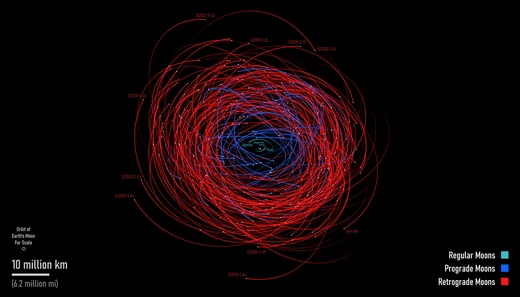
Kari, also known as Saturn XLV, is a moon of Saturn. It was discovered in observations made between January and April 2006, with the discovery announced on 26 June 2006 by Scott S. Sheppard, David C. Jewitt, Jan Kleyna, and Brian G. Marsden. Roughly 6 kilometers across, Kari orbits Saturn at an average distance of 22,305,100 km, completing one orbit in 1243.71 days. Its orbit is tilted 148.4° to the ecliptic (151.5° to Saturn’s equator) and is retrograde, with an eccentricity of 0.3405. The moon’s rotation period is 7.7±0.14 hours. Its light curve resembles that of Hyrrokkin, featuring two deep minima and one shallow minimum, suggesting a likely triangular shape.
Kari is the largest member of a collisional sub-family of retrograde moons named after it. This family is tightly clustered, with its members sharing similar orbital elements and inclinations ranging from 151.7° to 157°. The moon was named in April 2007 after Kári, the son of Fornjót, who personifies wind in Norse mythology.
Quick Facts
- Named After
- Kári
- Mpc Name
- Saturn XLV
- Discovered
- 2006
- Pronounced
- ˈ · k · ɑː · r · i, is · ˈkʰauːrɪ · lang
- Discoverer
- Scott S. Sheppard / David C. Jewitt / Jan T. Kleyna / Brian G. Marsden
- Inclination
- 156.3°
- Eccentricity
- 0.478
- Period
- −1233.6 days
- Satellite Of
- Saturn
- Group
- Norse group
- Rotation
- 7.70 · .14 h
- Albedo
- 0.06 (assumed)
Facts from the source article.
Lore & Background
Kari's discovery was announced on 26 June 2006 by Scott S. Sheppard, David C. Jewitt, Jan Kleyna, and Brian G. Marsden, based on observations taken between January and April 2006. It is about 6 kilometres in diameter and orbits Saturn at an average distance of 22,305,100 km in 1243.71 days, with a retrograde direction and an eccentricity of 0.3405. Its inclination is 148.4° to the ecliptic and 151.5° to Saturn's equator.
The rotation period has been determined to be 7.7±0.14 hours. Its light curve is similar to Hyrrokkin's, featuring two deep and one shallow minima, and the moon is probably triangular in shape. Kari is the largest member of an eponymous collisional sub-family of retrograde moons, which is generally tightly packed with an inclination range of 151.7–157°. It was named in April 2007 after Kári, son of Fornjót, the personification of wind in Norse mythology.
Reader's Guide
Kari's significance lies in its role as the largest member of a collisional sub-family of retrograde moons, indicating a past fragmentation event among Saturn's irregular satellites. The family's tightly packed orbital elements, with inclinations ranging from 151.7° to 157°, suggest a common origin. Its light curve, similar to Hyrrokkin's, with two deep and one shallow minima, and its probably triangular shape, provide clues about its physical structure. The rotation period of 7.7±0.14 hours adds to the understanding of its spin state. Named after a Norse mythological figure, Kari contributes to the naming tradition of Saturn's moons. Its discovery in 2006 by a team of astronomers using observations from early that year expanded the known population of Saturn's irregular satellites.
More in Moons of Saturn 1-24
Spotted an error? Know more?
Reader corrections go straight into our review queue. Suggest an edit · How this site is sourced