Inuit group
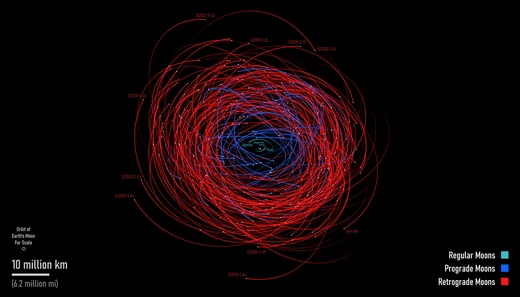
A dynamical grouping of prograde irregular Saturnian satellites.

The Inuit group is a dynamical grouping of prograde irregular satellites of Saturn that follow similar orbits. It is also referred to as the second inclination group or the 46° inclination cluster. The group is notable for its members' light-red color and similar infrared spectra, though later observations revealed that Ijiraq is distinctly redder than other members.
- Number of moons
- 39
- Semi major axis range
- 11 to 19 million km
- Inclination range
- 43° to 51°
- Eccentricity range
- 0.08 to 0.39
- Average orbital period
- 2 years
- Subgroups
- Kiviuq subgroup (23 moons), Siarnaq subgroup (15 moons), Paaliaq (alone)
Lore & Background
The Inuit group appeared homogeneous in early observations, with satellites displaying light-red color (colour indices B−V = 0.79 and V−R = 0.51) similar to the Gallic group. Later observations revealed that Ijiraq is distinctly redder than Paaliaq, Siarnaq, and Kiviuq, and unlike the other three, Ijiraq's spectrum does not display weak absorption near 0.7 μm, attributed to possible water hydration. The spectral homogeneity (except Ijiraq) is consistent with a common origin in the break-up of a single object, but the dispersion of orbital parameters requires further explanation; secular resonances among members could provide that explanation.
The group has three clusterings or subgroups, each associated with a moon (Kiviuq, Paaliaq, and Siarnaq) and a distinct semi-major axis. The Kiviuq subgroup is a confirmed collisional family with semi-major axes between 11 and 13 million km, inclinations between 44° and 51°, and higher eccentricities between 0.25 and 0.39. The Siarnaq subgroup has semi-major axes between 17 and 19 million km, inclinations between 43° and 49°, and eccentricities between 0.08 and 0.31. Paaliaq orbits alone at a distance between the two subgroups. It is unclear how a collisional family could have ended up with such a large spread in semi-major axis, but the probability of three unrelated clusters having a similar inclination by coincidence is low.
Reader's Guide
The Inuit group is significant as one of the major dynamical groupings of Saturn's irregular moons, providing insight into the capture and collisional history of the Saturnian system. The group's members are believed to have originated from a captured asteroid that later underwent collisions, though it is not known whether all members came from a single progenitor. The presence of three distinct subgroups with different semi-major axes—Kiviuq, Paaliaq, and Siarnaq—raises questions about how a collisional family could achieve such orbital spread, yet the similar inclinations suggest a common origin. The spectral homogeneity of most members supports a common break-up event, while Ijiraq's distinct redness and lack of water absorption hint at possible compositional differences or separate origins. The International Astronomical Union uses names from Inuit mythology for these moons, though only five have names as of the article's writing. The group's 39 known members, with 23 in the Kiviuq subgroup and 15 in the Siarnaq subgroup, represent a substantial fraction of Saturn's irregular satellite population, and their study helps refine models of satellite formation and orbital evolution.
Did You Know?
- Ijiraq is distinctly redder than Paaliaq, Siarnaq, and Kiviuq, and lacks a weak absorption near 0.7 μm attributed to water hydration.
- The group's moons have semi-major axes ranging from 11 to 19 million km and take an average of 2 years to orbit Saturn.
- Only five of the group's moons have names from Inuit mythology as assigned by the IAU.
More in Moons of Saturn 1-24
Spotted an error? Know more?
Reader corrections go straight into our review queue. Suggest an edit · How this site is sourced