Hyrrokkin (moon)
A retrograde Saturnian moon named after a Norse giantess.

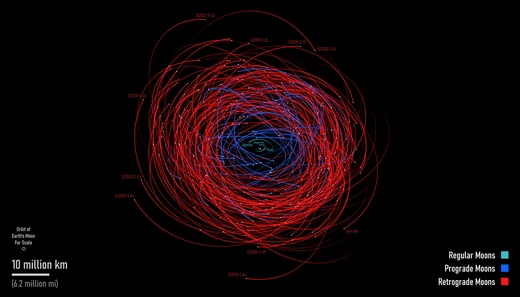
Hyrrokkin (Saturn XLIV) is a moon of Saturn. It was discovered by Scott S. Sheppard, David C. Jewitt, Jan Kleyna, and Brian G. Marsden, with the discovery announced on June 26, 2006, based on observations from December 12, 2004, to April 30, 2006. The moon is roughly 8 kilometers across. It orbits Saturn at an average distance of 18,168 million meters, completing one orbit in 914 days. Its orbit is retrograde, tilted 153° to the ecliptic (154° to Saturn's equator), and has an eccentricity of 0.3582. In March 2013, the Cassini spacecraft measured its synodic rotation period at about 12 hours and 45 minutes, later refined to 12.76 ± 0.03 hours. The light curve shows three minima, similar to those of Ymir and Siarnaq, but one minimum is much shallower than the others. Hyrrokkin's rotation and orbit resemble those of Greip, differing mainly in inclination, though it is unclear if the two moons are closely related. Named in April 2007, it comes from Norse mythology: Hyrrokkin, a giantess who launched Baldr's funeral ship, Hringhorni. The name was originally listed as Hyrokkin but later corrected.
Quick Facts
- Mpc Name
- Saturn XLIV
- Pronounced
- h · ɪ · ˈ · r · ɒ · k · ən
- Discovered
- December 2004
- Discoverer
- Scott S. Sheppard / David C. Jewitt / Jan T. Kleyna / Brian G. Marsden
- Named After
- Hyrrokkin
- Inclination
- 151°
- Eccentricity
- 0.3
- Period
- −931.8 days
- Satellite Of
- Saturn
- Group
- Norse group
- Rotation
- 12.76 · 0.03 h
- Albedo
- 0.06 (assumed)
Facts from the source article.
Lore & Background
Hyrrokkin's discovery was announced on June 26, 2006, by Scott S. Sheppard, David C. Jewitt, Jan Kleyna, and Brian G. Marsden, based on observations taken between December 12, 2004, and April 30, 2006. It is about 8 kilometres in diameter and orbits Saturn at an average distance of 18,168 Mm in 914 days, with an inclination of 153° to the ecliptic (154° to Saturn's equator), in a retrograde direction, and with an eccentricity of 0.3582. During four observations in March 2013, the Cassini spacecraft measured its synodic rotational period to approximately 12 hours and 45 minutes, later refined to 12.76±0.03 hours. Its light curve shows three minima as seen in Ymir and Siarnaq, but has one minimum much shallower than the others. The rotation period and orbit are similar to Greip's, with only the inclination being appreciably different, but it is not known whether the moons are closely related to each other. It was named in April 2007 after Hyrrokkin, a giantess from Norse mythology who launched Hringhorni, Baldr's funeral ship. The name was originally listed as Hyrokkin but later corrected.
Reader's Guide
Hyrrokkin is significant as one of Saturn's irregular moons, distinguished by its retrograde orbit and relatively small size of about 8 kilometres in diameter. Its discovery in 2006 by a team including Scott S. Sheppard added to the catalog of Saturn's outer satellites. The moon's light curve, measured by the Cassini spacecraft in March 2013, reveals three minima with one much shallower than the others, a pattern also seen in Ymir and Siarnaq, suggesting possible shared characteristics among these irregular moons. Its rotation period of 12.76±0.03 hours and orbital parameters are similar to those of Greip, though the inclination differs, and the article notes it is not known whether the moons are closely related. The naming after Hyrrokkin, a giantess from Norse mythology, connects the moon to cultural lore, and the correction of its spelling from Hyrokkin to Hyrrokkin reflects attention to mythological accuracy. The moon's legacy lies in its contribution to understanding the diverse population of Saturn's irregular satellites and their potential origins.
Did You Know?
- Its light curve shows three minima, with one minimum much shallower than the others, similar to Ymir and Siarnaq.
- The moon was named after Hyrrokkin, a giantess from Norse mythology who launched Baldr's funeral ship.
- Its rotation period was measured by the Cassini spacecraft in March 2013 as approximately 12 hours and 45 minutes.
More in Moons of Saturn 1-24
Spotted an error? Know more?
Reader corrections go straight into our review queue. Suggest an edit · How this site is sourced