Hati (moon)
Fastest rotating moon known, discovered in 2005.

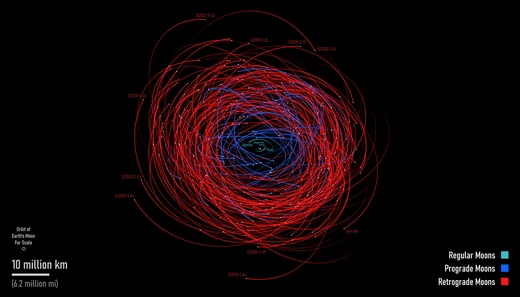
Hati, also known as Saturn XLIII, is a moon of Saturn. It was discovered by Scott S. Sheppard, David C. Jewitt, Jan Kleyna, and Brian G. Marsden, with the announcement made on May 4, 2005, based on observations from December 12, 2004, to March 11, 2005. This moon has a diameter of roughly 5 kilometers and orbits Saturn at an average distance of 19,697 million meters, completing one orbit in 1,040 days. Its orbit is retrograde, inclined 164° to the ecliptic, and has an eccentricity of 0.375, which is somewhat similar to that of Mundilfari. In March 2013, the Cassini spacecraft measured its synodic rotational period at about 5.45 ± 0.04 hours. This is the fastest rotation reliably measured for any moon in the Solar System, including those of asteroids. Like Mundilfari, Hati is very elongated in shape. It was named in April 2007 after Hati, a giant wolf from Norse mythology, the son of Fenrisúlfr and twin brother of Sköll.
Quick Facts
- Mpc Name
- Saturn XLIII
- Pronounced
- ˈ · h · ɑː · t · i (with the PASTA vowel)
- Discovered
- December 2004
- Discoverer
- Scott S. Sheppard / David C. Jewitt / Jan T. Kleyna / Brian G. Marsden
- Named After
- Hati Hróðvitnisson
- Inclination
- 164.1°
- Eccentricity
- 0.375
- Period
- −1040.29 days
- Satellite Of
- Saturn
- Group
- Norse group
- Rotation
- 5.45 · 0.04 h
Facts from the source article.
Lore & Background
Hati's discovery was announced on 4 May 2005 by Scott S. Sheppard, David C. Jewitt, Jan Kleyna, and Brian G. Marsden, based on observations taken between 12 December 2004 and 11 March 2005. It is about 5 kilometers in diameter and orbits Saturn at an average distance of 19,697 Mm, completing one orbit in 1040 days. Its orbit is retrograde, with an inclination of 164° to the ecliptic and an eccentricity of 0.375, somewhat similar to that of Mundilfari. In March 2013, the Cassini spacecraft measured its synodic rotational period to be about 5.45±0.04 hours, the fastest reliably measured rotation of any moon, including asteroid moons. Like Mundilfari, Hati is very elongated in shape. It was named in April 2007 after Hati, a giant wolf from Norse mythology, son of Fenrisúlfr and twin brother of Sköll.
Reader's Guide
Hati holds a unique place among Saturn's moons due to its exceptionally fast rotation. The Cassini measurement in March 2013 established its synodic rotational period at about 5.45±0.04 hours, making it the fastest known rotation of all Saturn's moons and, in fact, the fastest among all moons (including asteroid moons) for which a rotation period has been reliably measured. This rapid spin likely contributes to its very elongated shape, a characteristic it shares with Mundilfari. Its orbit, retrograde and highly eccentric, is also similar to Mundilfari's, suggesting a possible common origin or dynamical family. Discovered as part of a survey that added twelve new satellites to Saturn's system, Hati's naming in April 2007 continued the tradition of using Norse mythology for Saturn's irregular moons. Its significance lies in challenging models of moon formation and evolution, as such a fast rotation rate is unusual for a small body and may provide clues about its collisional history or internal structure.
Did You Know?
- Hati has the fastest known rotation of any moon with a reliably measured period.
- Its synodic rotational period was measured by Cassini in March 2013 as about 5.45±0.04 hours.
- Hati is about 5 kilometers in diameter and orbits Saturn in a retrograde direction.
More in Moons of Saturn 1-24
Spotted an error? Know more?
Reader corrections go straight into our review queue. Suggest an edit · How this site is sourced