Gallic group
A dynamical grouping of prograde irregular Saturnian moons.

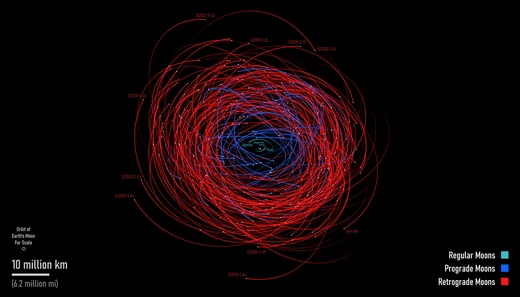
The Gallic group—also known as the first inclination group, the 34° inclination cluster, the Albiorix family, or the Gaulish cluster—is a set of prograde irregular moons orbiting Saturn. Scientists believe these moons likely originated from a single captured asteroid that later broke apart in a collision, forming a collisional family. Most of the moons share similar orbits, but one member, S/2004 S 24, stands out with a much larger semi-major axis and a much lower eccentricity, leaving its origin from the same parent body uncertain.
**Naming**
The International Astronomical Union (IAU) assigns names from Gallic mythology to these moons, though only four have been named so far. In October 2019, a team led by Scott S. Sheppard announced the discovery of 20 new Saturnian moons using the Subaru Telescope on Mauna Kea. Among them, S/2004 S 24 is also prograde and has a similar inclination, but it orbits Saturn at a much greater distance than the other Gallic moons. It will eventually receive a name from Gallic mythology as well.
**Characteristics**
**Physical characteristics**
The discoverers proposed a common origin for the group—a breakup of a larger body—based on similar mean orbital elements. Later observations showed the group is physically uniform: all satellites have a light-red color (color indices B − V = 0.91 and V − R = 0.48) and similar infrared indices. However, further study revealed that Albiorix, the largest member, displays two different colors: one matching Erriapus and Tarvos, and another that is less red. This led to the idea that Tarvos and Erriapus might be fragments of Albiorix, leaving behind a large, less red crater. Such an impact would need a body at least 1.25 km in diameter moving at 4.79 km/s, creating a crater with a 12 km radius. The presence of numerous large craters on Phoebe, an irregular moon in the Norse group, confirms that such collisions have occurred in Saturn’s system.
**Orbital characteristics**
The Gallic group is not centered on Albiorix, its largest moon. Relative to Albiorix, all other moons orbit farther away, and nearly all have higher inclinations. Eccentricity tends to increase with semi-major axis. The semi-major axes mostly range from 16 to 20 million km, inclinations between 34° and 41°, and eccentricities between 0.44 and 0.57.
- Number of members
- 19
- Semi major axis range
- 16 to 20 million km
- Inclination range
- 34° to 41°
- Eccentricity range
- 0.44 to 0.57
- Largest member
- Albiorix
- Color indices
- B − V = 0.91, V − R = 0.48
Lore & Background
The Gallic group is named after figures from Gallic mythology, as reserved by the International Astronomical Union, though only four of its moons have names at present. The discovery of 20 new moons of Saturn was announced in October 2019 by a team led by Scott S. Sheppard using the Subaru Telescope at Mauna Kea. One of them, S/2004 S 24, is also prograde and of similar inclination, but it orbits much further away from Saturn than the other Gallic moons; it will nevertheless receive a name from Gallic mythology.
Similar mean orbital elements led the discoverers to postulate a common origin for the group in a breakup of a larger body. The group was later found to be physically homogeneous, all satellites displaying light-red colour and similar infrared indices. Later observations revealed that the largest member, Albiorix, actually displays two different colours: one compatible with Erriapus and Tarvos, and another less red. Rather than directly originating from the common progenitor, it was postulated that Tarvos and Erriapus could instead be fragments of Albiorix, leaving a large, less red crater. Such an impact would require a body with a diameter in excess of 1.25 km and relative velocity of 4.79 km/s, resulting in a large crater with a radius of 12 km.
The Gallic group is not centred on Albiorix; within the group, relative to Albiorix, all other moons orbit at a larger distance, and almost all have greater inclinations. The eccentricity somewhat increases with semi-major axis. The group has a moderately large orbital spread and is unusual in that it has several large or medium size moons and fewer smaller members, casting doubt on whether it is a true dynamical family. One study found the group is unlikely to have a shared collisional origin unless fragments were ejected asymmetrically or some other mechanism later modified the moons' semi-major axes. Another study simulated a head-on collision scenario and found it plausible, but dispersion velocities only fit realistic ranges when S/2004 S 24 was excluded, leading to alternative explanations for that moon. A further study suggested the group may have been affected by the near-orbital resonance between Jupiter and Saturn known as the Great Inequality, which may have depleted the population rather than spreading it out.
Reader's Guide
The Gallic group is significant as one of the dynamical groupings of Saturn's irregular moons, notable for its prograde orbits and likely collisional origin. The article highlights that the group's largest member, Albiorix, shows two different colours, suggesting that Tarvos and Erriapus may be fragments from an impact on Albiorix, leaving a large crater. This scenario is supported by evidence of similar large collisions on Phoebe, an irregular moon in the Norse group. However, the group's status as a true collisional family is debated: its unusual size distribution—several large or medium moons and fewer small ones—and the outlier S/2004 S 24 raise doubts. Studies have proposed that a head-on collision could explain the group's orbital spread, but only if S/2004 S 24 is excluded, leading to suggestions that it may have originated from a secondary collision or be unrelated. Additionally, the Great Inequality resonance between Jupiter and Saturn may have eliminated most original fragments, leaving the present members as survivors. The group's legacy lies in illustrating the complexity of satellite formation and evolution in the Saturnian system, with ongoing uncertainty about its precise origin.
Did You Know?
- The Gallic group is also called the first inclination group or the 34° inclination cluster.
- The largest member of the group, Albiorix, displays two different colours, one compatible with Erriapus and Tarvos.
- S/2004 S 24 has a much higher semi-major axis and lower eccentricity than other Gallic moons, and its origin is uncertain.
More in Moons of Saturn 1-24
Spotted an error? Know more?
Reader corrections go straight into our review queue. Suggest an edit · How this site is sourced