Fenrir (moon)
One of the faintest known moons, discovered using the largest telescopes.

Fenrir, also designated Saturn XLI and provisionally S/2004 S 16, is a natural satellite of Saturn. It is notable as one of the faintest known moons in the Solar System, with an apparent magnitude of 25, and was discovered using some of the largest telescopes in the world.
Quick Facts
- Discovery Site
- Subaru, Gemini / Jan T. Kleyna / Brian G. Marsden
- Mpc Name
- Saturn XLI
- Pronounced
- ˈ · f · ɛ · n · r · ɪər or ˈ · f · ɛ · n · r · ər
- Adjective
- Fenrian ˈ · f · ɛ · n · r · i · ə · nThe oblique stem of the name is Fenri, as in Fenrisulfr. The -r is the nominative case ending.
- Named After
- Fenrir
- Semimajor
- 22 454 000 km
- Eccentricity
- 0.1363
- Period
- 1260.35 d (3.45 yr)
- Inclination
- 164.955°
- Mean Anomaly
- 146.614°
- Arg Peri
- 120.264°
- Asc Node
- 330.95°
Facts from the source article.
Lore & Background
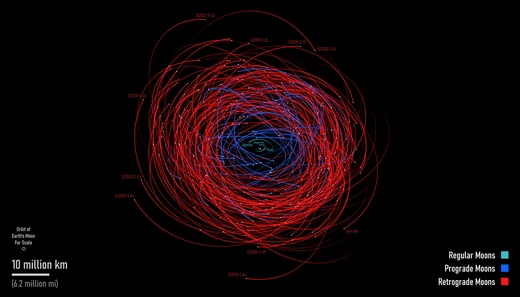
Fenrir's discovery was announced on May 4, 2005, by Scott S. Sheppard, David C. Jewitt, Jan Kleyna, and Brian G. Marsden, based on observations taken between December 13, 2004, and March 5, 2005. It has an apparent magnitude of 25, making it so dark that it was never observed by the Cassini spacecraft, for which it never got brighter than approximately 17th apparent magnitude. Fenrir is about 4 kilometers in diameter and orbits Saturn at an average distance of 22,454 Mm in 1260 days, with an inclination of 163° to the ecliptic (143° to Saturn's equator) and an eccentricity of 0.136. Its orbit is retrograde, meaning it moves opposite to Saturn's spin, indicating that this irregular moon was captured by Saturn. The moon was named after Fenrir, a giant wolf from Norse mythology, father of Hati and Skoll, son of Loki, destined to break its bonds for Ragnarök.
Reader's Guide
Fenrir's significance lies in its extreme faintness—apparent magnitude 25—which places it among the faintest known moons in the Solar System. Its discovery required some of the largest telescopes in the world, and it was too dark to be observed by the Cassini spacecraft during its orbit around Saturn, as the moon never reached brighter than approximately 17th magnitude. The retrograde orbit of Fenrir, inclined 163° to the ecliptic, suggests it is an irregular moon that was captured by Saturn's gravity rather than forming in place. Its small size of about 4 kilometers in diameter and distant orbit at 22,454 Mm with a period of 1260 days further characterize it as a typical captured irregular satellite. The naming after the Norse wolf Fenrir ties it to mythological themes, though the article does not elaborate on the cultural impact of this naming.
Did You Know?
- Fenrir was too dark to have been observed by the Cassini spacecraft, never getting brighter than approximately 17th apparent magnitude.
- Its retrograde orbit suggests it was captured by Saturn.
Frequently Asked Questions
What is Fenrir (moon)?
Fenrir is a tiny natural satellite orbiting Saturn, officially catalogued as Saturn XLI. It is one of the dimmest known moons in the entire Solar System.
How big is Fenrir (moon)?
The moon spans roughly four kilometers in diameter, making it an extremely small body. Its minuscule size, combined with its vast distance from Earth, is a major reason it was so difficult to detect.
Who discovered Fenrir (moon) and when was it announced?
Scott S. Sheppard, David C. Jewitt, Jan Kleyna, and Brian G. Marsden identified the satellite during a stretch of observations running from December 2004 to early March 2005. The find was made public on May 4, 2005.
Why is Fenrir (moon) so hard to observe?
Its apparent magnitude of 25 places it among the faintest objects ever catalogued in the Solar System. Spotting it at all required data gathered from some of the most powerful telescopes on Earth.
What is Fenrir (moon)'s provisional designation?
Before its name was assigned, the moon was tracked under the temporary label S/2004 S 16, a code indicating the year of first observation and its status as a Saturnian satellite. It also carries the sequential designation Saturn XLI.
More in Moons of Saturn 1-24
Spotted an error? Know more?
Reader corrections go straight into our review queue. Suggest an edit · How this site is sourced