Erriapus
A red, slow-rotating irregular moon of Saturn's Gallic group.

Erriapus (Saturn XXVIII) is a mid-sized irregular moon of Saturn. It was discovered in 2000 by Brett Gladman, John J. Kavelaars, and their team, initially designated S/2000 S 10. In August 2003 it was named Erriapo after a giant from Gaulish mythology (also spelled Erriappus), but the International Astronomical Union later changed the name to the nominative form Erriapus in late 2007.
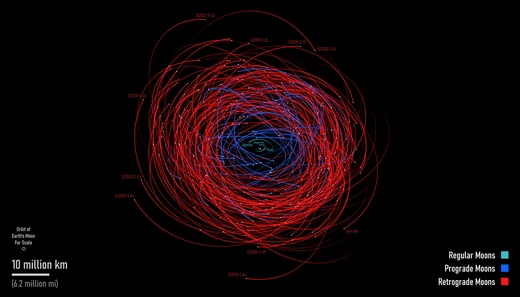
The moon orbits Saturn at an average distance of 17.5 million kilometers, completing one revolution in 864.92 days. Its orbit is prograde, inclined about 37° to the ecliptic, with an eccentricity of 0.475. This orbit is constantly altered by solar and planetary gravitational influences. Erriapus belongs to the Gallic group, a collection of prograde irregular moons that orbit between 16 and 23 million kilometers from Saturn, with inclinations from 34° to 41° and eccentricities ranging from 0.07 to 0.56.
Assuming an albedo of 6%, Erriapus has an estimated average diameter of about 10 kilometers. Its surface is red, with color indices B−V=0.83 and R−V=0.49, matching other Gallic group members. The Cassini spacecraft’s ISS camera measured its rotation period at 28 hours and 9 minutes, which is relatively slow compared to other known irregular Saturnian moons. It is thought to rotate on its side, producing seasonal variations similar to those of Uranus. Light curves show large brightness fluctuations, suggesting an elongated shape or possibly a contact-binary object.
Erriapus likely did not form near Saturn but was later captured. Like other Gallic group members with similar orbits, it is probably a fragment of a captured heliocentric asteroid that broke apart. Notably, recent observations indicate that Albiorix, the largest member of the group, displays two distinct colors: one matching Erriapus and Tarvos, and another less red. This has led to the hypothesis that Tarvos and Erriapus may be fragments of Albiorix rather than remnants of a common progenitor.
The Cassini spacecraft observed Erriapus, measuring its light curve and determining its rotation period.
Quick Facts
- Mpc Name
- Saturn XXVIII
- Pronounced
- ɛr · i · ˈ · æ · p · ə · s
- Named After
- Erriap(p)us
- Discoverer
- John J. Kavelaars et al.
- Discovered
- 2000
- Epoch
- 2000 January 1.5
- Semimajor
- 17 506 900 km
- Eccentricity
- 0.475
- Inclination
- 37.1
- Period
- 864.92 d / (2.37 yr)
- Satellite Of
- Saturn
- Group
- Gallic group
Facts from the source article.
Lore & Background
Erriapus was discovered in 2000 by Brett Gladman, John J. Kavelaars and colleagues, receiving the temporary designation S/2000 S 10. It was named Erriapo in August 2003 after a giant in Gaulish mythology, but the name was changed to the nominative Erriapus per IAU conventions in late 2007. The moon orbits Saturn at an average distance of 17.5 million kilometers in 864.92 days, with an inclination of about 37° to the ecliptic in a prograde direction and an eccentricity of 0.475. Its orbit is continuously changing due to solar and planetary perturbations. Erriapus belongs to the Gallic group, a prograde group of moons orbiting between 16 and 23 million km from Saturn at inclinations between 34 and 41°, and eccentricities between 0.07 and 0.56. Physically, Erriapus has an assumed albedo of 6% and an estimated average diameter of about 10 kilometers. It is red in color (B−V=0.83, R−V=0.49), similar to other Gallic group members. Its rotation period, measured by the Cassini spacecraft's ISS camera, is 28 hours and 9 minutes, which is relatively slow compared to other irregular Saturnian moons. It is thought to rotate on its side, giving it seasons similar to those of Uranus. Lightcurves show large brightness variations, indicative of an elongated or possibly contact-binary object. Erriapus probably did not form near Saturn but was captured later. Like other Gallic group members, it is likely the remnant of a broken, captured heliocentric asteroid. Remarkably, recent observations revealed that the largest Gallic group member, Albiorix, displays two different colors: one compatible with Erriapus and Tarvos, and another less red. Instead of a common progenitor, it was postulated that Tarvos and Erriapus could be fragments of Albiorix.
Reader's Guide
Erriapus holds significance as a member of Saturn's Gallic group, a set of irregular moons with similar orbital parameters that likely share a common origin. Its slow rotation period of 28 hours and 9 minutes, measured by the Cassini spacecraft, is unusually long compared to other irregular Saturnian moons, and its suspected axial tilt suggests seasonal variations analogous to Uranus. The large brightness variations in its lightcurve indicate an elongated or possibly contact-binary structure, making it a candidate for further study of such objects. The moon's red color aligns it with other Gallic group members, but recent observations of Albiorix showing two distinct colors have led to the hypothesis that Erriapus and Tarvos may be fragments of Albiorix rather than originating from a separate common progenitor. This challenges the simple model of a single disrupted parent body for the group. Erriapus was observed by the Cassini spacecraft, during which its light curve and rotation period were determined, providing key data for understanding the dynamics and evolution of captured irregular moons. Its orbit, continuously perturbed by solar and planetary influences, exemplifies the complex gravitational environment of Saturn's outer moon system.
Did You Know?
- Its rotation period of 28 hours and 9 minutes is relatively slow compared to other irregular moons of Saturn.
- It may be a fragment of the larger Gallic group moon Albiorix.
Frequently Asked Questions
What is Erriapus?
Erriapus, catalogued as Saturn XXVIII, is a mid-sized irregular moon with a reddish surface and a notably slow rotation. It is a member of Saturn's Gallic group of outer satellites.
Who discovered Erriapus and when?
Brett Gladman, John J. Kavelaars, and their team identified the moon in 2000, initially assigning it the temporary label S/2000 S 10. It received its mythological name in 2003.
What does Erriapus's orbit look like?
The moon travels a prograde, highly elliptical path (eccentricity 0.475) at a mean distance of about 17.5 million kilometers, tilted roughly 37 degrees to the ecliptic. One full revolution takes approximately 865 days.
Why is it called Erriapus instead of Erriapo?
The 2003 naming honored Erriapo, a giant from Gaulish legend, but the IAU later corrected the form to the nominative 'Erriapus' in late 2007. The older spelling 'Erriappus' is also sometimes seen in older references.
How does Erriapus compare to other Gallic-group moons?
Like its Gallic-group neighbors, Erriapus is a small, reddish, slowly rotating body on a distant, inclined, and eccentric orbit around Saturn. Its 865-day period and 37-degree tilt place it squarely within that family's shared orbital regime.
More in Moons of Saturn 1-24
Spotted an error? Know more?
Reader corrections go straight into our review queue. Suggest an edit · How this site is sourced