Nidaba (crater)
An ancient Ganymede crater fading into a ghost crater.

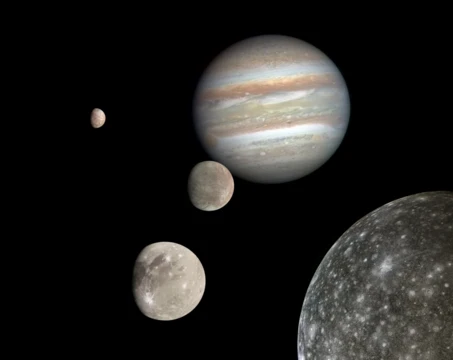
Nidaba is a penepalimpsest on Ganymede, the largest moon of Jupiter. It is an ancient crater in the process of disappearing, approximately 199 kilometers wide, and contains a smaller, younger, and better-preserved crater within it. Nidaba is notable as a transitional feature between a visible crater and a ghost crater, or palimpsest.
Quick Facts
- Diameter
- 199 km
- Eponym
- Nidaba
Facts from the source article.
Lore & Background
Nidaba is located in the southwestern section of the dark, ancient region Galileo Regio, an area densely packed with craters, palimpsests, and other possible penepalimpsests. To its west lies the wide palimpsest Memphis Facula, and to the east is the bright-floor crater Selket, while the more well-preserved pit crater Ninlil lies to the southwest. Nidaba sits on the hemisphere of Ganymede that never faces Jupiter due to the moon's synchronous rotation.
As a penepalimpsest, Nidaba displays more well-defined concentric ridges and hills than its more ghostly palimpsest counterparts, such as Memphis Facula and Buto Facula. The distinction between palimpsests and penepalimpsests is not always well defined, and the two are sometimes classified as the same type of structure. Within Nidaba lies a more recent, better-preserved pit crater that has not yet received a formal name.
Two main processes are believed to erase craters on Ganymede: slow tectonic activity, where fresh water ice erupts and overprints older terrain, and viscous relaxation, where the icy surface slowly flows, causing crater floors to rise and rims to slump. Nidaba may be one of the viscously relaxed craters found within Ganymede's dark terrain.
Reader's Guide
Nidaba's significance lies in its status as a penepalimpsest, offering a glimpse into the gradual erasure of impact features on Ganymede. The article notes that the distinction between palimpsests and penepalimpsests is not always well defined, highlighting the transitional nature of such structures. Its location in the ancient Galileo Regio, surrounded by other ghost craters, underscores the region's age and the processes that have shaped it over time.
Exploration of Nidaba has been limited. Voyager 1 imaged it from several million kilometers away in February 1979, but by its closest approach on 5 March 1979, Nidaba had rotated onto the moon's night side. Voyager 2 became the first to clearly image the hemisphere that never faces Jupiter during its July 1979 flyby, capturing images of Galileo Regio and Nidaba. The Galileo spacecraft obtained medium-resolution images of Nidaba between December 1995 and September 2003, but during a close flyby of Galileo Regio in June 1996, it focused on Memphis Facula instead, missing high-resolution imaging of Nidaba. The European Space Agency's Juice mission, scheduled to arrive at Jupiter in July 2031 and enter low orbit around Ganymede in July 2034, is expected to return the high-resolution images that Galileo missed.
Did You Know?
- Nidaba is a penepalimpsest, an ancient crater on the verge of becoming a ghost crater.
- The crater is named after the Sumerian goddess of grains, cereals, and reeds, Nidaba (or Nisaba).
- Voyager 2 was the first spacecraft to clearly image Nidaba, during its July 1979 flyby.
More in Moons of Jupiter, Part 3 1-24
Spotted an error? Know more?
Reader corrections go straight into our review queue. Suggest an edit · How this site is sourced